Plank Exercise: Benefits, Proper Form, Variations, and Beginner Tips
The plank exercise is one of the best core moves to include in your ab routine. It helps build core strength, improve stability, and support better overall body control.
At first glance, a plank may seem simple. There is no jumping, squatting, or fast movement involved. In fact, the main goal is to hold the position for a specific amount of time.
Because it involves muscle tension without visible movement, the plank is known as an isometric exercise. The challenge comes from bracing your muscles and maintaining proper alignment.
Whether you are a beginner or a trained athlete, planks can be surprisingly demanding and highly effective.
What Is a Plank?
A plank is a basic but powerful exercise that targets the core muscles while also engaging much of the body.
The traditional plank is considered an isometric hold, meaning your muscles are working without changing length through movement. Instead of performing reps, you stay in one strong position for a set duration.
While the classic version is static, there are also many plank variations that introduce movement and increase difficulty.
How to Do a Forearm Plank
The forearm plank is one of the most common and beginner-friendly versions.
Steps to perform a forearm plank
- Lie face down on the floor or mat.
- Place your feet about hip-width apart.
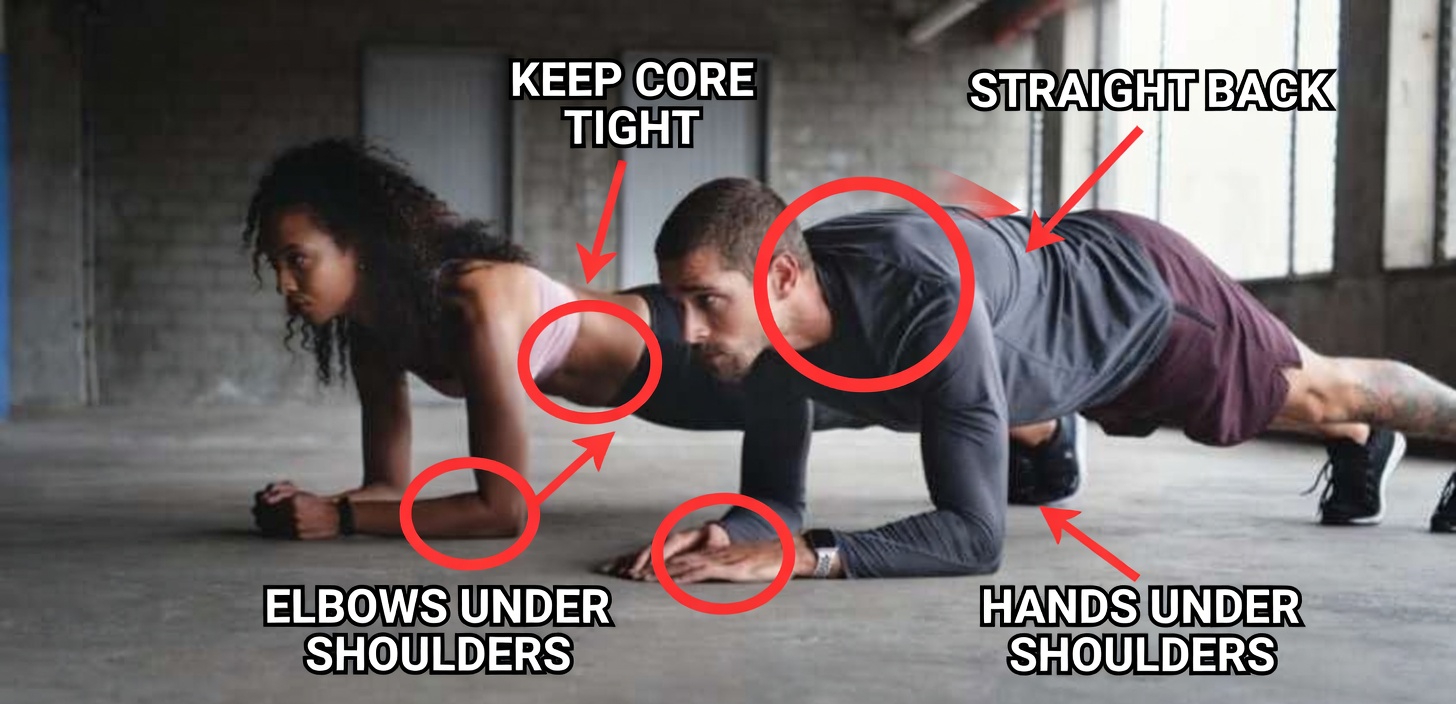
- Position your forearms on the floor and align your elbows under your shoulders.
- Engage your shoulders and core, then lift your body onto your forearms and toes.
- Keep your body weight supported by your forearms, elbows, and toes.
- Form a straight line from head to heels.
The real difficulty is not getting into position—it is maintaining good form for as long as possible.
When you hold the body still and aligned, you strengthen not only your abs but also your shoulders, back, glutes, and legs.
How to Do a Standard Plank
The standard plank, also called the high plank, is similar to the top of a push-up.
Steps to perform a standard plank
- Start on all fours.
- Place your palms flat on the floor directly under your shoulders, slightly wider than shoulder-width apart.
- Extend your legs behind you.
- Tighten your abs and keep your body in a straight line from head to ankles.
- Avoid letting your hips drop or rise too high.
- Hold the position for 30 to 60 seconds, depending on your strength and form.
Best Plank Variations
One major advantage of planks is their versatility. There are many ways to modify them based on your fitness level, goals, and comfort.
Knee Plank
If a full forearm plank feels too difficult, start with your knees on the floor. This reduces the load while still training your core, shoulders, and upper body.
High Plank
In a high plank, your arms are straight and your palms are on the floor. Think of the top position of a push-up. Keep your core tight and your spine neutral throughout the hold.
Side Plank
The side plank is excellent for training the obliques, side abdominals, and rectus abdominis.
How to do a side plank
- Lie on one side.
- Support yourself on one forearm.
- Lift your hips and pelvis off the floor.
- Keep your body in a straight line.
- Stack your shoulders and keep your supporting elbow under your shoulder.
For an extra challenge, raise your top arm toward the ceiling or lift your top leg.
Knee Side Plank
If the full side plank is too challenging, bend your knees and keep them on the floor for support. Stack your knees and focus on lifting your hips while keeping tension in your glutes and core.
Reverse Plank
The reverse plank shifts the body position so your chest faces upward.
How to do a reverse plank
- Sit or lie on your back on a mat.
- Place your hands behind you.
- Press through your arms and heels to lift your hips.
This variation can reduce wrist discomfort for some people and is also effective for the quads, glutes, and core.
Stability Ball Plank
Using a stability ball adds instability, which increases the demand on your core and shoulders. You can perform forearm or high plank variations with your arms supported on the ball.
Plank With Dumbbell Row
To make the movement more advanced, hold a dumbbell in each hand in a high plank position and alternate rowing one weight toward your hip.
The key is to keep your hips steady and avoid twisting from side to side.
Plank Variations With Movement
If you want to make planks more dynamic, you can add controlled movement while maintaining core tension.
Forearm-to-High Plank
Move slowly from a forearm plank to a high plank, then return to the forearms. This challenges your stability and upper-body control.
Plank Walk
From a high plank:
- Step your right hand out to the side.
- Move your right foot in the same direction.
- Follow with your left hand.
- Then move your left foot.
This movement should be slow and controlled. Keep your spine long and avoid letting your hips sag.
Mountain Climbers
Mountain climbers add a cardio element to the plank.
How to do mountain climbers
- Begin in a high plank.
- Drive one knee toward the same-side elbow.
- Return that foot to the starting position.
- Repeat on the other side.
You can perform these more quickly once you are comfortable with the form. As your fitness improves, increase your repetitions gradually.
Common Plank Mistakes to Avoid
To get the most from the plank and reduce injury risk, pay close attention to your form.
1. Letting the hips sag
Your body should stay in a straight line. Dropping the hips places unnecessary stress on the lower back.
2. Lifting the hips too high
If your hips rise too much, the core is no longer working as effectively and the exercise loses quality.
3. Dropping the head or looking forward too much
Keep your neck neutral. Look slightly ahead of your hands on the floor rather than staring straight ahead, which can strain the neck.
4. Placing the hands too far forward
Your shoulders should stay stacked above your wrists in a high plank. Reaching too far out can overload the shoulders and wrists.
5. Holding your breath
Many people forget to breathe during a plank. Instead, take steady, deep breaths into your rib cage while keeping the core engaged.
How Long Should Beginners Hold a Plank?
If you are new to planks, start with a hold of 15 to 30 seconds.
Focus on form first. As soon as your posture begins to collapse, stop the set. Over time, you can increase the duration by 10 to 15 seconds as your strength improves.
It is better to do a shorter plank with proper technique than a longer one with poor alignment.
Why Planks Are Worth Adding to Your Workout
Planks are a simple but highly effective exercise for building a stronger core, improving balance, and supporting total-body stability.
They can be adapted for nearly every fitness level, and the many variations keep the movement interesting and challenging. If you want an exercise that delivers a wide range of benefits without requiring equipment, the plank is an excellent choice.
Sources
- Calatayud, Joaquin, et al. “Trunk Muscle Activity during Different Variations of the Supine Plank Exercise.” Musculoskeletal Science and Practice, 2017.
- Laskowski, Edward R., M.D. “Are Isometric Exercises Good for Strength Training?” Mayo Clinic, 2020.
- Kim, Soo-Yong, et al. “Comparison of EMG Activity on Abdominal Muscles during Plank Exercise with Unilateral and Bilateral Additional Isometric Hip Adduction.” Journal of Electromyography and Kinesiology, 2016.