Side Plank Exercise: Build Strong Obliques and a More Stable Core
The side plank is an excellent exercise for training your obliques and improving overall core strength.
Like a traditional plank, this movement does more than work your abs. It is a full-body exercise that also activates the chest, shoulders, hips, glutes, and lower back. If you want stronger “plank abs” while also improving posture and body control, the side plank deserves a place in your routine.
It is also especially useful for developing balance, focus, and stability, which makes it valuable for athletes at every level.
Strong internal and external obliques help with everyday twisting and bending motions. In addition, the quadratus lumborum (QL) supports the lower back and lumbar spine, which can be particularly beneficial if you spend long hours sitting at a desk.
Another advantage of side planks is variety. Small adjustments to the exercise can shift the challenge to different muscle groups while also helping improve posture and alignment.
Below, you’ll learn how to perform a side plank correctly, along with easier and harder variations.
Benefits of the Side Plank
One of the biggest benefits of the side plank is how many muscles it recruits at once.
It Strengthens the Core
The side plank heavily targets the internal and external obliques, the muscles along the sides of your torso that run from the rib cage toward the hips. These muscles are often undertrained in basic core workouts like crunches or standard planks.
It Helps Open the Chest
As you stack the shoulders and rotate the upper body into position, the chest opens while the shoulders align in a strong, straight line. Whether you are supported on your forearm or hand, this position encourages better upper-body posture.
It Improves Hip and Pelvic Stability
When you lift your hips in a side plank, your body must stabilize the pelvis. This action strengthens the hips and core together, which supports efficient movement and better posture.
It Supports the Lower Back
Because the side plank trains the obliques, glutes, and lower back, it can help build a stronger foundation for spinal support. Since back pain is so common, improving core strength early can reduce the risk of future discomfort and chronic issues.
It Builds Balance and Endurance
Holding a side plank challenges your body to stay steady under tension. That means improved balance, stability, and muscular endurance, all of which are important for daily activity and sports performance.
Muscles Worked in the Side Plank
The side plank is known as a core exercise, but it trains much more than the midsection. It primarily strengthens the muscles along the sides of the waist while also engaging the hips, shoulders, and legs.
When you press your elbow, forearm, or hand into the floor, you activate the shoulder stabilizers and the lateral deltoid, which helps support the shoulder joint.
When you raise and hold your hips, your body also recruits the legs, especially the outer and inner portions of the quadriceps, to maintain alignment and stability.
It is also worth remembering that the core includes more than just the abs. It involves the glutes, hips, abdominal wall, and back muscles working together.
Primary Muscles
- Transversus abdominis
- Internal obliques
- External obliques
- Gluteus medius
- Gluteus minimus
- Hip adductors
Secondary Muscles
- Gluteus maximus
- Quadriceps
- Hamstrings
How to Do a Side Plank Correctly
Follow these steps to perform a proper side plank:
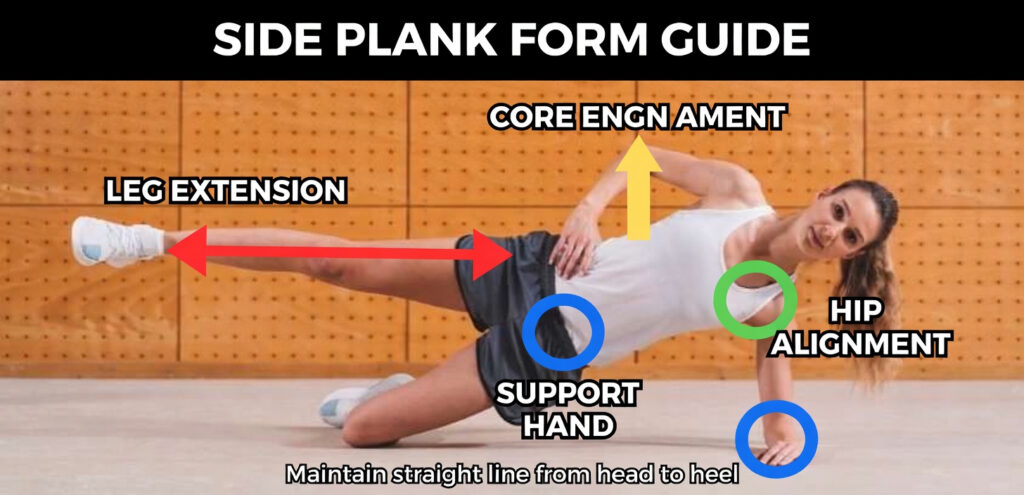
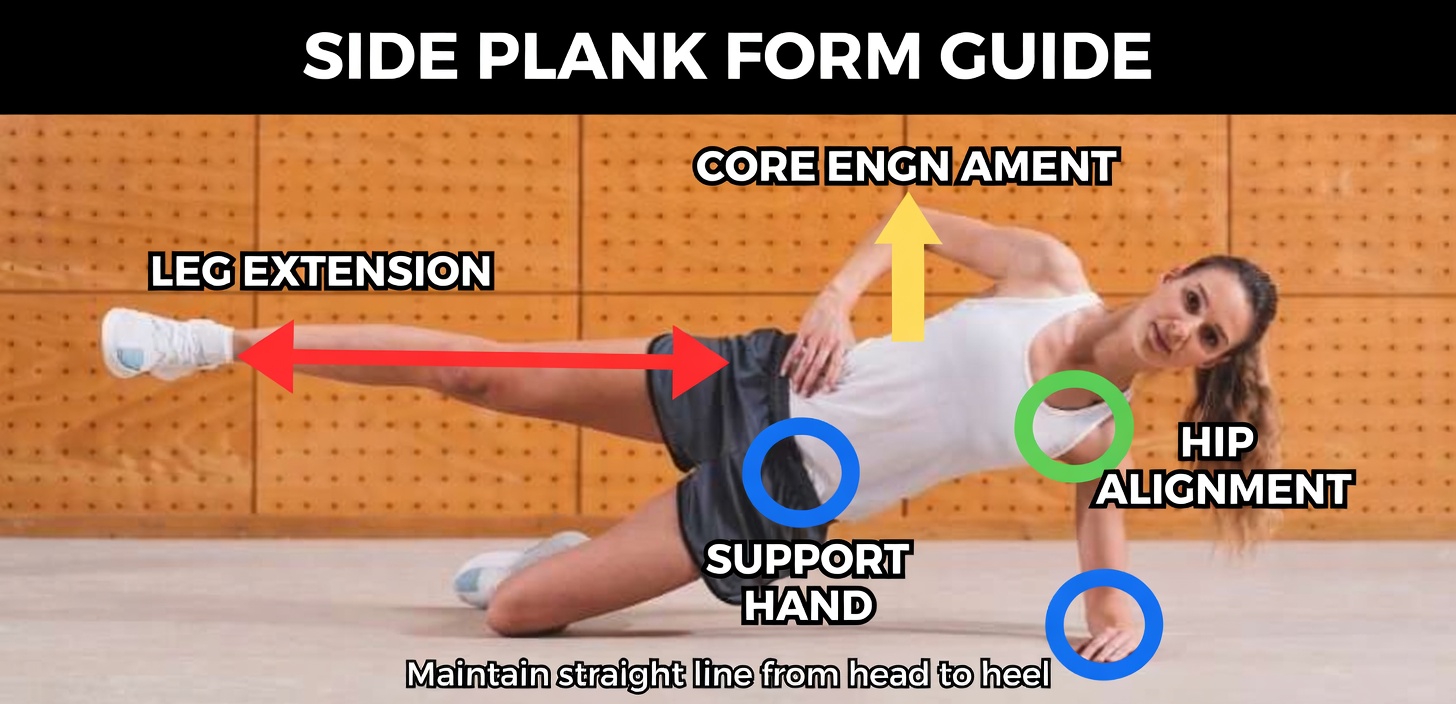
- Lie on one side with your elbow directly under your shoulder.
- Place your forearm on the floor so it is parallel to the front of your mat or the wall in front of you.
- Spread your fingers and press firmly into the floor to create a stable base.
- Stack your legs and pivot onto the outer edge of your lower foot.
- Lift your hips while keeping your body in one straight line from head to heels.
- Brace your core and breathe steadily as you hold the position.
How Long Should You Hold a Side Plank?
A good starting point is 30 seconds per side.
After that, lower to the floor and switch sides. As your strength improves, you can gradually increase the hold time. While side planks are highly effective, extremely long holds are not usually necessary.
Make It Easier: Kneeling Side Plank
If a full side plank feels too difficult at first, begin with a modified version from the knees.
Kneeling Side Plank Instructions
- Set up on your side with your knees bent and stacked.
- Place your elbow directly under your shoulder and press your forearm into the floor.
- Exhale and lift your hips and thighs away from the ground.
- Press through your forearm and shins to stay balanced.
This variation reduces the load while still helping you build strength and confidence.
Harder Side Plank Variations
Once the standard side plank feels manageable, try more advanced versions to increase difficulty.
Kneeling Side Plank With Leg Lift
- Begin in the kneeling side plank setup.
- Lift your top leg and hold it without letting your hips drop.
- Maintain control for as long as possible, or aim for 30 seconds.
- Repeat on the opposite side.
This variation strongly challenges the hip abductors and makes balance much harder.
Another option is to perform the side plank supported on your palm instead of your forearm. Place your hand directly under the shoulder and keep a slight bend in the elbow rather than locking the arm out. From there, lift one leg for an added challenge.
Side Plank Thread-Through
- Start in a side plank with your top arm reaching toward the ceiling.
- Rotate your torso and thread that arm underneath your body through the space between your torso and the floor.
- Turn your shoulders and hips as you move.
- Reverse the motion and reach the arm back up.
- Complete 3 sets of 8 to 12 reps per side.
This variation not only targets the core but can also raise your heart rate.
Common Side Plank Mistakes
Good form is essential if you want the full benefits of the side plank and want to reduce the risk of injury.
If you have a history of elbow, shoulder, or wrist pain, be especially careful with your setup and alignment.
Letting the Head Drop
Keep your neck in line with the rest of your body. From the top of your head to your feet, your body should form one long line.
Losing Shoulder Alignment
Your shoulders should stay stacked. Press the floor away with your forearm or hand to protect the shoulder joint and maintain stability.
Dropping the Hips
Do not allow the hips to sag. Keep them lifted and aligned while engaging the glutes and core throughout the hold.
Forgetting to Engage the Glutes
Squeezing the glutes helps support the pelvis and makes it easier to maintain strong form.
Final Thoughts
The side plank is one of the best exercises for building a stronger core, especially the obliques, while also training the shoulders, hips, glutes, and legs.
With proper alignment and steady tension through the floor, side plank variations can strengthen the whole body, improve posture, and increase stability.
It may feel more challenging than a regular plank, but the benefits make the effort worthwhile.
You May Also Like
- 17 Best Ab Workouts for Men
- 25 Best Ab Workouts for Women