Beginner Core Workout: Build Strength, Stability, and a Stronger Midsection
Many people begin a core workout plan because they want to improve the look and feel of their midsection.
If that sounds familiar, you are definitely not alone, regardless of your current fitness level.
A beginner core workout is an excellent starting point if your goal is to develop core strength, improve stability, and support better overall movement.
What Is Core Training?
Core training focuses on strengthening and conditioning the entire core area, not just the abs.
Your core includes the full torso: the front, sides, and back of your body.
That is where things can start to feel complicated. It is not always easy to know which exercises target specific muscles or which areas need the most attention.
The good news is that core exercises generally fall into three main categories:
- Brace-and-hold exercises, where you support and stabilize your bodyweight
- Spinal flexion and extension exercises, where the spine moves through a range of motion
- Compound full-body movements, where the core works as a key stabilizer
Each type of movement has its own benefits and limitations, but all of them can help you build a stronger core.
Choose the exercises that best match your goals, fitness level, and training routine.
1. Forearm Plank
When people think about core exercises, planks usually come to mind first, and for good reason.
The forearm plank is one of the best beginner core exercises because it develops both strength and muscular endurance at the same time.
It challenges not only the visible abdominal muscles, but also the deeper core muscles. One of these is the transverse abdominis, often described as a natural corset that wraps around the torso.
Because it strengthens the deep core, this bodyweight exercise can help create a firmer, flatter-looking stomach.
How to do it
- Lie face down on the floor or on an exercise mat.
- Position yourself on your forearms with your palms facing down.
- Keep your elbows directly under your shoulders.
- Tighten your abdominal muscles by drawing your belly button gently toward your spine.
- Lift both knees off the floor and form a straight line from your head to your heels.
- Hold your body steady, breathe normally, and avoid shrugging your shoulders toward your ears.
Repetitions
- 3 sets of 20 to 30 seconds
- Progress toward 3 sets of 60 seconds
Modification
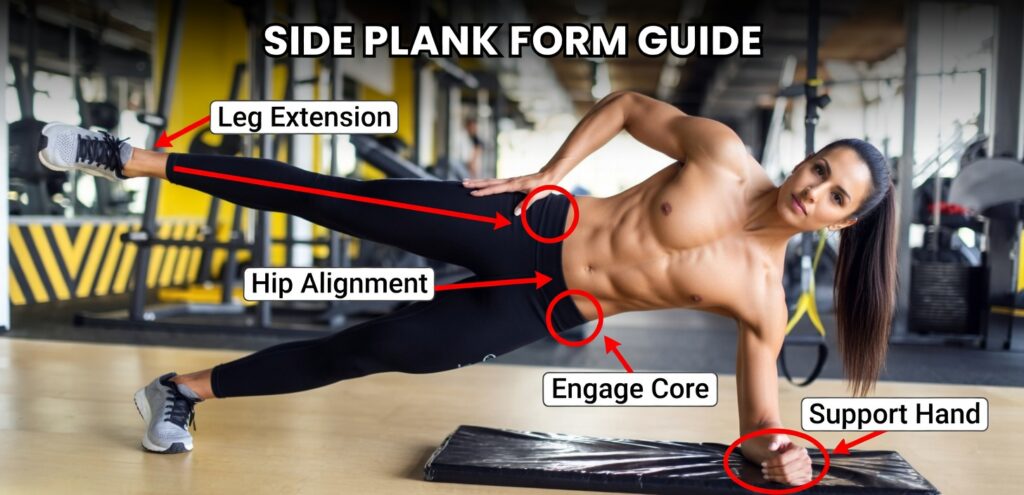
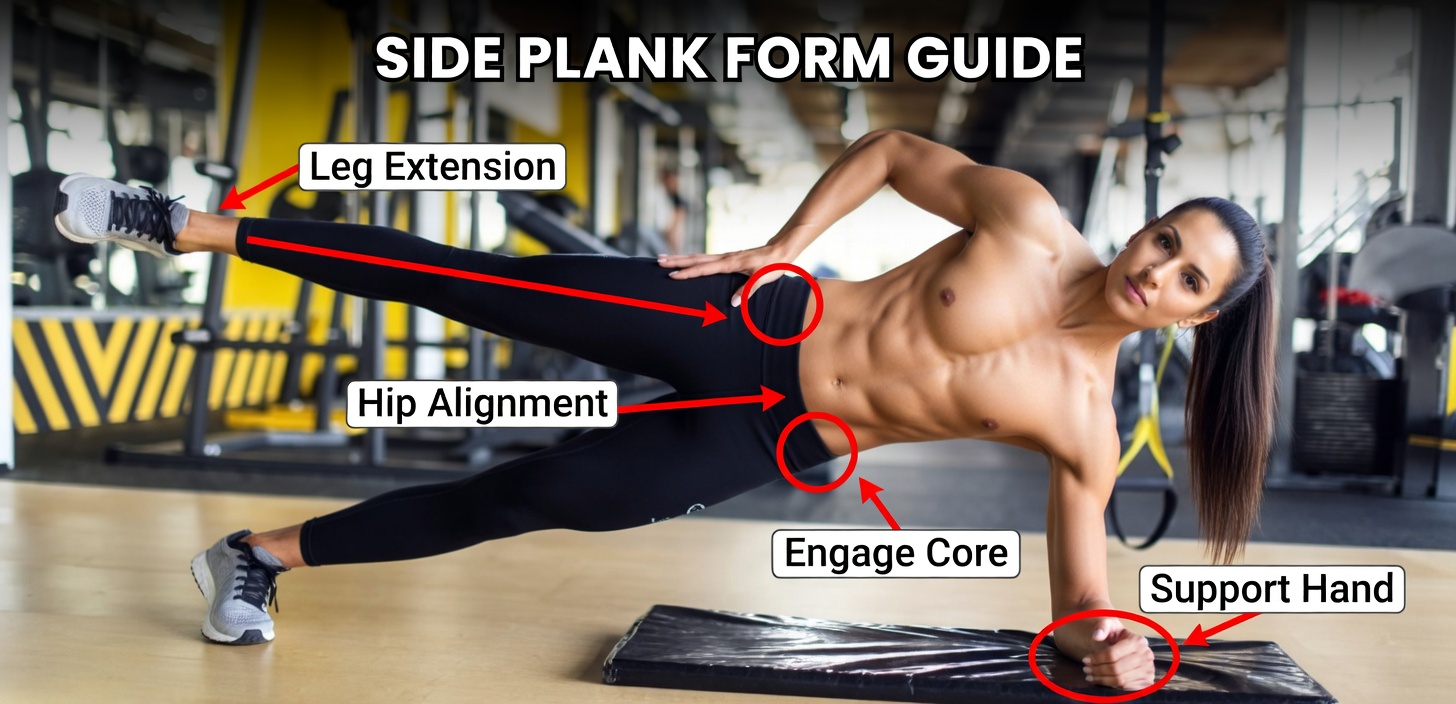
- Add a side plank for an extra challenge.
Type
- Brace and Hold
2. High Plank
The high plank is a great option if you want a core exercise that also works your shoulders and arms.
Along with improving core strength, it activates the front shoulders, chest, and triceps. It also trains the upper abs, lower abs, obliques, and transverse abdominis.
For some people, the high plank may feel more accessible than the forearm plank.
How to do it
- Start in a push-up position on the floor or on a mat.
- From your hands and knees, straighten your legs and lift your knees off the floor.
- Place your feet about hip-width apart, balancing on your toes.
- Keep your arms straight with your hands directly under your shoulders.
- Tuck your elbows in slightly rather than letting them flare out.
- Tighten your core and maintain a straight line from heels to head.
- Keep movement minimal and avoid letting your shoulders rise toward your ears.
- If wrist pressure is uncomfortable, you can brace on your fists.
Repetitions
- 3 sets of 20 to 30 seconds
- Progress toward 3 sets of 60 seconds
Modification
- Try a side plank from the high plank position for added difficulty.
Type
- Brace and Hold
3. Dead Bug
The dead bug is one of the most recommended core exercises by physical therapists, especially because it targets the deep abdominal muscles.
It is also useful for strengthening the pelvic floor muscles. Improving pelvic floor strength may support better bladder control, even in younger athletes. It may also contribute to improved sexual function in both men and women.
In addition to the pelvic floor, the dead bug works the transverse abdominis, erector spinae, and both the upper and lower abdominal muscles.
Since it is performed lying on your back, it is generally considered a back-friendly core exercise.
How to do it
- Lie flat on your back.
- Raise your arms straight up toward the ceiling with no bend in the elbows.
- Lift your knees so they are bent at a 90-degree angle.
- Press your lower back gently into the floor by engaging your core.
- Tighten your stomach by drawing the belly button inward.
- Slowly lower one arm overhead while extending the opposite leg.
- Stop both limbs just before they touch the floor.
- Return to the starting position.
- Repeat on the other side.
Repetitions
- 2 sets of 10 to 15 reps
- Progress toward 3 sets of 15 to 20 reps
Modification
- Hold small kettlebells to increase the challenge.
Type
- Flex and/or Extend
4. Hollow Hold
The hollow hold is a more intermediate core exercise that heavily challenges the front of the torso.
It also recruits the hip adductors, or inner thighs, as well as the hip flexors. Training these muscles can improve explosive movement for activities such as running and jumping, while also helping tone the inner thighs.
This move is especially effective for the upper and lower abdominal muscles. Because you hold the position, it builds both strength and endurance. Once you get stronger, you can increase intensity by adding a medicine ball, weight plate, or kettlebell.
How to do it
- Lie on your back.
- Lift your upper body slightly into a crunch position.
- Extend your arms out by your sides with your palms facing down, hovering a few inches above the floor.
- Keep your legs straight and raise your heels off the ground.
- Find your balance point so your body forms a hollow, boat-like shape.
- Brace your core and hold the position until the set is complete.
Repetitions
- 3 sets of 20 to 30 seconds
- Progress toward 3 sets of 60 seconds
Modification
- Extend your arms overhead while holding a light kettlebell to increase core engagement.
Type
- Brace and Hold
5. Stability Ball Crunch
Traditional crunches may be outdated, but the stability ball crunch offers a safer and more effective alternative.
Because the ball supports the natural curve of your lower back, it can help reduce strain and may be more comfortable for people concerned about lower back pain.
This variation also increases your range of motion and places greater emphasis on the upper portion of the rectus abdominis.
How to do it
- Sit and lean back onto a large stability ball so your lower back is supported.
- Position your legs so your knees are bent at 90 degrees.
- Keep your feet planted on the floor about hip-width apart for balance.
- Place your hands lightly at the sides of your head without pulling on your neck.
- Exhale as you crunch upward.
- Lower back down with control and repeat.
Repetitions
- 2 sets of 10 to 15 reps
- Progress toward 3 sets of 15 to 20 reps
Modification
- Hold a medicine ball, sandbag, or kettlebell to make the movement more demanding.
Type
- Flex and/or Extend
6. Leg Lift
Leg lifts, also called leg raises, provide more range of motion than many basic ab exercises when performed correctly.
They train both concentric and eccentric muscle contractions.
A concentric contraction happens when the muscle shortens under tension, which is the part most core exercises emphasize. But the eccentric phase, when the muscle lengthens under tension, is just as important.
Eccentric training may improve performance and help lower injury risk. For that reason, the lowering phase of the leg lift should be done slowly and with control to place more emphasis on the lower abdominals.
How to do it
- Lie on your back.
- Rest your arms by your sides with your palms facing down.
- Place your hands under your upper buttocks to support your lower back.
- Keep your legs straight, or maintain a slight bend in the knees if needed.
- Lift your legs toward the ceiling.
- Lower them back down slowly.
- Stop just before your heels touch the floor, then repeat.
Repetitions
- 2 sets of 10 to 15 reps
- Progress toward 3 sets of 15 to 20 reps
Type
- Flex and/or Extend
Final Thoughts
A beginner core workout does much more than target visible abs. It helps strengthen the muscles that support posture, balance, movement, and everyday function.
Whether you prefer planks, controlled floor exercises, or movements with added equipment, the best core training plan is one that fits your goals and that you can perform consistently.
Start with proper form, progress gradually, and choose the core exercises that make the most sense for your body and fitness level.