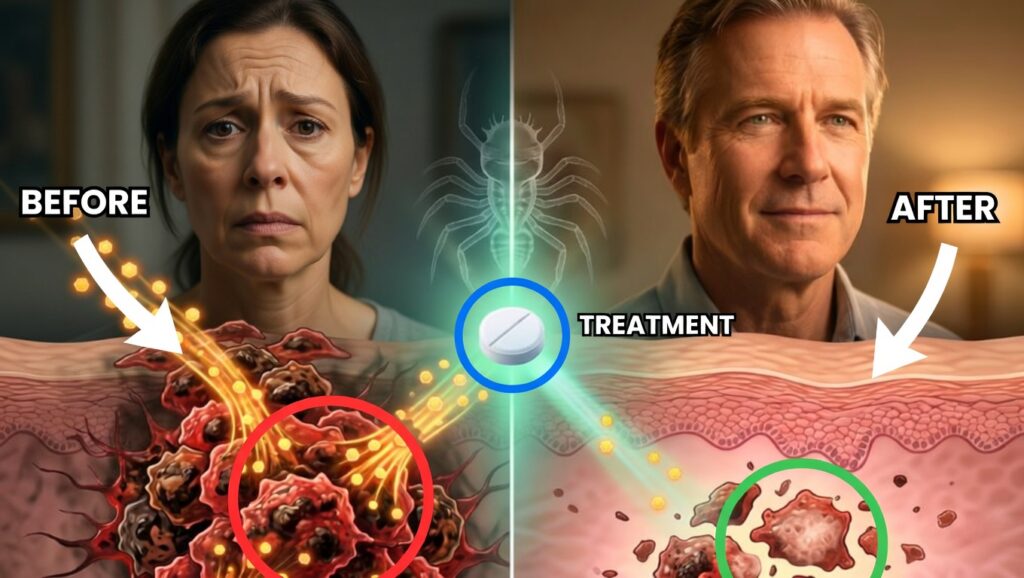
Cancer, Parasites, and a $5 Drug: What’s the Connection?
At a surprisingly basic level, cancer behaves very much like a parasite. Now imagine this: a low-cost medication originally created to eliminate intestinal worms—sometimes costing as little as $5—has been reported in anecdotal cases to coincide with complete remission in some stage 4 cancer patients.
It sounds far-fetched, and it remains highly controversial. Yet this idea is gaining attention in independent and alternative research communities, even if you rarely hear it discussed in mainstream oncology.
With cancer diagnoses increasing worldwide—and rates in younger adults reportedly up by about 79% over the past three decades—many people are looking beyond conventional narratives to understand what cancer really is and how to better support their bodies. This is not about promoting miracle cures. It’s about understanding how cancer survives, spreads, and evades the immune system.
At its core, cancer cells rely on the same ancient survival machinery that parasites and fungi have used for billions of years. Recognizing these shared systems can give you a fresh perspective on cancer and how to potentially weaken its grip through both medical and lifestyle strategies.
This article, based on the insights of Dr. Eric Berg, explains:
- How cancer metabolism mirrors that of parasites and fungi
- Why some anti-parasitic drugs and herbs are being studied for their potential anti-cancer effects
- The three key survival mechanisms cancer shares with parasites
- How you can strengthen your body’s natural defenses
Key Takeaways
-
Ancient Energy Pathway in Cancer
Cancer cells often switch back to a primitive, sugar-dependent energy process called glycolysis—the same metabolic pathway heavily used by parasites and fungi. -
Shared Survival Strategies
Cancer cells, parasites, and certain fungi rely on three major tactics:- A flexible internal scaffolding system that allows rapid growth and division
- Immune evasion, or an “invisibility cloak” that hides them from immune attack
- A strong dependence on glycolysis as their main energy source
-
Anti-Parasitic Drugs and Herbs as Potential Tools
Off-patent drugs such as fenbendazole and ivermectin, as well as traditional herbs like wormwood, may interfere with these same survival systems. Early and limited evidence suggests this is why they are being investigated for possible anti-cancer roles. -
Why You Don’t Hear This in the Mainstream
Many of these medications are old, off-patent, and inexpensive. Because there is little financial incentive, large pharmaceutical companies are unlikely to fund the large, costly clinical trials needed to move them into standard cancer care. -
Your Immune System Is Central
The most powerful anti-cancer tool you have is your own immune system. Supporting it with nutrient-dense food, fasting strategies, adequate vitamin D, quality sleep, and regular physical activity is essential.
Important: The ideas discussed here are experimental and controversial. Anti-parasitic drugs are not approved cancer treatments. Never start or stop any medication without working closely with a qualified healthcare professional.
1. What Is Cancer, Really? Inside Your Cell’s Power Plants
To understand how cancer behaves like a parasite, it helps to first know how healthy cells create energy.
Inside nearly every cell are tiny structures called mitochondria—your body’s power plants. Under normal circumstances, mitochondria are extremely efficient. From a single molecule of glucose (sugar), they can produce about 36 units of ATP, the energy currency your cells use to function.
This is clean, high-yield energy production.
When cells are injured or stressed—by toxins, radiation, chronic inflammation, nutrient deficiencies, or other damage—mitochondria can become impaired. But instead of dying immediately, many cells fall back on a much older, less efficient energy system that doesn’t depend on mitochondria.
This backup process is glycolysis. It is:
- Ancient
- Simple
- Used extensively by bacteria, fungi, and parasites
The catch? Glycolysis is terribly inefficient. From the same molecule of glucose, it produces only 2 units of ATP, compared to 36 from healthy mitochondrial respiration.
Nearly a century ago, Nobel Prize–winning scientist Otto Warburg discovered that cancer cells rely heavily on this primitive glycolytic pathway, even when oxygen is available. This shift is so characteristic of cancer that it’s often called the “Warburg effect.”
Because glycolysis yields so little energy, cancer cells become extremely hungry for sugar to compensate. They consume glucose far more aggressively than normal cells. This is the principle behind PET scans used in oncology: patients are injected with a radioactive sugar, and cancer cells—devouring sugar at 10–20 times the rate of healthy cells—absorb it and show up brightly on the scan.
In other words, one of the defining features of cancer is a reversion to the same crude energy system that primitive organisms like parasites and fungi use to stay alive.
2. The Parasite Parallel: Three Shared Survival Mechanisms
The overlap between cancer and parasites goes beyond energy production. Research and emerging hypotheses highlight three core survival systems that cancer cells share with parasites, worms, and certain fungi. This is the key reason some believe anti-parasitic drugs might also affect tumors: they’re targeting the same underlying “operating system.”
Think about what a parasite does:
- It lives off its host
- It spreads to new areas
- It develops sophisticated tactics to avoid being eliminated
Cancer behaves the same way:
- It hijacks nutrients and resources from your body
- It metastasizes to distant organs
- It manipulates and evades your immune defenses
The three overlapping mechanisms are:
- An internal scaffolding system that enables rapid, uncontrolled growth
- An immune “invisibility cloak” that prevents detection and destruction
- A dependence on glycolysis, making them vulnerable to blocked sugar metabolism
Let’s explore each in more detail.
3. Survival Mechanism #1: The Internal Scaffolding for Rapid Growth
Both parasites and cancer cells are defined by their ability to reproduce quickly.
- A tapeworm can produce tens of thousands of eggs per day.
- Cancer cells divide relentlessly because their internal growth control systems—the “brakes”—are damaged or disabled.
To divide and multiply, cells rely on an internal framework made of proteins called tubulin. This is the cell’s microtubule network—its structural scaffolding that helps organize and separate genetic material during cell division.
Many parasites and worms also depend on tubulin-based structures to grow, move, and reproduce.
Here’s where anti-parasitic drugs come in:
- Fenbendazole, a common dewormer used in animals
- Ivermectin, widely known as an anti-parasitic medication
These drugs work by binding to tubulin in parasites and disrupting their microtubules. When this scaffolding collapses:
- The parasite loses structural integrity
- It can no longer divide properly
- It eventually dies
Emerging lab research and anecdotal reports suggest that similar mechanisms may apply to some cancer cells—when these drugs interfere with microtubules, cancer cells may fail to divide and can be pushed toward cell death.
Traditional herbal remedies used in parasite cleanses, such as:
- Wormwood (Artemisia)
- Black walnut hull
- Clove
are also thought to affect similar structural or metabolic pathways, though their exact mechanisms remain less well defined and require more rigorous scientific study.
4. Survival Mechanism #2: The Immune System’s “Invisibility Cloak”
Your body is equipped with an extraordinary defense network. When a cell becomes damaged, infected, or turns cancerous, it is supposed to either:
- Self-destruct through a process called apoptosis, or
- Be identified and destroyed by immune cells such as killer T cells and natural killer (NK) cells
This system works well—until something finds a way to hide.
Cancer cells and many parasites have evolved a way to display signals on their surface that essentially say:
“Do not attack me.”
These molecular “badges” send a misleading message to your immune system, telling it to stand down and ignore the threat. As a result:
- The immune system fails to recognize them as dangerous
- Cancer cells or parasites can multiply freely
- Disease progresses without being properly targeted
Certain anti-parasitic medications and natural compounds appear to interfere with this deceptive signaling. Rather than killing cancer cells outright, they may:
- Strip away or block the “don’t kill me” signals
- Expose cancer cells to immune surveillance
- Allow your own immune system to finally recognize and attack them
In this view, these agents act more like immune unmaskers than direct killers. Once the disguise is removed, your body’s built-in defense forces can do what they were designed to do.
5. Survival Mechanism #3: Starving Cancer by Disrupting Glycolysis
As noted earlier, both cancer cells and many parasites are heavily reliant on glycolysis—a sugar-burning, oxygen-independent energy pathway.
Because glycolysis is inefficient, cancer cells develop an intense dependency on glucose. This dependency is one of their greatest vulnerabilities.
Many anti-parasitic drugs and herbs are believed, in early research, to:
- Block or inhibit key enzymes in the glycolytic pathway
- Interfere with the ability of cells to extract energy from glucose
When glycolysis is disrupted in cells that depend on it:
- Energy production plummets
- Growth and division are impaired
- The ability to spread (metastasize) may be reduced
This creates a multi-pronged attack:
- Undermining structural scaffolding (tubulin/microtubules)
- Removing immune camouflage
- Cutting off the main fuel supply (glycolysis)
It’s this combination of effects that fascinates many independent researchers exploring the overlap between anti-parasitic compounds and cancer biology.
6. Why Isn’t This Approach Mainstream?
If this concept shows such potential, why don’t we see headlines about fenbendazole or ivermectin as standard cancer treatments?
Several factors help explain this:
-
Expired Patents and Low Profit Potential
Drugs like fenbendazole and ivermectin are old, generic, and inexpensive. Their patents have expired, which means:- No single company can exclusively profit from them
- There is little financial incentive to invest tens or hundreds of millions of dollars in large-scale cancer trials
-
Cost of Clinical Research
To become an approved cancer treatment, a drug must go through:- Multiple phases of clinical trials
- Extensive safety and efficacy testing
- Regulatory review
This is extraordinarily expensive. Pharmaceutical companies typically reserve that level of investment for new, patent-protected medications with high potential returns.
-
Conservative Medical Standards
Mainstream oncology guidelines are based primarily on:- Large randomized controlled trials
- Peer-reviewed data
- Regulatory approvals
Until robust clinical evidence exists, major cancer centers are unlikely to incorporate anti-parasitic drugs into standard protocols, except possibly in research settings.
-
Need for Caution and Safety
While there are compelling hypotheses, lab data, and anecdotal case reports, these do not substitute for rigorous human trials. Self-experimentation with veterinary drugs or off-label medications carries real risks, including:- Toxicity
- Dangerous interactions with existing treatments
- Incorrect dosing
Bottom line: This field is intriguing but not yet fully validated. Any exploration of these options must be done carefully and under medical supervision.
7. Your Immune System: The Primary Defense Against Cancer
Regardless of which therapies are used, one principle remains constant:
Your immune system is the central weapon in the fight against cancer.
Even the most advanced treatments work better when your immune system is strong and responsive. Cancer generally gains the upper hand when:
- Immune surveillance is weakened
- Chronic inflammation is high
- Metabolic health is poor
Supporting immune function and metabolic health doesn’t replace medical treatment, but it can create an internal environment that is less hospitable to cancer and more supportive of healing.
Key strategies often emphasized by functional and integrative practitioners include:
-
Nutrient-Dense, Low-Sugar Nutrition
- Emphasize whole foods: vegetables, healthy fats, quality protein
- Reduce refined sugar and ultra-processed foods that fuel glycolysis-dependent cells
- Support stable blood sugar and insulin levels
-
Strategic Fasting or Time-Restricted Eating
- Approaches like intermittent fasting may help:
- Lower insulin
- Improve metabolic flexibility
- Reduce the constant availability of glucose
Always discuss fasting with a healthcare provider, especially during cancer treatment.
- Approaches like intermittent fasting may help:
-
Optimizing Vitamin D Levels
- Vitamin D plays a key role in immune regulation
- Many people are deficient
- Testing and supplementing under professional guidance can be important
-
Sleep and Stress Management
- Deep, restorative sleep is critical for immune function
- Chronic stress suppresses the immune system and drives inflammation
- Practices like breathwork, meditation, or gentle movement can help regulate stress responses
-
Regular Physical Activity
- Exercise improves circulation, insulin sensitivity, and immune cell activity
- Even light daily movement can be beneficial for those dealing with illness
8. Putting It All Together
Viewing cancer as a parasitic-like process—one that uses primitive energy pathways, hides from your immune system, and rapidly multiplies—offers a different lens on this complex disease.
Key ideas to remember:
- Cancer cells share ancient survival systems with parasites and fungi, particularly their reliance on glycolysis and structural microtubules.
- Certain anti-parasitic drugs and herbs are being studied for their potential to:
- Disrupt cancer cell scaffolding
- Remove immune camouflage
- Interfere with glycolysis and energy production
- These approaches remain largely outside mainstream medicine due to a lack of large, profitable clinical trials and the off-patent status of many drugs.
- Your immune system—supported by smart lifestyle choices—remains your most critical line of defense.
If you are dealing with cancer or supporting someone who is:
- Use this information as a framework for understanding, not as a replacement for medical advice.
- Discuss any interest in off-label or experimental therapies with your oncologist or an integrative medicine practitioner.
- Focus on what you can control daily: nutrition, movement, sleep, stress, and targeted supplementation under guidance.
Knowledge is power, especially when facing a disease as complex as cancer. Understanding its parasitic-like behavior can help you ask better questions, evaluate options more clearly, and work with your healthcare team to create a more comprehensive, informed strategy for your health.