Can a Traditional Japanese Food Help Fight Heart Disease?
The world’s leading cause of death, cardiovascular disease, might have an unexpected challenger—and it doesn’t come from a pharmaceutical lab. Instead, it comes from a sticky, pungent breakfast dish eaten in Japan for centuries. Growing scientific evidence suggests that an enzyme called nattokinase, extracted from the fermented soybean dish natto, may play a significant role in combating arterial plaque and supporting heart health.
For years, most experts believed that once your arteries became clogged with plaque, the most you could do was slow the damage. Reversing it in any meaningful way seemed nearly impossible. Yet newer research is starting to question that assumption, hinting that some forms of arterial plaque might actually be reduced.
In this article, we’ll break down what atherosclerosis is, why conventional treatments have limits, what nattokinase is, and what recent human studies suggest about its potential to shrink arterial plaque.
Key Takeaways
- Atherosclerosis is the gradual buildup of fatty deposits (plaque) inside your arteries, which can eventually cause heart attacks and strokes.
- Standard therapies like statins mainly work by lowering LDL (“bad”) cholesterol and slowing plaque growth; they are not primarily designed to substantially remove plaque that has already formed.
- Nattokinase is a naturally occurring enzyme found in natto, a traditional Japanese fermented soybean dish, and is known for its strong ability to help dissolve blood clots.
- Human clinical trials have reported that nattokinase may significantly decrease arterial plaque volume. In one study, plaque was reduced by more than 36% in just six months.
- Dose matters: studies using higher doses of nattokinase (around 6,000 FU per day or more) report notable benefits, whereas trials using lower doses have generally not shown the same effect.
- Because nattokinase has blood-thinning properties, it must be used cautiously and only after discussing it thoroughly with a healthcare professional, especially if you are taking other medications that affect clotting.
1. What Exactly Is Atherosclerosis (And Why Is It So Dangerous)?
To understand why nattokinase is attracting attention, it helps to first understand atherosclerosis itself.
Imagine your arteries as high-speed roadways carrying oxygen-rich blood from your heart to every organ and tissue. In a healthy person, these vessels are open and flexible, allowing blood to flow smoothly. Atherosclerosis is what happens when those roads begin to narrow and harden because of plaque deposits.
This plaque is a chaotic mix made up of:
- LDL (“bad”) cholesterol and other fats
- Calcium
- Cellular debris
- Fibrin, a protein involved in clotting
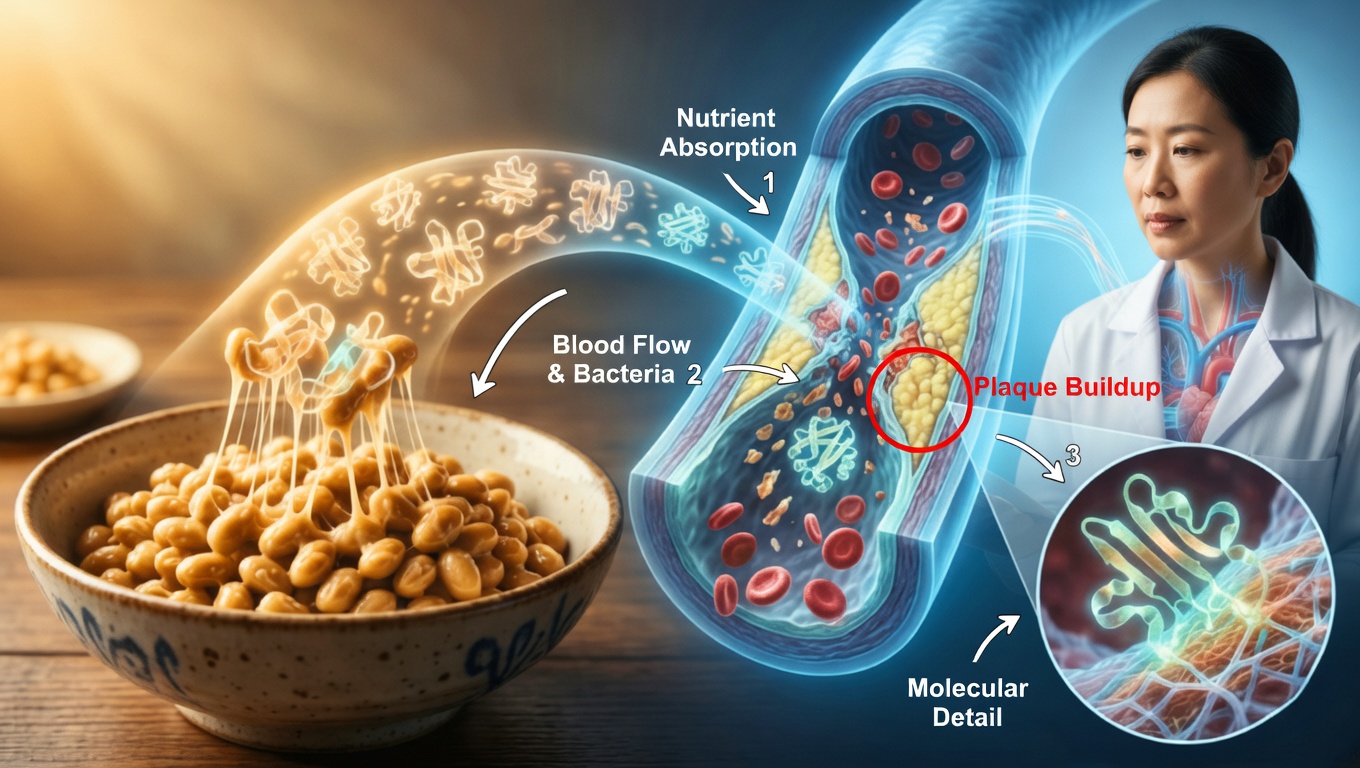
The process often begins when the inner lining of the artery—the endothelium—is injured. Triggers can include high blood pressure, smoking, high blood sugar, or chronic inflammation. In response, the body sends in immune cells called macrophages to clean up cholesterol that has lodged in the artery wall.
However, these macrophages can become overloaded with cholesterol, turning into “foam cells.” These foam cells get trapped, then die and release their contents, which fuels further inflammation. More immune cells arrive, more damage is done, and the plaque grows and hardens over time—slowly narrowing the artery and impeding blood flow.
The most dangerous moment comes when a plaque ruptures. Your body treats this rupture as an emergency wound and forms a blood clot at the site. In an already narrowed artery, that clot can completely block blood flow.
- If this occurs in a coronary artery, the result is a heart attack.
- If it happens in an artery supplying the brain, it can cause a stroke.
This is why atherosclerosis is often called a “silent killer”: the process advances quietly for years, only becoming obvious when a major event occurs.
2. The Limits of Conventional Treatments
For decades, the frontline strategy against atherosclerosis has been to reduce LDL cholesterol, and the primary tool has been statin medications.
Statins work by decreasing the liver’s production of cholesterol, thereby lowering the amount of LDL circulating in the bloodstream. That means there is less raw material available to form new plaque. In countless studies, statins have been shown to:
- Lower LDL cholesterol
- Reduce the rate at which plaque accumulates
- Decrease the risk of heart attacks and strokes
These drugs have undoubtedly saved many lives. However, they are best described as a brake pedal, not a reverse gear.
Even with aggressive statin therapy, the regression of existing plaque is usually modest. In the most optimistic large trials, a subset of patients shows plaque reductions in the range of 10–15%. That’s beneficial, but it doesn’t eliminate the disease or remove the majority of the plaque already present.
As a result, researchers have continued to search for approaches that don’t just slow plaque formation, but may help actively break down and clear existing plaque.
3. Enter Nattokinase: The Enzyme from Fermented Soybeans
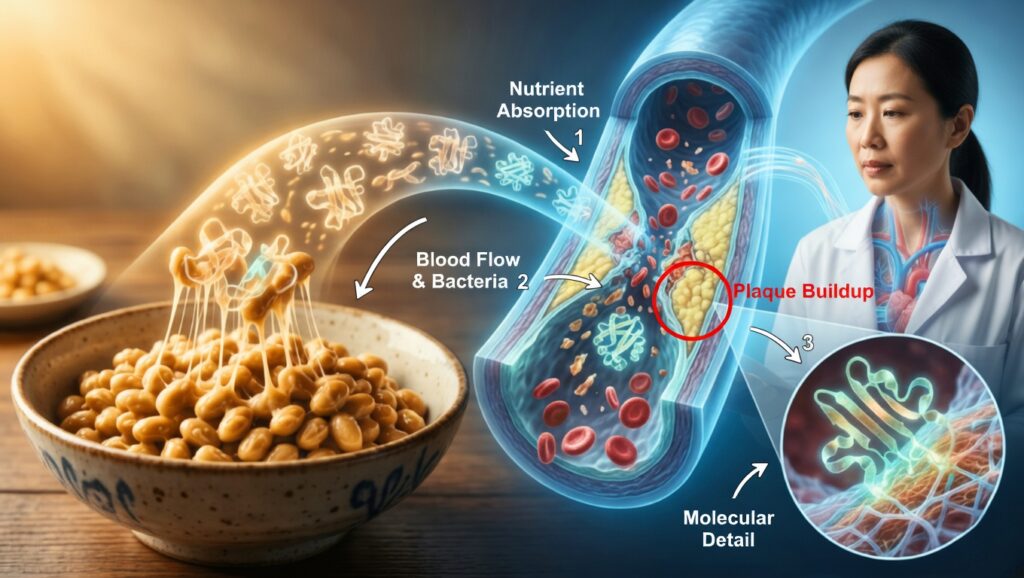
This search has led some scientists to look closely at natto, a traditional Japanese food made by fermenting soybeans with a bacterium called Bacillus subtilis natto. Natto has a distinctive smell and a sticky, stringy texture that many people outside Japan find challenging—but it also contains a unique enzyme: nattokinase.
Nattokinase was first identified in the 1980s by Dr. Hiroyuki Sumi. While testing various foods for natural clot-dissolving activity, he placed a bit of natto on an artificial blood clot in a laboratory dish. Within hours, the clot had essentially dissolved. Investigation revealed that a powerful enzyme in natto was responsible, and it was named nattokinase.
Nattokinase is known for its strong fibrinolytic activity, meaning it is very effective at breaking down fibrin, the protein strands that form the structural framework of blood clots. Because of this, researchers have studied nattokinase for its potential to:
- Support healthy blood flow
- Help prevent abnormal clot formation
- Contribute to overall cardiovascular health
More recently, evidence has emerged suggesting that its benefits might extend beyond clot dissolution to include reduction of arterial plaque itself.
4. The Shocking Study: Nattokinase vs. Statins
Nattokinase’s reputation as a natural clot-buster was already established, but a study published in 2017 in the Chinese Journal of Medicine brought it to the forefront of plaque research.
In this 26-week clinical trial, 76 participants with atherosclerotic plaque in their carotid arteries (the major arteries in the neck that supply blood to the brain) were enrolled. The subjects were randomly assigned to one of two treatment groups:
- Statin group: 20 mg of simvastatin daily
- Nattokinase group: 6,000 FU (fibrinolytic units) of nattokinase daily
Both groups showed a reduction in plaque size over the six-month period. However, the magnitude of change was strikingly different:
- The statin group experienced about an 11.5% decrease in plaque size.
- The nattokinase group saw an average 36.6% reduction in plaque size.
In other words, the nattokinase group achieved more than three times the plaque regression of the statin group in this study.
On top of that, the nattokinase group experienced favorable shifts in their blood lipids, including:
- Lower triglycerides
- Reduced LDL (“bad”) cholesterol
- Increased HDL (“good”) cholesterol
Seeing such pronounced changes from a natural enzyme was highly unusual and has generated significant interest in the cardiovascular research community.
5. Does Dosage Matter? A Tale of Two Studies
As with many nutraceuticals, dosage appears to be crucial for nattokinase’s effectiveness.
The promising 2017 trial used a relatively high dose of 6,000 FU per day. In contrast, some later studies that used lower doses have not shown the same benefits. For instance, a 2023 clinical trial led by Dr. Howard Hodis tested 2,000 FU per day and reported a “null effect” on the progression of atherosclerosis.
This raised an important question: is nattokinase ineffective, or were the doses simply too low?
A larger study published in 2022 by Chen and colleagues in Frontiers in Cardiovascular Medicine offered additional insight. This year-long trial provided further evidence that nattokinase’s impact on cardiovascular markers and arterial health is dose-dependent, reinforcing the idea that higher daily intakes are likely necessary to see meaningful effects on plaque.
Final Thoughts: Powerful Potential, But Use with Caution
Nattokinase is an intriguing natural compound with impressive clot-dissolving capabilities and emerging evidence suggesting it may help reduce arterial plaque, especially at higher doses around 6,000 FU per day.
However, because nattokinase thins the blood and affects clotting, it is not appropriate for everyone. It can interact with:
- Prescription blood thinners (e.g., warfarin, DOACs)
- Antiplatelet medications (e.g., aspirin, clopidogrel)
- Other supplements that influence bleeding risk
Anyone considering nattokinase—especially those with cardiovascular disease, bleeding disorders, upcoming surgery, or who are already on medication—should consult a qualified healthcare provider before starting supplementation.
The research is promising, but it is still evolving. For now, nattokinase should be viewed as a potentially valuable adjunct to, not a replacement for, proven medical therapies and a heart-healthy lifestyle.