Why Vitamin K2 Alone Won’t Solve Your Calcium Problems
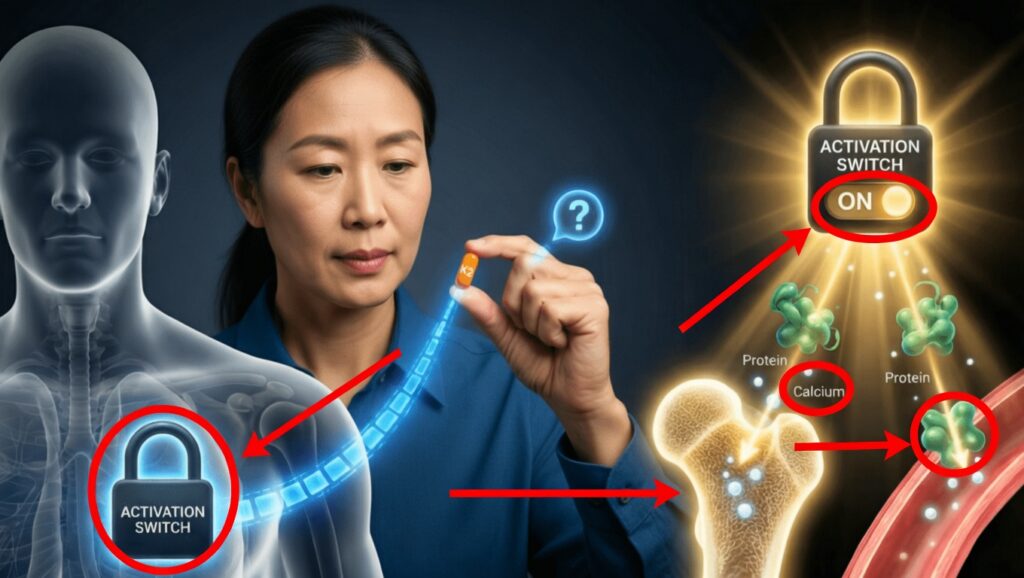
You’re taking vitamin K2. You’ve read the articles, watched the videos, and learned that K2 acts like a “traffic cop” for calcium—guiding it into your bones and steering it away from your arteries. You want to protect your heart, keep your joints moving freely, and maybe even undo some of that worrying calcification.
On paper, it looks like you’re doing everything right.
But relying on K2 alone can create a false sense of security. The deeper issue often isn’t a lack of vitamin K2—it’s a disrupted system that mishandles calcium on multiple levels.
Vitamin K2 is not a scam; it is a crucial nutrient. The problem is that most explanations reduce a complex process to a simple pill-based fix. K2 is just one part of a larger network that governs where calcium goes and how it’s used. If you’re taking K2 (even with vitamin D) and still worried about stiff arteries, joint pain, or bone loss, this is what you need to understand.
Below, we’ll break down why K2 by itself isn’t enough—and what must be in place for it to actually work.
Key Takeaways
- Vitamin K2 is essential but not sufficient. It helps direct calcium, but it cannot correct deep-rooted metabolic and mineral imbalances on its own.
- Calcification comes from “mineral traffic chaos.” It’s usually not about a single vitamin deficiency, but about a long-term breakdown in mineral regulation.
- Magnesium is a central co-factor. It keeps calcium dissolved and mobile in the blood, reducing the risk of calcium depositing in soft tissues.
- Other nutrients matter too. Vitamin D, vitamin A, electrolytes (especially potassium), and minerals like boron all influence how your body manages calcium.
- Exercise is non-negotiable. No supplement can replace the mechanical signals that movement and load send to your bones, telling them to absorb calcium.
1. The Standard Vitamin K2 Story (And What It Leaves Out)
Most people hear a very simplified version of the K2 story:
- Calcium can harden your arteries.
- Vitamin K2 “tells” calcium to go into bones instead.
- Therefore, taking K2 should prevent calcification and strengthen your skeleton.
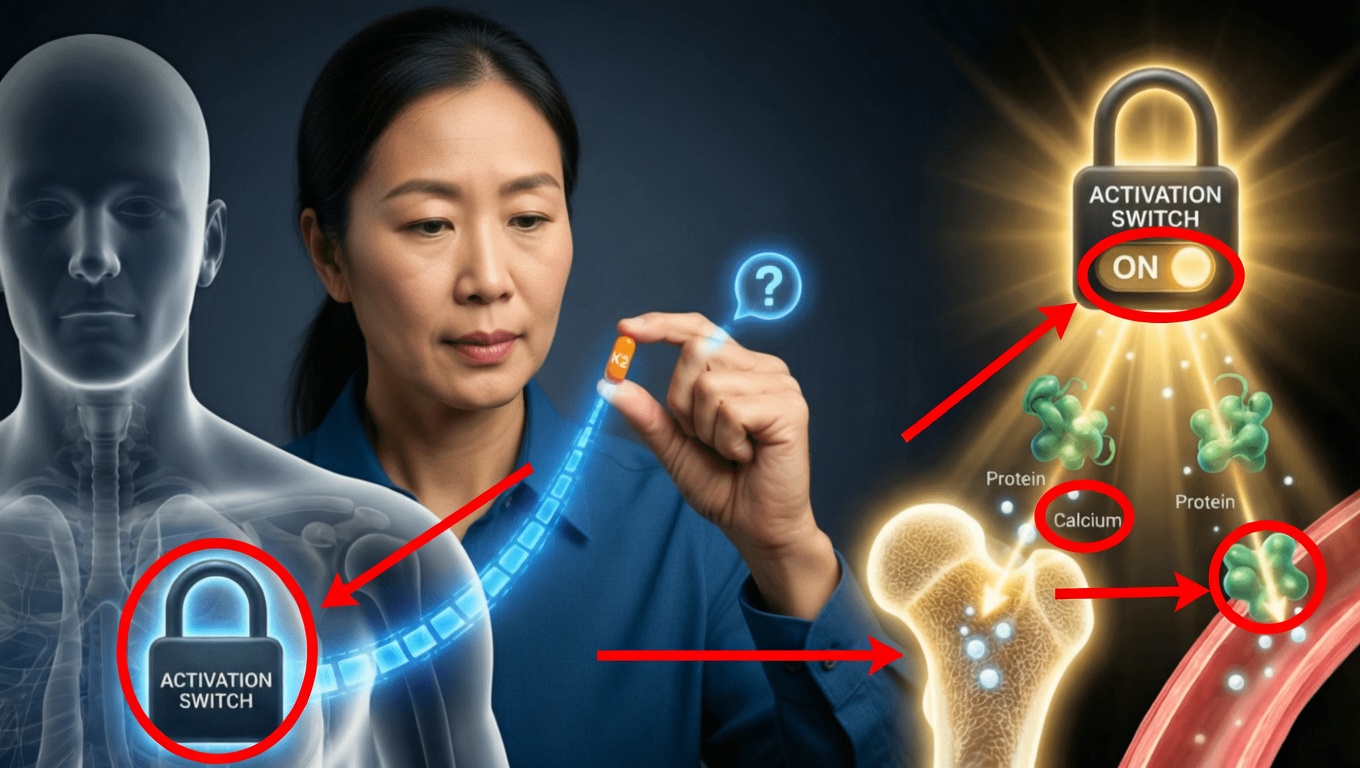
There is some truth here. Vitamin K2 activates two important proteins:
- Matrix Gla Protein (MGP): Think of this as a security system in your blood vessel walls. When activated by K2, MGP binds to stray calcium and helps keep it from forming hard deposits in arteries.
- Osteocalcin: A protein in bone tissue that, once activated by K2, helps your bones pull calcium out of the blood and lock it into the bone matrix.
Research supports this. Higher dietary intake of K2 is associated with:
- Less vascular calcification
- Lower risk of cardiovascular disease
So the science is not the issue. The mistake is assuming that calcification happens only because you’re low in K2. In reality, hardened arteries are usually the outcome of a system that has been mismanaging minerals for many years. The usual narrative is simply too narrow.
Instead of asking, “Does vitamin K2 work?”, a better question is:
“What conditions must be in place for vitamin K2 to work properly?”
2. What Is Calcification Really? Understanding the Calcium Paradox
To address calcification, you first need a clear picture of what it is.
Calcium is the most plentiful mineral in the human body. Under normal conditions:
- Most of it should be stored in bones and teeth, providing structure and strength.
- A small, tightly regulated amount circulates in the blood and enters cells to support key functions like:
- Heart rhythm
- Muscle contractions
- Nerve transmission
This balance is healthy and necessary.
Problems arise when calcium begins to accumulate where it doesn’t belong—in artery walls, heart valves, joints, brain tissue, and other soft tissues. Over time:
- Arteries lose their elasticity and become stiff, increasing blood pressure and cardiovascular risk.
- Joints can feel rigid and painful.
- The risk of serious cardiovascular events goes up dramatically.
Calcification is especially dangerous because it is silent. You don’t feel it building up. By the time it appears on imaging or causes symptoms, the process often has been ongoing for decades.
Then comes the so-called “calcium paradox”:
Many people with significant arterial calcification also have low bone density or osteoporosis. Their arteries are getting overloaded with calcium while their bones are becoming weaker and more fragile.
This contradiction tells us something important:
The issue often isn’t too little or too much calcium overall—it’s that your body is misdirecting calcium to the wrong places.
3. Mineral “Traffic Chaos”: When Calcium Becomes Unusable
Expecting vitamin K2 to fix calcification on its own is like hiring a traffic cop in a city where:
- The roads are crumbling
- The cars are out of gas
- The destinations are closed
The traffic officer can wave signals all day, but nothing is moving efficiently.
For calcium to end up where it should, several phases of the process have to work together. If any step breaks down, calcium becomes “bio-unavailable”—present in the body, but not being used correctly.
This breakdown often starts in the digestive system:
- You need sufficient stomach acid to absorb minerals, including calcium, from food.
- Many people, especially older adults or those under chronic stress, have low stomach acid, which severely limits mineral absorption.
Next, vitamin D plays a major role:
- It helps transport calcium from the gut into the bloodstream.
- Most people know about taking vitamin D3 with K2, but that’s only part of the story.
Once calcium circulates in the blood, it must remain dissolved and properly escorted. Here, magnesium is indispensable:
- Magnesium helps keep calcium in solution, preventing it from forming crystals and depositing in soft tissue.
- A chronic, low-level magnesium deficiency is extremely common and often goes unnoticed.
- Many individuals struggling with calcification aren’t necessarily taking too much calcium—they’re operating on a long-standing magnesium deficit.
Without adequate magnesium and proper digestion, your body may have plenty of calcium, but it behaves like a poorly managed fleet of cars with no fuel, no maintenance, and no clear destination.
4. The Supporting Cast: Nutrients Most People Ignore
K2, vitamin D, and magnesium are the headline players in calcium management—but they don’t work in isolation. A number of additional nutrients quietly influence how calcium moves, where it settles, and how effectively your bones can use it.
Ignoring these “supporting actors” is a bit like trying to bake a cake with only flour and sugar.
Electrolytes: Sodium and Potassium
We’ve been warned for years about the dangers of sodium, but the real issue is often imbalance, not sodium itself.
- Your body needs sodium for fluid balance, nerve function, and mineral transport.
- The typical modern diet is overloaded with sodium from processed foods, while severely lacking in potassium from fruits and vegetables.
This sodium-potassium imbalance affects:
- How minerals move in and out of cells
- How calcium behaves inside tissues
The goal usually isn’t to cut out all salt, but to:
- Choose a high-quality, minimally processed salt
- Greatly increase potassium through whole foods like leafy greens, avocados, beans, and certain fruits
Vitamin A and Vitamin D Synergy
Vitamin A works hand-in-hand with vitamin D to:
- Regulate genes involved in bone turnover
- Support proper formation and remodeling of bone tissue
Having vitamin D without adequate vitamin A can skew this balance, just as having A without D can, too. Both need to be in a healthy range.
Boron and Other Trace Minerals
Boron is a lesser-known trace mineral that:
- Helps the body retain magnesium
- Supports a healthy balance between calcium and magnesium
This makes it indirectly important for keeping calcium where it belongs.
Protein Status
A major transport protein in your blood, albumin, carries calcium throughout the body. Low protein intake or poor overall protein status can:
- Reduce albumin levels
- Impair calcium transport and distribution
When any of these secondary factors are lacking—electrolytes, vitamins A and D in balance, boron, adequate protein—the entire calcium-handling system can struggle, even if you’re taking K2 faithfully.
5. The One Factor Supplements Can’t Replace: Movement
This may be the most crucial piece of all: your bones do not strengthen just because calcium and K2 are present.
Bones remodel and absorb more calcium when there is a clear mechanical signal—in other words, when you physically use them.
Activities that create this signal include:
- Walking (especially brisk or uphill)
- Strength training and weightlifting
- Running or jogging
- Resistance bands and bodyweight exercises
- Impact-based movements appropriate for your fitness level
When you load your skeleton through movement:
- Your body receives the message: “We need stronger bones here.”
- Osteoblasts (bone-building cells) respond by drawing calcium from the blood and incorporating it into the bone structure.
Without that physical demand, your bones have no reason to take up extra calcium. It’s like having a delivery truck full of packages with no addresses:
- The truck keeps circulating.
- Eventually, those “packages” (calcium) get dropped off in the wrong neighborhoods—such as your arteries, heart valves, or joints.
No capsule or combination of supplements can replace this mechanical stimulus. Movement is non-negotiable for healthy bones and proper calcium use.
In summary, vitamin K2 is an important part of the calcium story—but it’s not the whole story. For K2 to truly help protect your heart, joints, and bones, it needs:
- Proper digestion and sufficient stomach acid
- Adequate vitamin D and vitamin A
- Robust magnesium levels
- Balanced electrolytes, especially potassium
- Support from trace minerals like boron
- And, critically, regular physical activity that signals your bones to get stronger
When all these pieces are in place, vitamin K2 can finally do what it’s meant to do: help direct calcium to the right places—and keep it out of the wrong ones.