No Time for the Gym? Try This Bodyweight Strength Training Routine
Not everyone can make it to the gym for strength training. While free weights and machines can help you train every part of the body, many people simply do not have the time to get there regularly.
The good news is that you can still build strength without a gym. If you prefer to work out at home or at the park using your bodyweight and very little equipment, this routine is a great fit.
Why Bodyweight Training Works
A lot of people want a simple strength routine they can do anywhere. The main challenge is finding exercises that train the whole body without relying on a full gym setup.
This bodyweight workout solves that problem by combining classic calisthenic movements that target nearly every major muscle group. Some exercises can also be adjusted to make them easier or harder, which makes the routine useful for beginners and more experienced exercisers alike.
A Simple Full-Body Bodyweight Strength Routine
Use the following exercises together 3-4 times per week.
1. Push-Ups
Push-ups are one of the most important movements in a calisthenics routine. They are a strong starting point for beginners and still highly effective for experienced bodyweight trainers. Since there are many variations, you can choose the version that matches your current ability.
How to do it:
- Begin with both hands and both feet on the floor.
- Keep your shoulders directly over your hands.
- Bend your elbows slowly and let your shoulders move backward as you lower yourself.
- Keep your back straight as you move down, aiming to touch your chest to the floor.
- Push back up to the starting position.
Reps and sets:
- 10-15 reps
- 3 sets per session
2. Pull-Ups
Pull-ups are another popular calisthenics exercise. They can be very difficult for many people, especially if you are new to training, so using a modified version at first may help. No matter which version you do, pull-ups give your back and biceps a strong workout.
How to do it:
- Grab the bar with both hands, with your palms facing away from you.
- Pull your shoulder blades down and back.
- Bend your arms and pull yourself upward, aiming to touch your chest to the bar.
- Lower yourself down slowly to finish the rep.
Reps and sets:
- 8-10 reps
- 3 sets per session
3. Air Squats
Squats are an excellent lower-body exercise. They work the triple extensor group, including the glutes, quads, and calves. Like the other exercises in this routine, squats also help prepare you for more advanced movements later on.
How to do it:
- Stand with your feet about hip-width apart.
- Bend your knees and lower your hips slowly.
- Go down until your thighs are parallel to the floor.
- Stand back up by straightening your legs.
Reps and sets:
- 10-15 reps
- 3 sets per session
4. Standing Dips
Standing dips require parallel bars or gymnastics rings, so you may need to do them at a local park or another location that has the right setup. If that is not available, you can do seated dips on a bench or chair instead.
How to do it:
- Grip the bars firmly.
- Press yourself up so your body is supported only by your hands.
- Bend your elbows slowly and let your shoulders move backward as you lower your body.
- Push yourself back up to the starting position.
Reps and sets:
- 10-12 reps
- 3 sets per session
5. Forearm Planks
Planks are a great exercise for the core. This is the only isometric move in the routine, but it is very effective for building strong abs.
How to do it:
- Place your forearms and feet on the floor.
- Keep your back straight.
- Tighten your abdominal muscles and hold the position.
Time and sets:
- Hold for 45 seconds
- Repeat 3 times per session
6. Alternating Lunges
Lunges are another smart addition to a calisthenics workout. They work the same muscles as squats—glutes, quads, and calves—but they also add a balance challenge because of the single-leg position.
How to do it:
- Stand with one foot about 24 inches in front of the other.
- Lower your back knee slowly toward the floor.
- Stop when your knee is about an inch from the ground.
- Switch sides and repeat.
Reps:
- 10-12 reps per side, per session
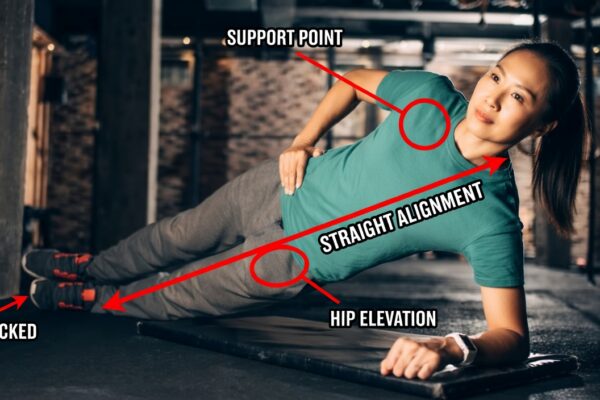
7. Side Planks
This final exercise targets the obliques. Together with regular planks, side planks can help strengthen the core muscles significantly.
How to do it:
- Lie on your right side.
- Stack your left foot on top of your right foot.
- Place your right forearm on the floor under your shoulder.
- Lift your hips and trunk so your body forms a straight line.
- Hold the position, then repeat on the other side.
Time and sets:
- Hold for 30 seconds
- Repeat 5 times on each side, per session
The Bottom Line
Calisthenic exercises make strength training more accessible, no matter what equipment you have. If getting to the gym is difficult, this routine gives you a practical way to train your whole body at home or outdoors.
Try this workout for the next few months and see what it can do for your strength and physique.
Consult a healthcare professional before making changes.