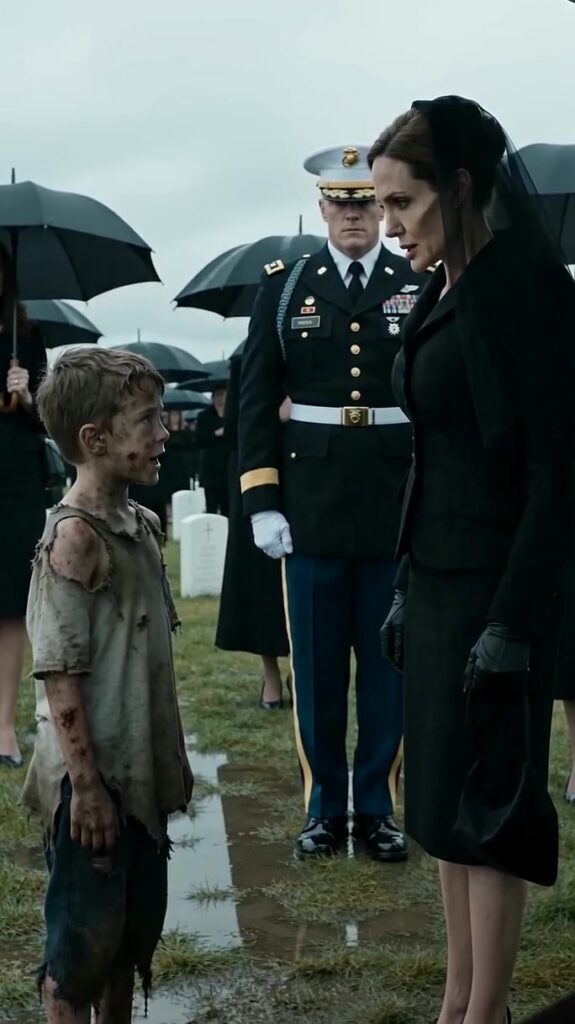
The funeral was quiet in the way only military funerals are: not silent, but disciplined. Even the wind seemed to understand the rules. It slid across the cemetery in careful breaths, flattening wet grass and pushing at the edges of black umbrellas without daring to lift one. Rows of white headstones ran like ribs over the hill beneath a sky the color of gunmetal. Men and women stood in straight lines as if grief could be measured and issued in uniform amounts.
At the front, the coffin waited on its stand, draped in the flag. The red stripes were impossibly bright against all that gray. A photograph sat beside it—Captain Daniel Mercer, crisp in dress blues, eyes forward, mouth caught between pride and weariness. If you didn’t know him, you might think he was simply brave. If you did, you knew he’d been brave in complicated ways, and sometimes that was more terrifying than the simple kind.
His widow, Eliza Mercer, stood closest, a figure in black lace and restraint. Her gloves were immaculate. Her posture was the posture of someone who had been trained to survive public moments. She had said very little since they brought Daniel home—no interviews, no speeches, no weeping into microphones. Grief, in her world, was private. Here, at least, it was controlled.
The honor guard moved with practiced precision. A chaplain murmured words that floated and sank in the damp air. The rifle team readied for the salute. The bugler raised his instrument, and the first note of “Taps” threaded through the cemetery—thin, mournful, and perfect.
Then the metal hit.
It wasn’t loud in any ordinary sense. It was loud because it didn’t belong. A sharp clatter, two quick taps, then the final small ring of something settling. The sound cut through the trumpet’s note so cleanly it felt like someone had touched the world’s pause button.
Dog tags lay on top of the flag, near the center of the coffin, catching the flat daylight in brief, hard flashes.
Every head turned at once, not out of curiosity but instinct. Military funerals teach you where to look, when to look, and what not to acknowledge. This was something no one had been trained for.
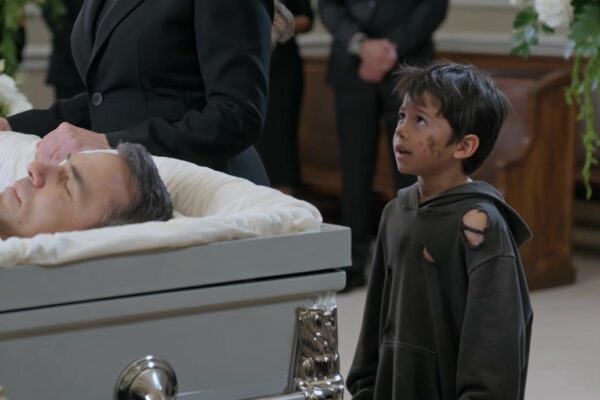
Near the front stood a boy who hadn’t been there a moment before—at least not where anyone had noticed him. He was small enough that umbrellas could swallow him. His clothes hung off him in a wet, frayed way that made his age hard to guess, but he couldn’t have been more than twelve. Mud clung to his shoes in heavy crusts. His hair was dark and plastered to his forehead, and his hands trembled as if the cold had found bone.
What didn’t tremble were his eyes.
Eliza stepped forward, and the motion of her was so abrupt, so sharp, that even the honor guard faltered for half a heartbeat. The bugler’s note wavered and died. The silence that followed didn’t feel empty. It felt armed.
“You should not be here,” Eliza said. Her voice carried without effort, the way a command does when it has been practiced in hallways full of power.
The boy didn’t back away. His shoulders were hunched from cold, but his feet stayed planted in the wet grass, inches from the line of uniformed men who could have removed him with one gesture. His throat moved as he swallowed. “He told me to come,” he said quietly.
Eliza’s gaze dropped to the tags. She stared as though letters could rearrange themselves into something less impossible. Her breath caught—not theatrically, not for anyone else, but because her body betrayed her before her mind could.
She leaned in, just enough to read.
Mercer. D. A. O POS. B POS. The numbers beneath, the ones she had copied onto forms and insurance papers, were Daniel’s numbers. There was no mistaking them.
She looked back at the boy. The cemetery seemed to tilt around them, everyone else becoming peripheral, like blurred faces in a photograph.
“…Where did you get those?” Eliza asked. Her voice had fallen into something smaller, almost a whisper, as if volume might make the truth more real.
The boy glanced at the coffin first. The movement was reverent, practiced by necessity rather than etiquette. Then he lifted his eyes to hers. “He wore them the night he found us.”
A military officer to Eliza’s left—Major Rourke, Daniel’s commanding officer—shifted his jaw. His face tightened the way men’s faces tighten when a plan collapses. He didn’t speak. He didn’t need to. His silence was an admission that this had not been scripted by command.
Eliza took one slow step closer. The wet grass pulled at her heels, trying to keep her rooted. “Found who?” she asked.
The boy’s lip trembled. For a second he looked like he might break, like the weight of all these staring adults might finally crush him. But when he spoke, his words were steady, as if he’d rehearsed them on nights when hunger kept him awake.
“My mom and me.”
The wind moved through the funeral flowers, bending lilies and dark roses. Somewhere a child’s umbrella flipped inside out and was hastily corrected. A murmur rolled through the mourners—small, scandalized, instantly suppressed. Military families know how to swallow questions. They’ve learned it the hard way.
Eliza’s face did something subtle and devastating. The mask did not shatter; it cracked. The controlled widow, the dignified figure in black, let fear show through the seams, a fear that had nothing to do with public embarrassment and everything to do with the shape of the life she thought she’d known.
“I don’t understand,” she said, though her eyes did. Her gaze swept over the boy’s soaked clothes, his too-thin wrists, the way he stood as if he’d already learned you never get to relax. Her mind was chasing something backward—dates, deployments, emergency calls, long silences on the phone, the nights Daniel came home looking like he’d left part of himself somewhere else.
The boy lifted his chin. Raindrops clung to his eyelashes like tiny weights. “Before he died,” he said, “he said I was the son nobody was supposed to know about.”
Eliza stumbled half a step back, and for the first time that day she looked unbalanced. Her black glove slid from her hand and dropped into the grass. It lay there like a fallen bird, helpless and out of place.
For a moment, nobody moved. Even the honor guard, trained to hold position through chaos, looked uncertain about which duty came first.
Eliza’s voice came out thin. “That’s… that’s impossible.” But her eyes were already measuring the boy’s face. The shape of the jaw. The dark set of the brows. The angle of his ears. Things you don’t notice when you don’t need them and can’t stop noticing when you do.
The boy’s hands unclenched and unclenched again. He wasn’t trying to be brave; he was trying not to disappear. “His name was Daniel Mercer,” he said, as if confirming the obvious would force her to accept the rest. “He came to the shelter when the storm hit last winter. Mom was sick. We got turned away because we didn’t have the right papers and there were too many people. He saw us outside under the bridge.”
Eliza’s mouth tightened. She had heard Daniel talk about that winter. He’d been different after it—quieter, restless, as if something had followed him home and lived behind his eyes. He’d started carrying cash he never accounted for. He’d volunteered for extra shifts. He’d said, once, half-asleep, “Nobody should freeze like that.” She had assumed he meant soldiers.
“He gave us his coat,” the boy continued. “He put his gloves on my mom’s hands because hers were purple.” He hesitated, and the hesitation was the rawest thing in him, the part that still felt like a child. “He took us to a clinic and paid. He used a different name at first. But later he came back.”
Major Rourke finally spoke, his voice low and tight. “Son, what is your name?”
The boy looked at the major, then back to Eliza as if she was the only one who mattered in this moment. “Evan,” he said. “Evan Mercer.”
The name hit Eliza harder than the tags. It was an act of claim. A declaration. A dare.
“He told me not to come to the house,” Evan said quickly, as if trying to show he’d obeyed, that he hadn’t wanted to ruin anything. “He said you didn’t deserve a surprise like that. He said he’d do it right. He said after he got back from this last deployment, he’d tell you himself.” Evan’s voice caught at the word deployment. “But he didn’t come back.”
Eliza stared at the coffin. The folded flag seemed suddenly too perfect, too clean for the mess of a man’s life. She had thought she was burying Daniel. Instead, she was meeting a part of him that had been alive in secret.
She knelt, right there in the wet grass, her knees darkening, her lace touching mud. She picked up the fallen glove with fingers that didn’t feel like her own. She didn’t put it back on. She held it like proof that she could still hold anything at all.
“Where is your mother now?” Eliza asked, and the question came out as something between accusation and desperation. She needed an anchor. She needed a villain, or a victim, or a story that made sense.
Evan’s eyes flicked away. “Hospital,” he said. “They said she’s not getting better.”
Eliza’s chest tightened. The cemetery, the uniforms, the ceremonies—none of it had prepared her for this kind of casualty. This was not an enemy you could salute.
She looked up at Major Rourke, and for the first time her control wasn’t a weapon but a plea. “Is this true?” she asked him.
Rourke’s gaze softened by a fraction. “Captain Mercer requested emergency leave three times last winter,” he said quietly. “He said it was for personal matters. He never explained.” He paused, then added, “He was a good man, Mrs. Mercer. Good men… they carry things alone.”
Eliza looked back at Evan. The boy stood rigid, braced for rejection. He was ready to be thrown out. He was ready for security, for police, for scorn. He looked like someone who’d been taught that kindness is temporary.
Eliza rose, slowly, and the motion made the crowd inhale as one. She stepped to the coffin. With a reverence that felt like surrender, she picked up the dog tags and set them beside the folded flag, arranging them so they lay straight, so they wouldn’t slip.
Then she turned to Evan.
She should have been furious. A part of her was. Fury is often just grief with a spine. But as she looked at his soaked sleeves and his stubborn, terrified courage, something else rose up—something Daniel would have recognized, something that felt like duty but warmer.
“You came because he asked you to,” she said, and it was not a question. Her voice was still controlled, but it had changed. It held the tremor of a door being opened.
Evan nodded, once, hard. “Yes, ma’am.”
Eliza exhaled as if she’d been holding her breath for months. She extended her bare hand—un-gloved, unprotected—into the cold air between them. “Then you can stand with me,” she said.
Evan stared at her hand like it was a miracle he didn’t know how to touch. When he finally reached out, his fingers were icy and hesitant, and she closed hers around them firmly.
Behind them, the bugler lifted the instrument again. This time the note did not break. “Taps” began once more, threading through the gray sky, through the wet grass, through the ranks of the living and the dead.
Eliza stood at the coffin with a boy who carried Daniel’s name and Daniel’s eyes. The funeral remained quiet—controlled, dignified—but the quiet had shifted. It no longer meant the absence of disturbance. It meant everyone was listening to the sound of a life being rewritten in real time, one breath at a time, under the watchful rows of white stones.