The invitation called it a “garden luncheon,” as if naming something could keep it gentle.
From the terrace, the event looked like a painting commissioned to flatter everyone in it: linen the color of snow stretched across tables; glasses made small prisms of the sun; laughter traveled in careful, educated bursts. Even the roses seemed arranged by someone paid to keep their thorns out of sight.
At the center table sat Lionel Harrow, the host, the kind of man whose name softened doors before his hand ever touched them. His suit was dark despite the heat, his cufflinks bright as coins, and his smile practiced enough to look like kindness from a distance. Around him, local officials, donors, and a newspaper columnist leaned in as if his words could warm them.
When the boy appeared at the edge of the hedgerow, the illusion broke in a thin, sharp line.
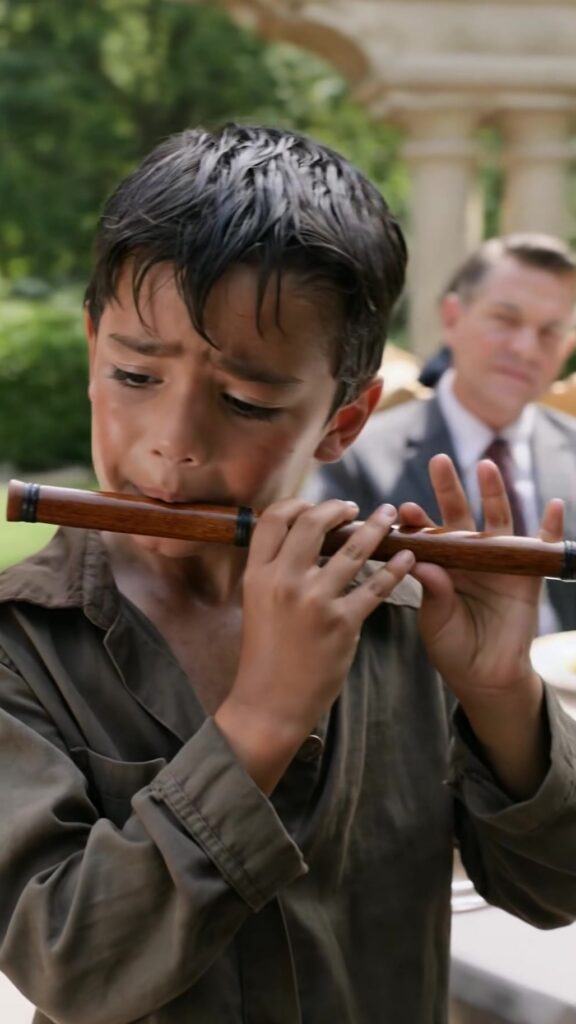
He was small, bones and angles under cloth that had forgotten its purpose. Dirt sat in the seams of his skin. His hair was matted flat as if he had slept against stone. In his hands he held a wooden flute—worn smooth in places by fingers that had nothing else to hold.
Some guests turned their heads away with quick, obedient discomfort. Others watched as if poverty were a street performance they hadn’t paid for. A server stepped forward, then hesitated, taking his cue from Lionel’s face.
Lionel’s eyes narrowed, not in concern but in irritation, the way a man looks at a stain on a shirt he’s wearing to be admired.
“This is private,” he said, loud enough to reclaim the garden. “Remove him.”
The boy did not retreat. He came forward one careful step at a time, as if the gravel under his shoes could swallow him if he moved too quickly. He stopped just short of the white tablecloths and swallowed, his throat working like he was forcing something bitter down.
“Please,” he said. His voice was thin but steady. “I need money. My mother… she’s sick.”
The garden held its breath. A few guests exchanged glances that meant, See? This is why we donate to charities, to keep this away from us.
Lionel leaned back, fingers steepled lightly, savoring the moment as if it were a dish placed in front of him. “Everyone needs something,” he said. “Surprise us, then. Earn it.”
There was a soft ripple of laughter—quick, nervous, relieved to be on the right side of power.
The boy’s hands tightened around the flute. His knuckles whitened. For a heartbeat, it looked as if he might fling the instrument down and run. Instead, he lifted it to his lips with a care that made it look holy.
The first note came out small and unadorned, a thread of sound that shouldn’t have survived in a place this loud with wealth. Then the second. Then a short phrase that felt like someone speaking a name they hadn’t dared to say for years.
The melody was not technically impressive. It didn’t leap or whirl. It simply ached. It made space inside the listeners, the way a sudden memory can hollow you out before you know what you’ve lost.
A woman at the far end of the table lowered her fork. The columnist stopped smiling mid-sentence. Even the breeze seemed to slow, as if unwilling to disturb the line of music.
Lionel’s smirk faltered, a hairline crack in polished stone.
The boy ended after only a few bars, not because the tune was finished but because he had made his point. He lowered the flute. His eyes, too old for his face, stayed on Lionel as if the space between them were a bridge he intended to cross.
Then he reached into his pocket and drew out a photograph, edges soft with age. He held it up with a tremor that did not read as fear but as effort—like lifting something heavy that mattered.
Lionel took the picture without permission, as if ownership were instinct. He glanced at it casually at first, prepared to dismiss it as another plea, another trick.
Color drained from his face so fast it looked like someone had turned a dimmer switch. The hand holding the photo tightened until the paper bowed.
“Where did you get this?” he asked. The words came out raw, stripped of performance.
The boy’s chin lifted a fraction. “My mother kept it,” he said. “She said you would recognize me.”
The guests shifted in their chairs. A few looked down at their plates, suddenly fascinated by the gleam of silverware. The server who had been about to escort the boy away stopped entirely, caught between instruction and instinct.
Lionel stared at the photograph as if it had accused him aloud.
In it, he was younger—no silver at his temples, no weight of influence in his posture. He sat on the edge of a cheap bed, a baby in one arm, a wooden flute in the other hand. His expression in the photo was the most damning thing: unguarded tenderness, the kind that suggested he had once been capable of promises.
“No,” Lionel whispered, though no one had spoken his secret yet. “That’s not—”
“She said you left,” the boy continued, and his voice never rose. It didn’t need to. “Before I learned your song.”
Lionel’s chair scraped back harshly. It toppled, wooden legs catching on stone. He stood too quickly, as if the garden itself had caught fire.
“What is your name?” he demanded, and the demand was only a mask for fear.
“Elias,” the boy said. “But she called me Little Finch when she wanted me to laugh.”
The name hit Lionel like a blow. His throat worked. He looked around at the watching faces—people who had applauded his donations, people who had repeated his talking points, people who would pretend loyalty until the story turned against him.
“Where is she?” he asked. “Your mother.”
Elias hesitated for the first time. His fingers slid along the flute, finding a familiar groove, a place worn by repetition. “In a room that smells like bleach,” he said quietly. “A clinic that said it won’t keep her if we can’t pay.”
“Why come here?” Lionel’s voice cracked. “Why… this?”
Elias’s eyes stayed fixed on him, steady as a judge. “Because she couldn’t stand up,” he said. “And because she still believed you might.”
The garden was silent except for the faint clink of glass as someone’s hand shook. A man at the table cleared his throat, then thought better of it. The roses, bright and indifferent, leaned into the sun.
Lionel looked at the boy’s flute. “That tune,” he said. “Where did you learn it?”
“From her,” Elias answered. “She said you used to play it when you thought no one was listening.”
Lionel’s face tightened. For a moment it seemed he might deny everything, smooth the truth back under money and manners. That was what he had always done—make discomfort disappear, make mistakes vanish, make people forget.
But the photograph was in his hand, real as bone. The flute was there, proof that something had survived him.
He turned, suddenly aware of his audience, and the panic in his expression sharpened into command. “My car,” he snapped to an assistant. “Now. And call my physician.”
The assistant blinked, startled into obedience.
Elias didn’t move. “If you’re doing this,” he said, “don’t do it because they’re watching.” He glanced toward the guests without fear. “Do it because you remember.”
Lionel swallowed. He looked down at the boy—at the dirt under his nails, at the torn sleeves, at the way his shoulders stayed squared as if he had learned that collapsing invited kicking.
“I do remember,” Lionel said, and the admission sounded like it hurt. He held the photo out, but his fingers lingered on the edge before letting go. “And I’m sorry.”
“She doesn’t need sorry,” Elias said. “She needs tomorrow.”
Lionel flinched as if struck again, because it was the kind of sentence no child should have had to invent.
He stepped around the fallen chair, and for the first time he seemed unsure what to do with his own hands. Slowly, he reached out—not to take, but to offer. “Come with me,” he said. “Please.”
Elias looked at the hand. Looked at the garden full of people who had laughed. Looked at the sunlit tablecloths that would be washed clean by evening.
Then he placed the flute under his arm like a promise and took Lionel’s hand with a grip that wasn’t trust yet—only necessity.
As they walked away, the guests began to murmur, the spell breaking into gossip and speculation. The columnist’s pen scratched furiously. A woman lifted her glass and set it down without drinking.
At the edge of the terrace, Elias spoke again, low enough that only Lionel could hear. “She told me,” he said, “that you used to say a song can be a door. That if you play it, someone might finally come home.”
Lionel’s eyes burned. He nodded once, stiffly, as if motion were all he could manage.
Behind them, the garden luncheon remained perfect from a distance, bright and orderly, as though nothing had happened at all.
But Lionel knew—because the boy’s melody still threaded through his chest—that some doors, once opened, never close the same way again.