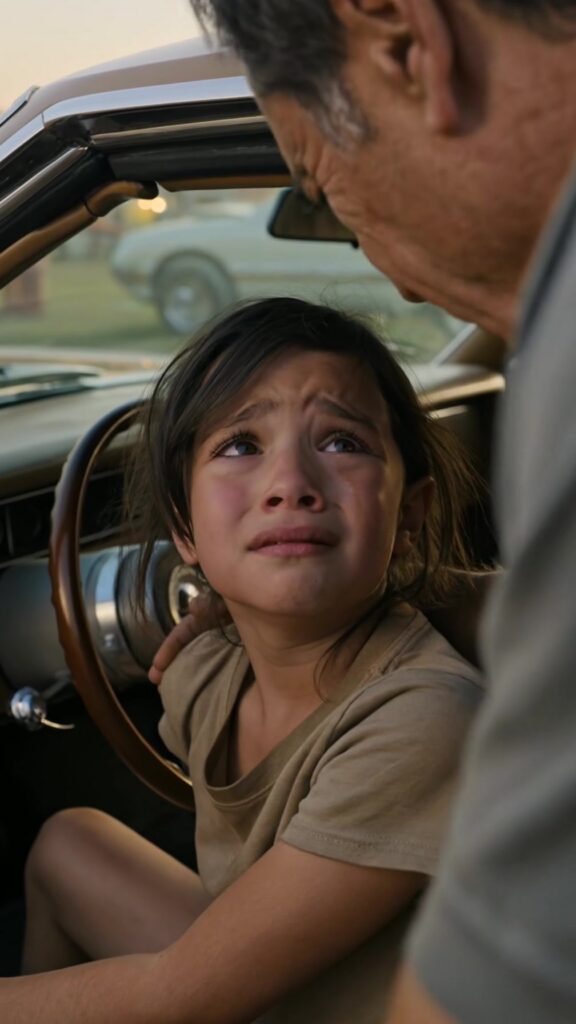
The little girl wasn’t asking to go home because she was tired. She had been begging for one more ride all evening—one more spin of painted horses, one more cone of pink cotton candy, one more chance to win a stuffed bear that was almost as big as her. But now she sat turned sideways in the passenger seat of the old brown sedan as if the vinyl could burn her, as if the whole car were suddenly not a place to rest but a place to hide.
Beyond the windshield, the county fair still glittered with its harmless lies: strings of bulbs like warm pearls, tinny music that stumbled out of broken speakers, the smell of grease and sugar drifting into the night air. The sound of laughter carried across the lot. None of it belonged to the inside of the car, where Ellie’s face was wet and pale and her fist was clenched so tightly the knuckles shone.
“Dad,” she said, voice breaking in a way that made him reach for her before he understood why, “can we go home? Please.”
Tom leaned across the console, the old seat springs squeaking under his weight. He cupped her shoulder, careful, like she was a bird that might shatter. “Hey. We can go whenever you want. What happened?” His eyes darted to the fairground lights and back to her. He expected scraped knees or a fight over funnel cake. He did not expect the look she gave him—like she’d seen something she couldn’t unsee.
Ellie climbed down from the seat, shoes scraping the asphalt, and stood between his knees. She kept her fist pinned to her chest. “I have something,” she whispered. “I found it, and… and I don’t want you to be mad.”
“I’m not mad.” Tom heard his own voice go thin. “Show me.”
She opened her hand.
In her palm lay a paper wristband, narrow and childish, the kind they snapped onto kids so they couldn’t wander out without a stamp of permission. It was pink—too bright, too new—and on the inside someone had written a name in thick black marker. Not Ellie’s. Not anyone Tom recognized. The band was smudged as if it had been dragged across dirt and oil.
Tom stared, unable to make his mind accept what his eyes had already decided mattered. “Where did you get this?”
Ellie’s lip trembled. “Under Mom’s car,” she said. “On the other side. I dropped my glow bracelet and it rolled there. And when I reached, I saw this. It was stuck on something.” She inhaled in a ragged, determined way, the way she did when she tried not to cry in front of strangers. “And, Dad… I heard Mom.”
The name on the band blurred as Tom’s pupils tightened. His hands went cold. “You heard her where?”
“Behind the game booths,” Ellie said. “You were buying tickets, and I was looking at the duck pond. I heard Mom talking to somebody. A man. She was… she was mad at him.” Ellie’s eyes darted toward the fair as though the man might still be standing between the tents. “She said not to let her cry near the rides because people would hear. She said to keep her in the back.”
Tom felt the world tilt, the fairground lights suddenly too bright, too exposed. His wife—Mara—had told him she couldn’t come tonight because she had a late shift at the nursing home. He’d kissed her cheek at the door while she stood in her scrubs, hair still damp from the shower. He’d believed her because believing her was the cheapest kind of peace.
Tom took the wristband gently from Ellie’s palm. The paper was warm from her skin. The name—Kendra—sat there like an accusation. “Did you see Mom?” he asked, and hated himself for needing the answer.
Ellie shook her head quickly. “I saw her jacket,” she whispered. “The blue one with the rip in the sleeve. And I heard her laugh. Only she doesn’t laugh like that with us.”
It was a small sentence, but it landed like a fist. Tom’s mind began to build a map from scraps: the back of the booths, the maintenance lanes between the tents, the dark parts of the fair nobody paid for. He turned his head and looked at the fair as if he were seeing it for the first time—the gaps between the cheerful signs, the trailers parked beyond the last row of lights, the security gate that hung open because no one thought anyone would use it.
He swallowed. “Ellie, you did the right thing,” he said. “You’re not in trouble. Not for anything.” He forced his voice steady, forced his hands to work. He unbuckled her seatbelt again—she’d already slipped out, but he needed something to do—and then he locked the doors with a click that felt far too small. “Stay in the car. Don’t open it for anybody. Not even if you think you see me. Understand?”
Ellie’s eyes widened. “Dad, don’t go back.”
Tom leaned in until his forehead touched hers for one second, a vow without words. “I’m going to get help,” he lied, because he didn’t know if there was time to wait for help. His phone was in his pocket, but his hands shook too hard to dial. He stepped out into the night air and the smell of caramelized sugar turned sour in his throat.
He moved fast, keeping to the edges where the shadows pooled. He passed a ring-toss booth, a line of teenagers laughing, a mother holding a toddler on her hip. He wanted to shout, to tell them all to leave, to run, to stop pretending the world was safe because it had music. But fear is private. It convinces you that if you speak, you will be the one everyone stares at.
Behind the booths, the fair changed. The lights thinned. The music became a distant heartbeat. He found a corridor of mud and crushed paper cups, and beyond it a row of utility trailers. One door stood cracked, a sliver of yellow light spilling out onto the ground like a warning. Tom’s stomach twisted as he approached.
He heard a muffled sob, quickly smothered. Then a woman’s voice—sharp, urgent. Not tired. Not kind. “If she makes noise again, tape her mouth. Do you want attention?”
It was Mara.
Tom’s knees threatened to fold. For a moment he was floating above himself, watching a stranger walk up to a trailer and place his hand on the metal. He could feel vibration on the other side—movement, a shuffle, a child’s frightened breath.
He pulled his phone out and hit emergency call before he could talk himself out of it. The dial tone sounded obscene against the muffled sobbing. The operator answered, and Tom whispered, “County fairgrounds. Behind the booths. Utility trailers. I think—” His voice broke. “I think there’s a child in there. My wife is here. She shouldn’t be.”
Inside the trailer, someone moved closer to the door. A male voice, low and annoyed. “Who’s out there?”
Tom didn’t answer. He stepped back, heart hammering so hard it made his teeth ache. He could run—back to Ellie, to the car, to the illusion of safety. He could drive away and pretend this belonged to somebody else’s life. But Ellie’s small fist and red-marked palm flashed in his mind, and with it the unbearable fact that his daughter had been braver than him.
He planted his feet. “Open the door,” he said, loud enough for the operator to hear through the phone, loud enough for the night to carry. “I called the police.”
There was a crash inside, a chair scraping. The door jerked wider, and in the slice of light he saw Mara’s face—her eyes wide, her mouth open as if she’d swallowed something burning. For a single second she looked not like a villain but like a person cornered by the truth. Then her gaze flicked past him toward the fair’s glow, calculating distance, calculating exits.
“Tom,” she said, as if she could still use his name like a key. “This isn’t—”
From behind her, a small hand appeared, fingers curling around the edge of a blanket. A child’s eyes blinked in the light—red-rimmed, terrified, pleading without words.
Tom’s voice turned to steel. “That wristband,” he said, holding the pink strip up. “My daughter found it. Under your car.” His throat tightened around each word. “You brought her here.”
Sirens began to rise in the distance, faint at first, then sharpening, like the world waking up.
Mara’s face crumpled—not with remorse, not fully, but with the dawning understanding that the story she’d been telling herself was ending. The man behind her cursed, and the child flinched. Tom stepped forward into the light, phone still at his ear, and reached for the little hand. It was small and shaking and very real.
“It’s okay,” he told the child, though he didn’t know if okay was a thing that existed anymore. “You’re coming out. You’re not staying back here.”
And somewhere, across a parking lot flooded with cheerful bulbs, his own daughter waited behind locked doors—safe, for the moment—because she had asked to go home not from fatigue, but from instinct. Because she had found what should never have been there, and she had refused to let it stay hidden under anyone’s car.