The restaurant was glowing with wealth, the kind that didn’t merely sit on wrists and necks but hovered in the air like perfume—expensive, suffocating, unforgettable. Crystal chandeliers scattered light across white cloths so pristine they looked newly fallen. A quartet in the corner coaxed soft notes from strings, music meant to flatter conversation rather than compete with it. The guests, dressed in midnight shades and polished smiles, laughed into their flutes of champagne as if laughter itself could be purchased by the bottle.
Lina moved through them with the practiced invisibility of someone who was paid to be unseen. She balanced a tray of coupe glasses, her fingers steady though her shoes pinched and her back ached. She had worked three jobs in her life and learned the same lesson at each one: the rich rarely looked at you unless you were late. Tonight, however, someone was looking. Lina could feel it—like a draft along her neck—before she ever heard the chair scrape.
A woman rose so quickly her napkin fluttered to the floor. She was radiant in a dark green dress that fit like a verdict, her hair pinned perfectly, her mouth painted a crimson that seemed almost violent in candlelight. The room recognized her before Lina did. Conversations thinned. The quartet’s bow hesitated.
“You,” the woman said, not loudly at first, but with a sharpness that sliced through the room. She crossed the distance in three steps and seized Lina by the arm, nails digging through linen sleeve into skin. “You’ve been circling my husband for weeks, haven’t you?”
The tray tilted. Lina tightened her grip, struggling to keep the glasses from sliding. Her eyes searched for a manager, for any lifeline, but the staff had become statues at the perimeter. “Ma’am—” she began.
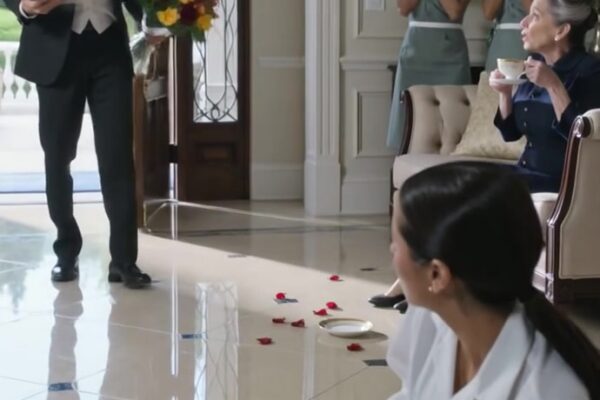
The slap arrived before her second breath. It snapped her head sideways with such force that the tray lurched free. Glasses fell, champagne arced, and then the floor erupted in shattering sound. The violinist’s note died mid-vibrato. People gasped, then lifted their phones with the reflex of those who never miss a spectacle.
Lina staggered, her palm pressed to her burning cheek. Tears sprang up instantly—less from pain than from the humiliation that had always waited for her somewhere, like a dog behind a gate. “I never spoke to him,” she managed, her voice thin. “I— I don’t know—”
“Then explain this.” The woman shook a folded paper in the air like a flag of conquest. “Explain this love letter.”
A murmur passed through the tables. Heads leaned. The phones adjusted angle. Lina’s throat tightened. For a moment she wondered if someone had slipped her name into a joke, if this was a prank that had escaped its boundaries.
A man stood at the woman’s table—tall, immaculately dressed, the kind of face that belonged in framed photographs above a mantel. He looked as if he wished he could dissolve into the cream-colored wall. “Marianne,” he said, voice strained, “stop.”
“Stop?” Marianne turned, eyes glittering. “You recognize her, don’t you? You’ve been looking at her all night.”
“I was looking because you were staring,” he said, but it landed weakly.
Marianne thrust the note toward him. “Read it.”
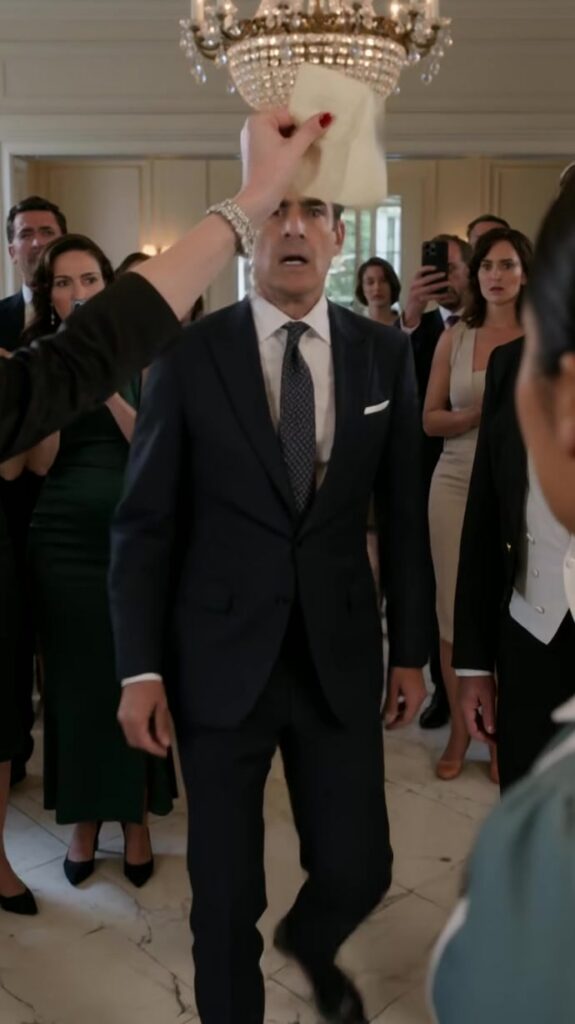
He snatched it, unfolded it with careless irritation, and began to scan. His expression shifted so abruptly the room felt it. The color drained from his face as if pulled out by an unseen hand. The paper trembled between his fingers.
“This…” he whispered, as if the word hurt. His eyes lifted—past his wife, past the guests, and landed on Lina’s face with a stare that did not belong to a stranger. “This is my mother’s handwriting.”
The restaurant’s wealth, its music and light and laughter, seemed to recede, leaving behind a cavern of silence. Marianne blinked, stunned into momentary stillness. “What are you talking about?”
The man—Elliot, someone whispered at a nearby table, Elliot Varron—lowered the note as if it were suddenly too heavy. “This isn’t—” His voice cracked and he swallowed. “This isn’t a love letter.”
From the edge of the dining room, an elderly waiter took a step forward. He had been polishing the same wineglass for several minutes, hands moving out of habit. Now he stopped entirely. His eyes fixed on Lina with a strange, frightened tenderness, like someone looking at a ghost they had once known as a baby.
“No,” the waiter breathed. “No… it can’t be.” His voice carried despite its softness, because the room was listening now. “She looks like—”
“Like who?” Marianne demanded, but her fury had shifted; it had found something colder to cling to.
The waiter’s lips trembled. “Like the child.” He looked at Elliot, and his old posture seemed to shrink under the weight of memory. “The baby she paid to have taken away.”
A low sound went through the crowd, somewhere between disbelief and hunger. Phones rose higher. Someone whispered, “Is this real?” Another whispered, “Don’t stop filming.”
Elliot’s jaw tightened. “You— you’re Arthur,” he said slowly, as if naming the waiter unlocked a door that had been sealed for decades. “You worked here when my mother—”
Arthur nodded once, his eyes wet. “I was the one who carried the breakfast tray to the private room,” he said. “The next morning. Your mother had been awake all night. She looked… empty. Like a lamp with no oil.” He swallowed. “She burned a little ribbon in an ashtray. Pink. It had a name stitched into it, but I couldn’t read it in time.”
Lina’s breath snagged. The world narrowed until she could only hear the scrape of Arthur’s voice and the pounding in her own ears. “Why are you telling me this?” she whispered. “I— I don’t know any of you.”
Elliot stared at her as if she were the edge of a cliff he had been walking toward his entire life without seeing. He looked down at the note again, and his hand moved to the bottom, where a signature curled in familiar elegance. His mother’s name—Evelyn Varron—written with the confident flourish of a woman who believed the world could be rearranged to suit her.
Marianne took a step backward. Her eyes darted between Elliot and Lina. “Elliot,” she said, the syllables suddenly fragile. “This is absurd. Your mother would never—”
Arthur’s voice cut in, quiet but final. “Your mother did,” he said to Elliot. “I didn’t understand then. I was young, and I needed the job. She handed an envelope to a private nurse, right there near the kitchen door, and told her to leave through the alley. She said the child had died. She said there had been complications and that no one must speak of it.” He inhaled shakily. “She said the father must never know.”
Elliot’s eyes closed for a moment as if he were trying to stop the past from entering him. When he opened them, they were glassy. “My father grieved,” he said, voice barely louder than the candle flames. “He grieved for a son we were told didn’t make it. He kept a tiny pair of booties in his desk drawer until the day he died.”
Lina swayed. The room seemed to tip with her. She clutched the edge of a table to steady herself, feeling the expensive linen beneath her fingers, feeling how quickly it could be stained.
“Lina,” a manager hissed from somewhere behind her, but Lina could not turn. Her name sounded distant, like it belonged to someone else.
Marianne’s face hardened again, searching for a target she could understand. “So what is this?” she snapped, gesturing at Lina. “Some scheme? Someone trying to take—”
“Stop,” Elliot said, louder now, and the word silenced even Marianne. He looked at Lina with an expression that was terror disguised as composure. “Where did you get this note?”
Lina’s fingers slipped into the pocket of her apron, not because she intended to hide anything, but because her body moved on instinct toward the only anchor she had brought with her tonight. She pulled out a creased envelope, worn at the edges from years of being unfolded and refolded. “My foster mother gave it to me,” she said. Her voice was steadier than she expected, as if the truth had its own spine. “The day she died. She told me she’d been paid once to keep me quiet. She said she’d been ashamed for forty years and didn’t want to die with it.”
The crowd leaned in as one creature. Even the quartet had stopped, bows lowered. The wealth of the room—its glitter and perfume—felt suddenly like a set built around a confession.
Lina lifted her eyes to Elliot’s. “She told me to find the man whose family erased me,” she said, and the words seemed to rearrange the air. “She said he would either slam the door in my face… or finally tell me who I am.”
Elliot’s throat moved, working around something too large to swallow. He looked at her cheek, still red from Marianne’s hand, and something broke in his expression. Not pity. Not shame. Something more frightening: recognition.
Arthur stepped forward, close enough now that Lina could see the fine tremors in his hands. “There was a mark,” he said softly, to Lina this time. “On the baby’s wrist. A small crescent birthmark, like a pale moon.” His eyes flicked down. “Do you have it?”
Lina stared at him, pulse crashing. Slowly, as if her arm belonged to someone else, she pushed her sleeve back. The dining room seemed to hold its breath. There, on the inside of her wrist, was the crescent—faint, familiar, something she had looked at her whole life without knowing it was evidence.
Arthur made a sound like grief finding its way out. Elliot’s hand went to his mouth, and for a second he looked like a child who had been told the world was not what he thought.
Marianne’s eyes widened, then narrowed again as panic sharpened her. “Elliot,” she said, voice shaking, “if this is true—”
“If this is true,” Elliot echoed, and his gaze never left Lina, “then my entire life has been built on a lie.”
The chandeliers kept glittering. The candles kept burning. Outside the tall windows, the city moved on, indifferent. Inside, wealth had nowhere to hide. Elliot unfolded the note again, but this time he read it as a sentence of history instead of scandal. His mother’s instructions were clear enough to make his hands tremble, and at the bottom, the nurse’s name—an unfamiliar signature—sat like a co-conspirator.
He looked up. “Come with me,” he said to Lina, voice hoarse. “Not— not to a table. Not to be stared at.” He glanced at the phones, and his jaw tightened. “To my office. Somewhere quiet.”
Lina hesitated. Every part of her wanted to run—out into the street, into anonymity, back into the safety of being nobody. But another part, older and hungrier, had waited her whole life for a door to open.
She nodded once.
As Elliot guided her away, Marianne remained frozen beside the shattered glass, her perfect world cracking around her feet. Arthur stood with his hands clasped as if in prayer, watching them go. The guests murmured, already shaping the story into entertainment, but beneath their whispers something heavier moved—an invisible inheritance passing through the room.
The restaurant was still glowing with wealth. Yet now, in the wake of broken glass and burned ribbons and a crescent mark on a wrist, the glow looked less like gold and more like a fire—beautiful, dangerous, and impossible to ignore.