Quiet Your Racing Mind: A Simple Nighttime Technique for Better Sleep
If your thoughts start sprinting the second your head touches the pillow—reliving conversations, planning tomorrow, or worrying about everything that could go wrong—you’re not alone. Feeling exhausted yet unable to switch off is incredibly common.
The good news: you don’t need pills, pricey supplements, or complicated meditation apps to change this. There is a simple, science-based technique you can use tonight that works with your body’s own physiology. In just a few minutes, you can gently move your nervous system out of “high alert” and into a state where sleep can finally unfold naturally.
This approach, inspired by the work of Dr. Mandell, combines specific breathing with targeted muscle relaxation to calm both your mind and body.
Key Takeaways
-
Core Principle:
This method centers on breathing out for longer than you breathe in, which stimulates the vagus nerve and activates your body’s parasympathetic “rest and digest” response. -
Two-Way Calm:
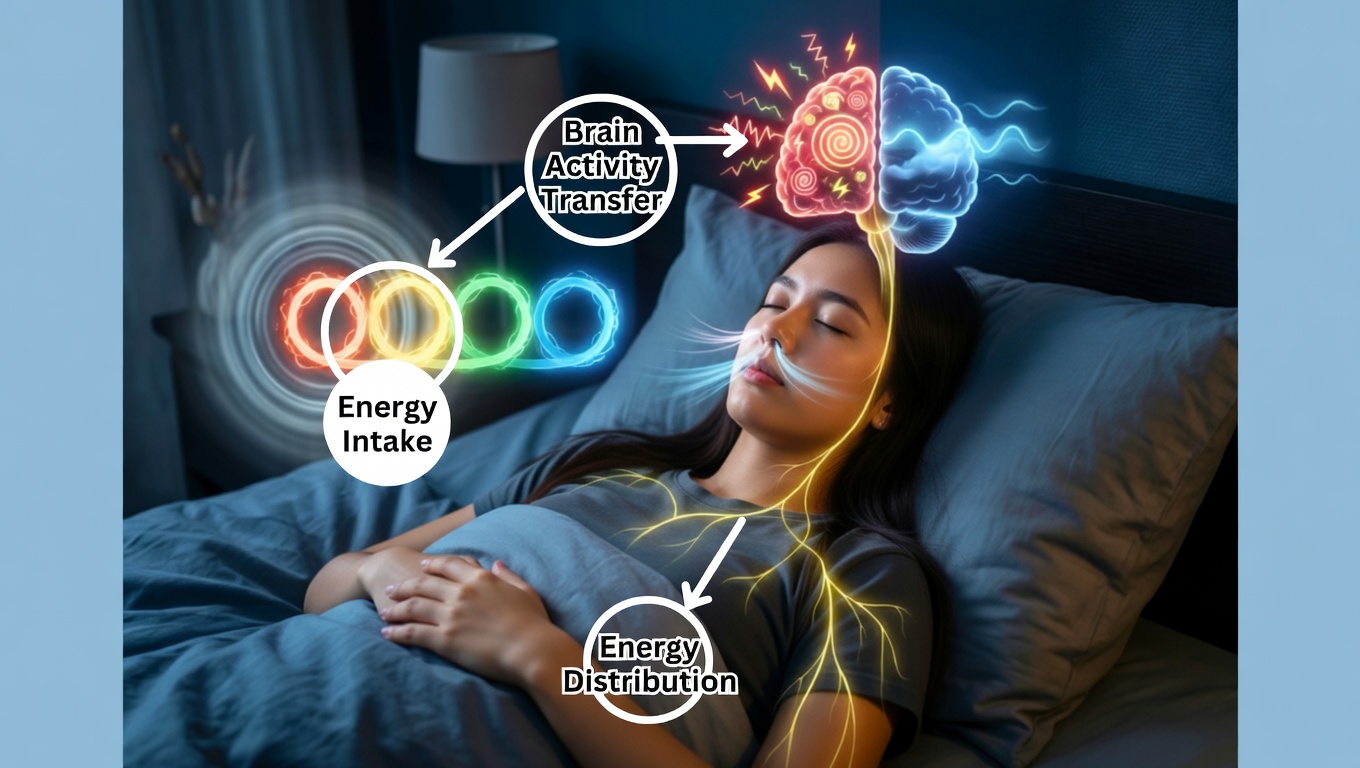
It blends controlled breathing with progressive muscle relaxation, sending calming signals from the brain downward (through conscious breath control) and from the body upward (through relaxed muscles) to reduce wakefulness. -
Real Physiology, Not Placebo:
The relaxation you feel stems from measurable changes: a slower heart rate, lower blood pressure, improved heart rate variability (HRV), and better blood flow to key brain regions. -
Creating a Sense of Safety for Sleep:
Sleep can’t be forced. It emerges when your nervous system feels safe. This technique sends a clear message to your brain: “There is no danger. It’s okay to let go.”
1. Master the Breath: How to Activate the Vagus Nerve
The foundation of this sleep technique is a specific breathing pattern that deliberately calms your nervous system.
You will:
- Inhale slowly and deeply through your nose.
- Exhale even more slowly through your mouth.
The key is the extended exhale.
When your exhalation is noticeably longer than your inhalation, you directly stimulate the vagus nerve—a major communication highway of the parasympathetic nervous system, which is responsible for rest, recovery, and digestion.
Your sympathetic nervous system is the opposite—it drives the “fight or flight” stress response that keeps you alert, wired, and unable to sleep. When you’re anxious or overthinking, this system is in overdrive.
To drift into sleep, you need to flip that switch and let the parasympathetic system take over.
The long, slow exhale:
- Sends a signal along the vagus nerve to your brain.
- Your brain then communicates with the sinoatrial (SA) node—your heart’s natural pacemaker.
- The SA node slows down its firing, which reduces your heart rate.
- As your heart rate drops, your entire system begins to settle.
- This improves heart rate variability (HRV), a marker of a flexible, resilient, and relaxed nervous system.
In other words, by controlling your breath—especially your exhale—you are using a built-in switch to calm your body quickly and naturally.
2. Systematic Shutdown: Progressive Limb Relaxation
Breath alone is powerful, but pairing it with progressive muscle relaxation creates a potent two-step shutdown of your alertness systems.
Here’s the general idea:
- With each long exhale, you focus on relaxing one limb at a time in this order:
- Right arm
- Left arm
- Right leg
- Left leg
Why this works so well:
- When you consciously tell a muscle to relax, you reduce the electrical activity (alpha motor neuron firing) that your brain sends to that muscle.
- As the muscle relaxes, it sends fewer proprioceptive signals (body-position and tension feedback) back up to your brain.
- These signals normally travel to a region in your brainstem called the Reticular Activating System (RAS).
- The RAS acts like your brain’s alertness control center—it helps determine how awake and vigilant you feel.
By progressively relaxing your major limbs, you:
- Cut down the amount of sensory input flowing into the RAS.
- Give your brain less “noise” and fewer alerts to process.
- Encourage the RAS to power down, leading to reduced overall cortical arousal and mental chatter.
This is a bottom-up calming process—from muscles to brain—that perfectly complements the top-down calm created by your breathing.
You are essentially sending your brain a clear message:
“Everything is quiet and safe. No threats. It’s okay to stand down.”
3. Inside the Calm: What Happens in Your Body
As you breathe and relax your limbs, your body goes through a very real, measurable shift. This is not just “feeling a bit calmer”—it is a full physiological cascade.
Here’s what’s happening internally:
-
Stress hormones decrease:
Activating the parasympathetic nervous system helps lower levels of cortisol and adrenaline, two key hormones that keep your mind racing and your body on edge at night. -
CO₂ gently rises and blood flow improves:
Prolonged exhalations through your mouth cause a slight, temporary increase in carbon dioxide (CO₂) in your blood.
This triggers cerebral vasodilation—the widening of blood vessels in your brain—allowing more oxygen-rich blood to flow to your brainstem and forebrain. -
You feel heavier and more settled:
The improved circulation to the brain is partly responsible for that familiar heavy, drowsy feeling just before sleep. -
Warmth and heaviness in your limbs:
As your nervous system shifts out of stress mode, peripheral vasodilation occurs. Blood vessels in your arms and legs widen, increasing blood flow and creating a sense of warmth and weight.
These sensations—heavy limbs, warmth, slowed breathing, dropping heart rate—are proof that your body is leaving the stress response behind and transitioning into deep rest, the ideal state for sleep to naturally arise.
4. Your 4-Round Bedtime Routine: Step-by-Step
Here’s how to put everything together into a quick nighttime routine you can use in bed.
You’ll go through four rounds of breathing, each one focused on a different limb.
Preparation
- Lie down comfortably in bed (or sit back in a chair if you prefer).
- Place one hand on your belly so you can feel it gently rise on the inhale and fall on the exhale.
- Let your jaw loosen and your shoulders drop away from your ears.
Round 1 – Right Arm
- Inhale slowly and deeply through your nose, as comfortably as you can.
- Let your belly expand.
- Aim for about 10–15 seconds if that feels natural (shorter is fine if needed).
- Exhale as slowly as possible through your mouth, stretching it out for 10–15 seconds or longer.
- During the exhale, focus your entire attention on your right shoulder and right arm.
- Feel the muscles soften.
- Imagine tension melting down your arm and out through your fingertips.
- Let the arm become heavy, loose, and completely limp.
Round 2 – Left Arm
- Take another deep, unhurried breath in through your nose.
- As you begin the long, controlled exhale through your mouth, shift all of your awareness to your left shoulder and left arm.
- Silently instruct the arm to release and let go.
- Notice if your jaw slackens or your tongue drops from the roof of your mouth—both are strong signs that your sympathetic (stress) drive is dialing down.
Round 3 – Right Leg
- Inhale fully through your nose, filling your lungs from belly to chest.
- On the extended exhale, direct your focus to your right leg.
- Soften the big muscles in your thigh.
- Release any tightness around your knee.
- Let your calf, ankle, and foot grow warm, heavy, and relaxed.
Round 4 – Left Leg
- Take one more slow, deep nasal breath in.
- As you exhale gently and completely through your mouth, bring all of your attention to your left leg.
- Relax the hip and thigh.
- Let go of any tension in the knee.
- Allow your calf, ankle, and foot to sink into the bed, heavy and at ease.
When you finish the four rounds, simply return to a natural, easy breathing pattern. Notice how your body feels heavier, your mind quieter, and your overall state more peaceful.
If you’re still awake, you can:
- Repeat the cycle again, or
- Just rest in the sensation of warmth, weight, and calm, trusting that sleep will come as your nervous system continues to feel safe and settled.
You’re not forcing sleep—you’re creating the conditions in which sleep naturally and reliably appears.