Decline Push-Up: A Powerful Exercise for Upper Chest Strength
The push-up is one of the most effective bodyweight exercises for building chest size and upper-body strength.
Because it uses only your body weight, it is simple, accessible, and highly effective.
It is also one of the best movements for improving core stability while helping develop a stronger, fuller chest.
When the goal is to emphasize the upper chest, especially the pectoralis major, one of the best variations to use is the decline push-up.
In this version, the movement is performed like a standard push-up, but with your feet elevated on a raised surface. This creates a downward body angle and increases the challenge.
The decline push-up is considered a more advanced form of the regular push-up.
It does more than train the chest. This variation also places significant demand on the front of the shoulders.
Because of the decline angle, your shoulders, upper chest, and lats must handle more resistance while working with less overall stability.
That increased demand makes the target muscles work harder.
Like other push-up variations, decline push-ups also train the triceps and deltoids.
They also activate the abs and core, while involving the glutes, quads, and several stabilizing muscles in the back.
What Muscles Do Decline Push-Ups Work?
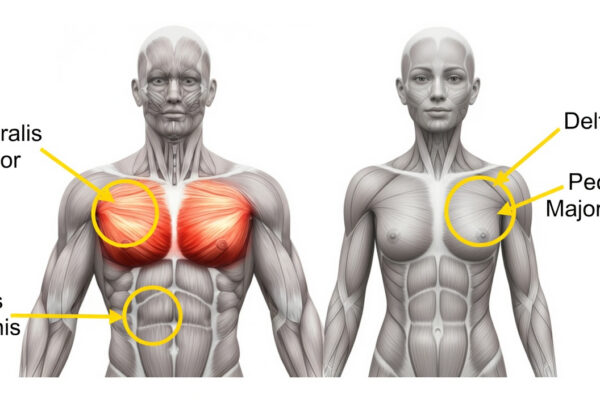
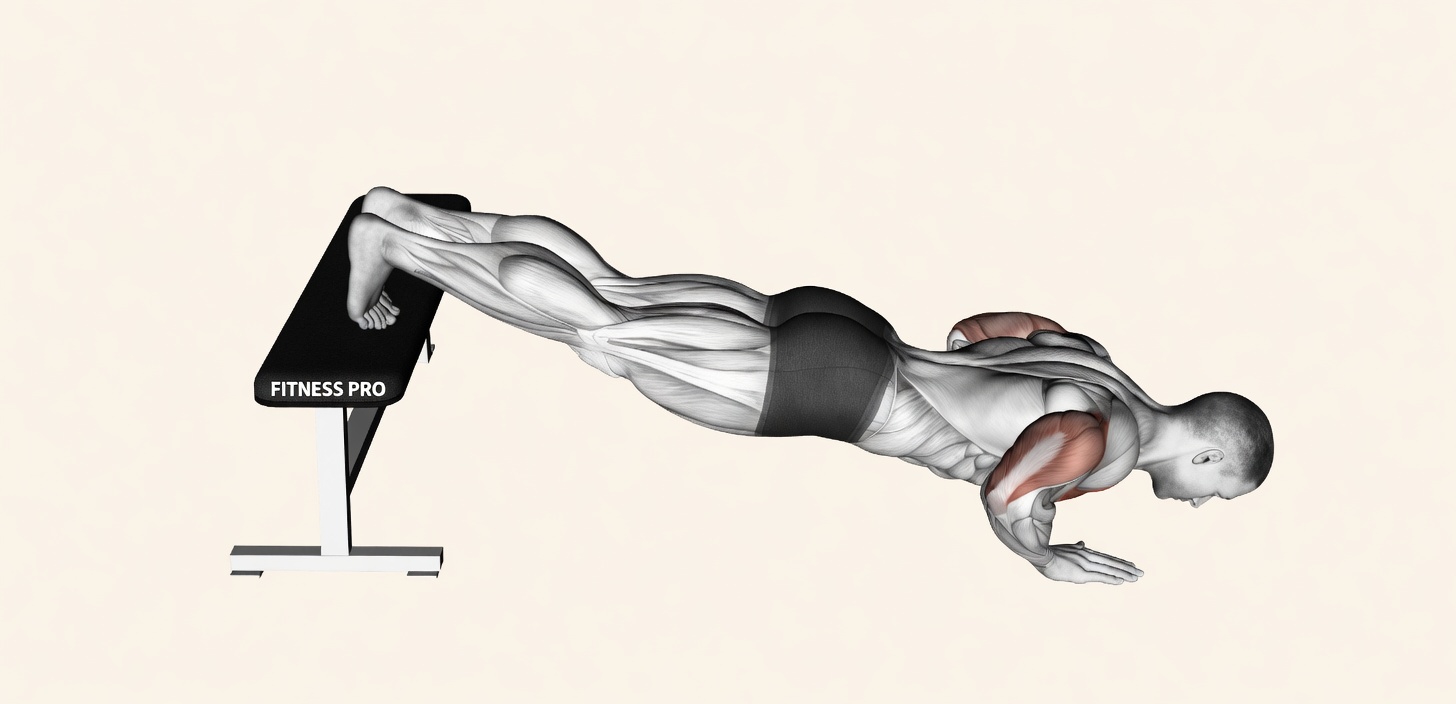
The main muscles trained during decline push-ups are the chest, shoulders, and triceps.
This exercise also recruits the serratus anterior, upper-back stabilizers, abs, glutes, and quads.
Primary Muscles Worked
- Pectoral muscles (chest)
- Anterior and medial deltoids (shoulders)
- Triceps brachii (back of the arms)
Secondary Muscles Worked
- Serratus anterior (below the armpit area)
- Abdominals (core)
- Glutes
- Quads
- Upper-back stabilizing muscles
How to Do a Decline Push-Up
To perform decline push-ups, you need a stable elevated surface such as a bench, box, chair, or step.
The higher your feet are placed, the harder the exercise becomes. If you are just starting out, use a lower surface such as a small step or curb. As your strength improves, you can gradually increase the height.
For safety, always make sure the object supporting your feet is solid and secure.
Step-by-Step Instructions
- Place the bench or raised surface behind you.
- Face away from it and kneel down.
- Put your hands on the floor and rest your feet on top of the bench.
- Set your feet about hip-width apart.
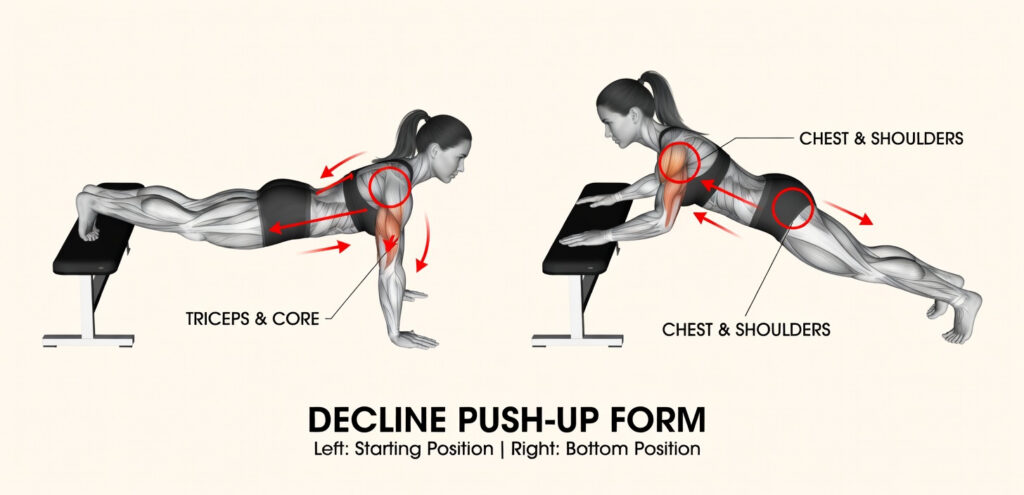
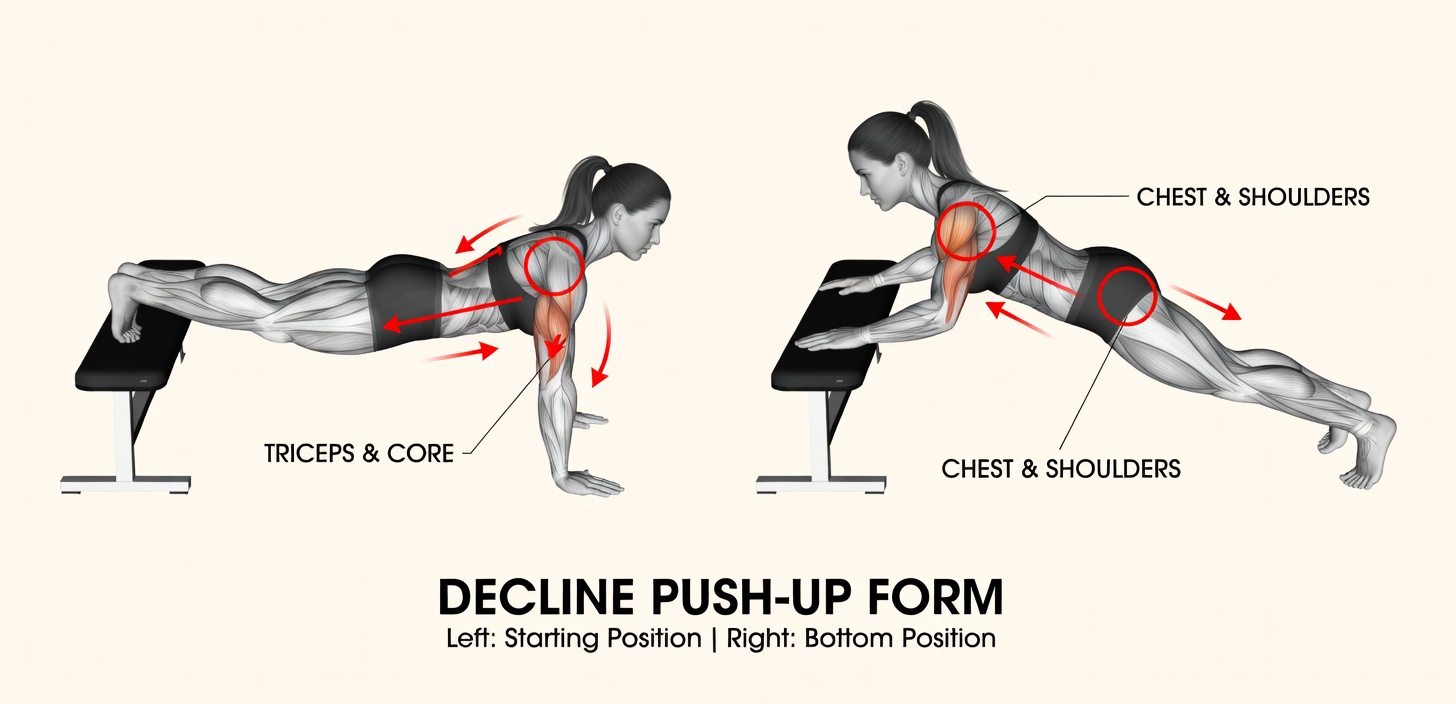
- Move into the starting position with your shoulders stacked over your wrists and your elbows angled at about 45 degrees.
- Tighten your core, glutes, and quads.
- Lower your chest toward the floor by bending your elbows while keeping your back and neck in a straight line.
- Pause briefly at the bottom.
- Press through your hands to return to the high-plank starting position.
Recommended Sets and Reps
- Perform 2 to 4 sets
- Aim for 15 to 20 repetitions
If you feel pain in your wrists, elbows, or shoulders, stop the exercise immediately.
Benefits of Decline Push-Ups
The biggest advantage of decline push-ups is their ability to build a stronger and more developed upper chest.
Because your feet are elevated, your upper pecs and shoulders take on more of the load and work harder against gravity.
This helps you place greater emphasis on the upper body while still keeping the core, legs, and back engaged.
When performed with correct technique, decline push-ups can improve both strength and full-body stability.
They are especially useful for people who want to strengthen the stabilizing muscles around the shoulders.
The Bottom Line
The decline push-up is an advanced progression of the classic floor push-up.
By elevating the feet, you create a decline angle that increases resistance and makes the exercise more demanding.
Since it is a more challenging movement, it is important to first master the standard push-up before adding this variation to your training.
If you are new to decline push-ups, begin with a lower bench or platform so there is less stress on the upper chest and shoulders.
If you are recovering from a shoulder injury, this exercise may not be appropriate or safe. In that case, consult a qualified fitness or medical professional before attempting this advanced push-up variation.