Lower Abs Not Looking Defined? Here’s How to Train Them Effectively
Many people work out consistently and eat a balanced diet, yet still feel their lower abs need more strength and definition. Sit-ups are a common go-to, but they are far from the only choice if your goal is to build a stronger, more sculpted core.
Training this area with the right movements can help improve strength and make everyday activities easier. Adding core exercises like planks, crunches, scissor kicks, and butterfly kicks can support better overall performance. According to a 2019 study, a strong core may also improve posture, help prevent injuries, and reduce back pain.
Why Lower Abs Can Be Hard to Target
A lot of people talk about “upper abs” and “lower abs” as if they are completely separate muscles. In reality, they are part of the same abdominal muscle group, though trainers often divide them this way to make teaching easier.
Your abdominal area includes three main muscle layers along the front and sides of the body:
- External oblique
- Internal oblique
- Transverse abdominis
These work together with the rectus abdominis, which runs along the front of the abdomen. Because all of these muscles work together, exercises that emphasize lifting the legs, stabilizing the trunk, or controlling rotation can help place more focus on the lower part of the core.
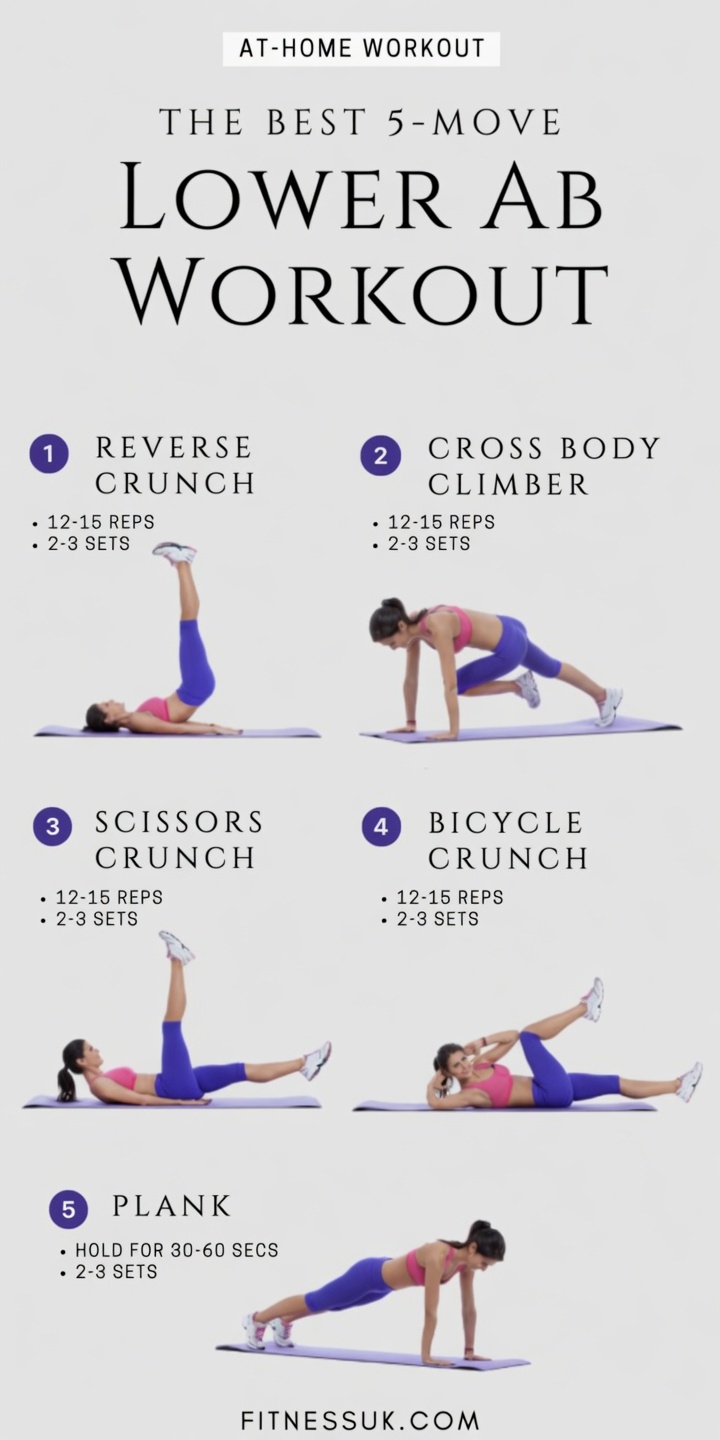
The Solution: A 5-Move Lower Ab Workout
If you want to build lower ab strength, choose exercises that challenge the core through slow, controlled movement. Focus on drawing your navel toward your spine and bracing your midsection during every rep to better engage the lower abs and reduce injury risk.
1. Reverse Crunch
This move places emphasis on the area below the belly button by lifting the legs rather than the upper body. It is done from a boat pose or hollow hold position and deeply activates the transverse abdominis.
How to do it:
- Lie on your back on a mat with your knees bent and feet flat on the floor.
- Keep your arms by your sides.
- Lift your feet off the floor so your knees form a 90-degree angle.
- Tighten your core and curl your lower back, lifting your tailbone and buttocks off the ground.
- Keep your shoulder blades on the floor and avoid swinging with momentum.
- Pause briefly at the top.
- Lower back down slowly.
Reps:
- Aim for 12–15 reps
Trainer tip:
- Move slowly to increase core engagement.
Variation:
- Add resistance by holding a medicine ball between your knees or a Swiss ball between your ankles.
2. Cross Body Climber
This high-intensity exercise works the abs while also burning calories. By adding a twist to the standard mountain climber, it places extra emphasis on the obliques.
How to do it:
- Start in a high plank with straight arms, hands shoulder-width apart, and legs extended.
- Keep your body in a straight line from shoulders to ankles.
- Do not let your hips drop or sag.
- Brace your core and lift one foot from the floor.
- Drive that knee toward the opposite shoulder.
- Return to the start and switch sides.
- Continue alternating sides with control.
Reps:
- Perform 12–15 reps per side
Trainer tip:
- If mountain climbers feel uncomfortable, try the dead bug instead.
3. Scissors Crunch
This exercise is a dynamic core movement that also strengthens the back. It targets the lower abs while involving the external obliques and the legs.
How to do it:
- Lie on your back with your legs straight and feet together.
- Place your hands at your sides.
- Raise one leg toward the ceiling while keeping the other slightly above the floor.
- Lift your upper torso into a small crunch.
- Alternate your legs in a scissor motion.
- Keep your back flat and your core engaged throughout.
Reps:
- Do 12–14 reps per side
4. Bicycle Crunch
The bicycle crunch is a classic core exercise that targets the lower portion of the abs and activates the external obliques.
How to do it:
- Lie flat on your back with your knees bent and feet on the floor.
- Place your hands behind your head.
- Lift your shoulders and legs off the floor.
- Bring one knee toward the opposite elbow.
- Rotate your torso so the opposite elbow moves toward that knee.
- Switch sides in a pedaling motion.
- Keep each rep controlled and core-focused.
Reps:
- Complete 12–15 reps per side
5. Plank
The plank is an isometric move that works the full core, including the lower abs. It also helps build stability and control.
How to do it:
- Begin in a forearm plank with your elbows shoulder-width apart.
- Extend your legs behind you.
- Form a straight line from shoulders to ankles.
- Engage your core and glutes.
- Hold the position while breathing steadily.
- Keep your hips level and avoid arching or sagging your back.
Time:
- Hold for 30–60 seconds
Variation:
- You can also try side planks or high-to-low planks for a greater challenge.
Bonus Move: Straight Leg Raise
If you want an added challenge, straight leg raises can intensely work the entire core, especially the lower abs.
How to do it:
- Lie on your back with your legs extended.
- Place your hands under your hips for support.
- Raise both legs toward the ceiling while keeping them straight.
- Squeeze your glutes as you lift.
- Lower the legs slowly with control.
- Keep your core engaged to reduce strain on the back.
Reps:
- Perform 10–12 reps per set
Important note:
- Skip this exercise if you have lower back pain and choose an alternative such as the dead bug.
Lower Ab Training Tips
To better activate your lower abs during these exercises:
- Pull your navel toward your spine
- Brace your core during each movement
- Use slow, controlled reps instead of momentum
- Keep proper form throughout the workout
You May Also Like
- Best Ab Workouts For Men
- The Best Exercises to Lose Belly Fat for Men
- The Best and Worst Ab Workouts for Six-Pack Abs
Final Takeaway
If your lower abs feel like a weak point, you are not alone. This area can be challenging, but targeted exercises can help improve strength and definition. Sit-ups are only one option. Moves like reverse crunches, cross body climbers, scissors crunches, bicycle crunches, planks, and straight leg raises can all help you train your core more effectively.
Consult a healthcare professional before making changes.