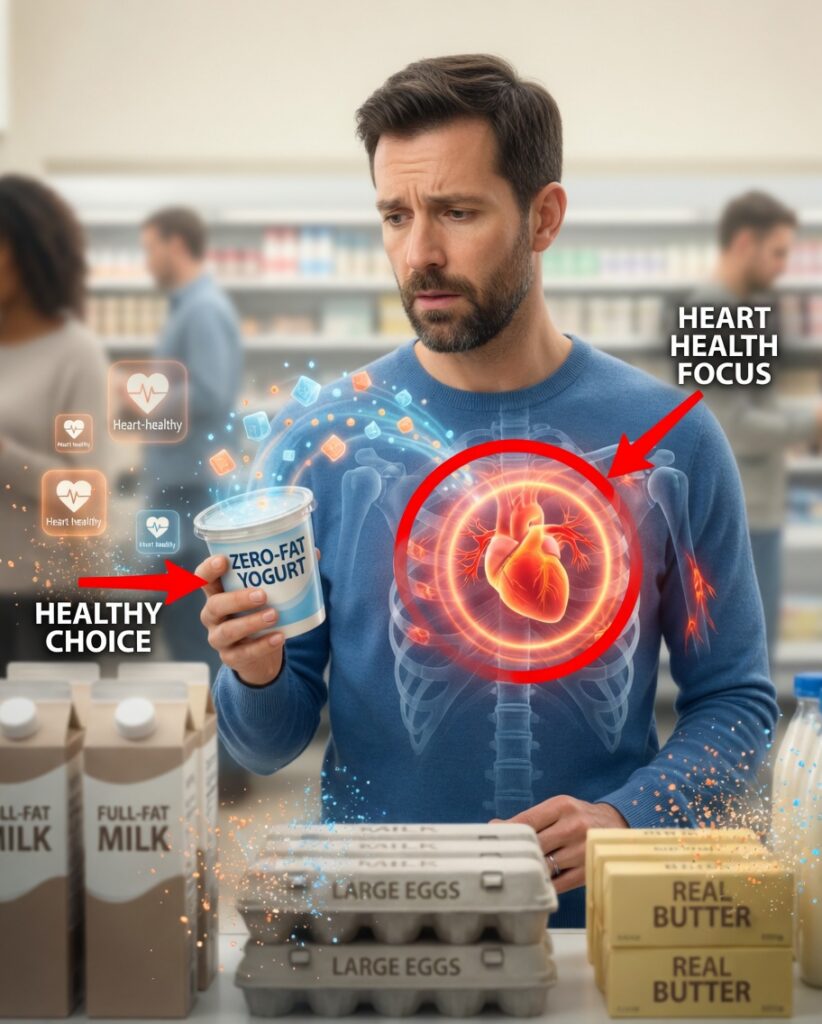
Rethinking Heart Health: Are You Fighting the Wrong Enemy?
For years, most people have been blaming the wrong culprit for heart disease. As a cardiologist, I want to walk you through two simple but powerful ideas that can completely change how you protect your heart.
First, we’ll count down five common foods and habits that trigger far more heart attacks than dietary cholesterol ever did. Cholesterol has taken all the blame, and many people avoid it unnecessarily, while far more harmful foods slip under the radar. The items at the end of this list—especially number two—may surprise you, and in my view, they are among the main drivers of heart and blood vessel disease.
Second, I’ll share the same guiding principle I give my patients in the clinic—my “golden rule.” It’s an easy-to-apply, practical guideline that can genuinely improve your life and long-term health.
If you’re serious about living better and taking care of your heart, keep reading.
(Based on the insights of Dr. Juan Veller)
Key Takeaways
- Many products marketed as “healthy,” such as low-fat or fat-free foods and fruit juices, can quietly harm your heart because they are loaded with sugar or stripped of fiber.
- The real engines of heart disease are often chronic inflammation and repeated insulin spikes—not cholesterol in your diet.
- The kind of fat you eat matters more than the total amount. Industrial seed oils and trans fats are highly inflammatory, while natural fats like olive oil and avocado are protective.
- Most of the sodium you consume doesn’t come from your salt shaker; it comes from processed, packaged foods.
- The simplest, most effective heart-health rule is to eat real food—things that don’t come with a long ingredient list.
5. The “Zero-Fat” Food Trap
Let’s begin with one of the most misleading categories in the supermarket: “zero-fat” and “low-fat” products.
When food manufacturers remove fat, they have to replace it with something so the product still tastes appealing. That “something” is almost always a mix of added sugars and artificial additives. Without fat, most of these items would taste like flavored cardboard.
For decades, we were taught—thanks in part to the old 1990s food pyramid—that eating fat was dangerous and would clog our arteries. We followed that advice for more than 20 years. During that time, rates of obesity, type 2 diabetes, heart attacks, and other chronic diseases have skyrocketed. Clearly, the strategy didn’t work.
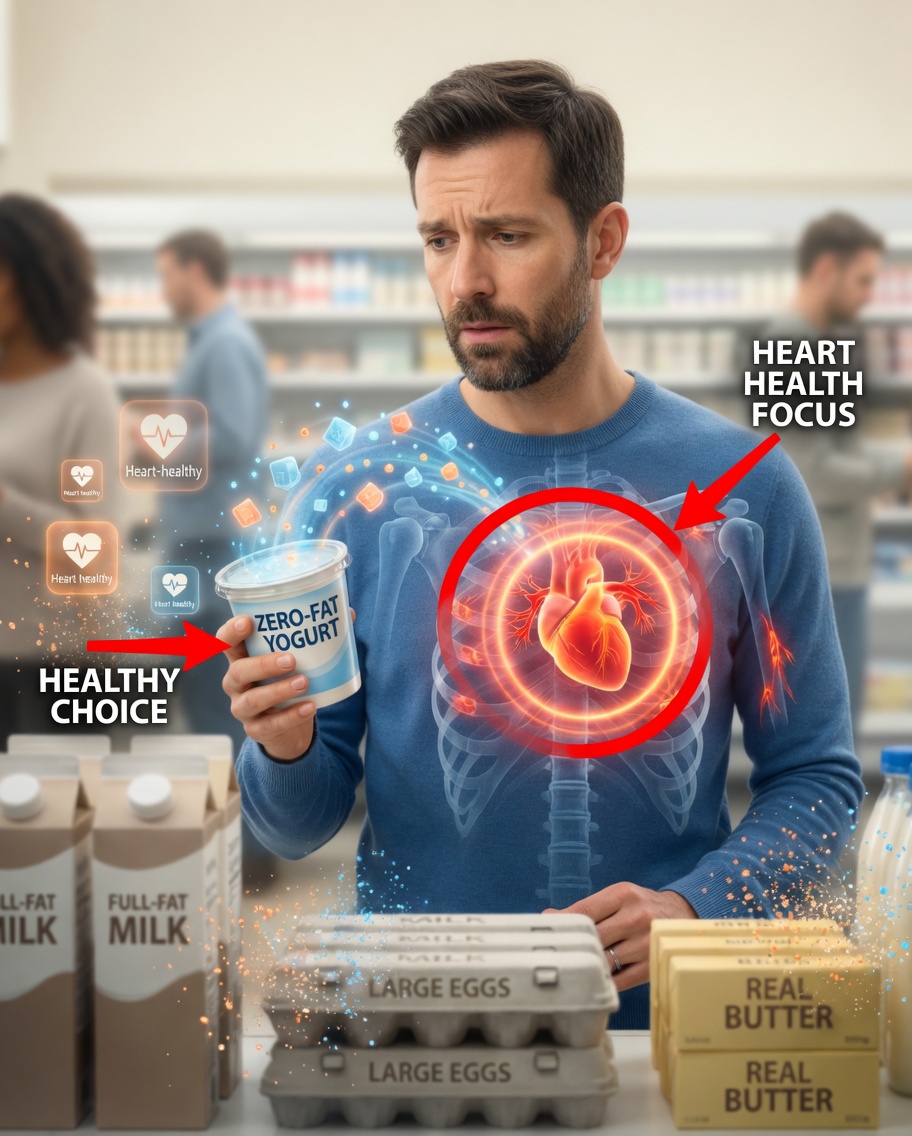
Take fat-free yogurt as a classic example. Many people buy it thinking they’re making a smart, heart-healthy choice. In reality, most fat-free yogurts are sugary desserts with extra chemicals, and often with fewer beneficial probiotics. We now understand that even the saturated fat in regular, full-fat yogurt is not nearly as harmful as once believed.
The real damage comes when natural fat is removed and replaced with sugar. That added sugar:
- Spikes your insulin levels
- Drives systemic inflammation
- Promotes plaque buildup inside your arteries
Those plaques can rupture and cause heart attacks. And the worst part? People consuming these “diet” products often truly believe they are doing the right thing for their health.
4. The Sweet Deception of Fruit Juice
Next on the list is a product most people assume is healthy simply because it comes from fruit: freshly squeezed fruit juice.
Think about how you prepare a glass of orange juice. You might use three, four, or even five oranges. Then you discard all the pulp and fiber. What you’re left with is essentially liquid fructose—fruit sugar—stripped of the fiber that nature included for a reason.
Whole fruit is a perfectly balanced food. The fiber:
- Slows the absorption of sugar into your bloodstream
- Helps you feel full and satisfied
- Feeds your gut microbiome
When you drink juice from multiple oranges without the fiber, you deliver a rapid, concentrated sugar load straight to your liver. A glass of juice doesn’t fill you up, so you often continue with toast, cereals, pastries, or other refined carbohydrates at breakfast. This combination:
- Leads to a big calorie surplus
- Forces your liver to convert excess sugar into fat
- Promotes belly fat, chronic inflammation, and damaged blood vessels
From the perspective of your heart and arteries, this is toxic.
Having a small glass of juice once in a while is not the problem. The issue is drinking it daily under the illusion that it’s “heart healthy.” It isn’t. Whole fruit is; fruit juice is not.
3. The Salty Truth: It’s About the Right Amount
Now let’s address a controversial topic: salt.
You’ve probably heard extreme messages from both sides. Some claim salt is so essential you should add it to your water for “better hydration.” Others insist salt will inevitably kill you. So who is correct?
Here’s the cardiology perspective.
Sodium—the main component of table salt—is vital for life. Your body cannot function without it. But the key word is dosage. The amount of sodium a typical adult actually needs is about 2–2.4 grams per day, which roughly corresponds to 5 grams (a level teaspoon) of table salt.
When your daily sodium intake goes much beyond this, your risk of:
- High blood pressure
- Heart disease
- Stroke
rises significantly. This relationship is as scientifically solid as the fact that we need water to live.
The problem today is that many people consume two, three, or even four times that sodium amount—5, 6, 7, 8 grams or more per day—often influenced by fads with no scientific basis, like drinking salt water “for hydration.” This overload:
- Stresses your kidneys
- Raises your blood pressure
- Strains your entire cardiovascular system
It’s not that sodium is inherently “bad”; it’s that excess sodium is harmful. Water is essential too, but drinking 20 liters in a day would be dangerous. The same logic applies to salt: necessary in the right quantity, damaging in excess. And no, you do not need salt water to stay hydrated; you need an appropriate daily intake of sodium.
For years, we doctors also contributed to confusion by telling patients to “remove the salt shaker from the table.” That advice missed the real issue. The salt you sprinkle on home-cooked meals is only a small fraction of what you consume—and at least you can control it.
Roughly 70% of your sodium intake comes from hidden salt in processed foods, such as:
- Cured meats and cold cuts
- Many cheeses
- Instant soups and noodles
- Soft drinks and some flavored waters
- Packaged baked goods
- Pre-made sauces, bouillons, and broths
That’s where you should focus your attention: cutting down on ultra-processed, packaged foods, not demonizing the salt shaker you use on real, whole foods.
2. The Toxic Truth About Vegetable Seed Oils
Now we arrive at one of the top offenders—foods that, in my view, cause more heart attacks than dietary cholesterol because they inflame and damage your body from the inside out: industrial vegetable seed oils.
These include common cooking oils such as:
- Sunflower oil
- Corn oil
- Soybean oil
- Canola (rapeseed) oil
The clear, golden liquid you see on supermarket shelves doesn’t come that way naturally. To create it, manufacturers use intensive industrial processes involving high heat, pressure, and often chemical solvents and deodorizers. The result is an oil that is heavily refined and extremely rich in omega-6 fatty acids.
When these oils are heated—especially to high temperatures for frying—they become highly unstable and oxidize. That greyish smoke and rancid smell from an overheated pan is your warning sign: toxic, inflammatory compounds are being created.
These byproducts:
- Injure the inner lining of your arteries
- Make the artery surface rough and more “sticky”
- Encourage cholesterol and other particles to adhere and form plaque
Over time, these plaques can rupture and form clots, blocking blood flow and causing a heart attack.
Frying food is particularly harmful. When you deep-fry something:
- At least a quarter of the final weight of that food can be oxidized, burnt oil
- You are literally eating damaged fat that fuels inflammation and vascular injury
For heart health, you should avoid frying altogether as a regular cooking method.
What can you do instead?
- Use gentle cooking techniques such as steaming, baking, or grilling at moderate temperatures.
- When you need to cook with fat, use small amounts of more stable, less processed fats, such as:
- Avocado oil
- Ghee
- Extra-virgin olive oil
These fats tolerate moderate heat better and have a far more favorable impact on inflammation and cardiovascular health than industrial seed oils.
The Golden Rule for a Heart-Healthy Life
After reviewing these hidden threats—fat-free products, fruit juices, excess sodium from processed foods, and industrial seed oils—what’s the simplest, most powerful lesson?
It’s the same “golden rule” I share with my patients:
Eat real food.
In practice, that means:
- Choose foods that are as close to their natural state as possible.
- Avoid products with long ingredient lists, especially those full of additives, refined sugars, and industrial oils.
- Base your meals on vegetables, whole fruits, legumes, nuts, seeds, quality proteins, and minimally processed fats like olive oil and avocado.
- Use seasoning—salt included—thoughtfully, on real foods you cook yourself, rather than relying on highly processed, packaged items.
When you follow this rule, you automatically:
- Reduce sugar spikes and insulin surges
- Lower chronic inflammation
- Cut back on hidden sodium
- Avoid toxic, oxidized fats
All of which directly protect your heart and blood vessels.
Final Thoughts
Heart disease is not just about cholesterol numbers. It’s about the daily choices that either inflame or heal your body.
By:
- Being skeptical of “zero-fat” labels
- Treating fruit juice as an occasional treat, not a health drink
- Controlling sodium by cutting processed foods, not just table salt
- Eliminating industrial seed oils and avoiding fried foods
- And, above all, prioritizing real, minimally processed food
you give your heart the best possible chance to stay healthy for decades to come.