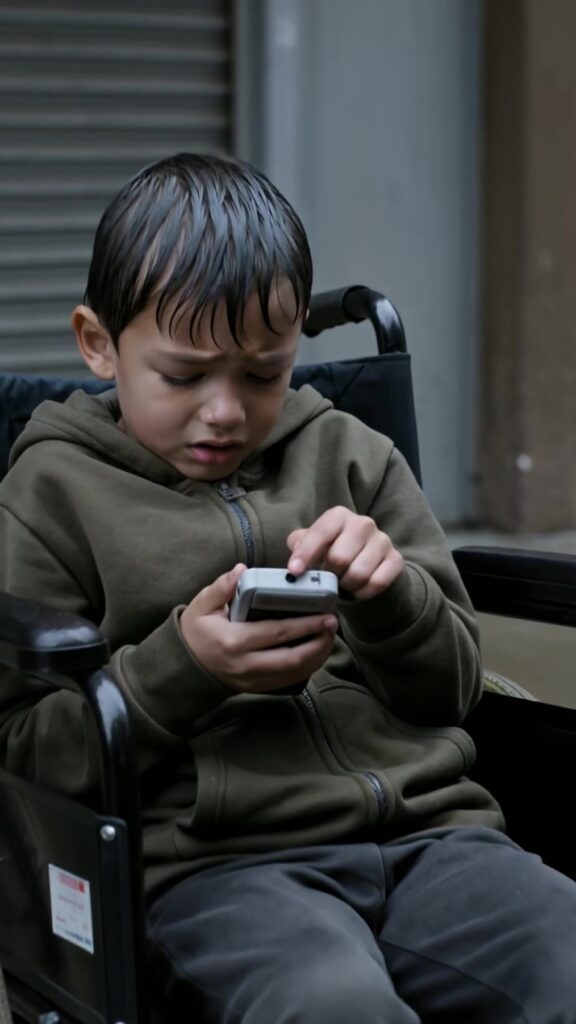
Rain threaded down the awning of the closed optician’s shop, tapping the metal like impatient fingers. The boy waited in the shallow shelter, wheels of his chair tucked close to the brick so he didn’t block the sidewalk. His hood was too big, his sneakers too small, and the cheap recorder in his hand looked like something won at a fair—plastic, hollow, easily snapped. He held it as if it were a bone that might keep him alive.
He had counted the listens because counting gave him a railing to grip when everything else moved. One. Two. Three. Each time the same voice, warped by wind and distance and whatever had happened to the microphone: a woman speaking quickly, like breath was a currency she was trying not to spend. He stopped, rewound with his thumbnail, pressed play again anyway. Six. The words were familiar now, but the fear they carried did not fade.
“If you find this—if you’re hearing me—hide the place they’ll look first. Don’t let them see the sign.” A pause; a shiver of static. “It’s on your neck.”
The boy’s hand flew up before his mind decided. His palm covered the left side of his throat, fingers splayed as if he could smooth his skin into invisibility. His heart kicked hard enough to hurt. He tilted his head, listening past the recorder to the street: the hiss of tires in wet lanes, the mutter of strangers, the drip-drip from a gutter that never held its promise. No one had looked at him longer than a blink all afternoon. That was why his mother had chosen this corner. That was why she had said, with eyes bright from panic, Only here. Only when you’re sure you’re alone.
Across the street, under a pharmacy sign that blinked from green to sickly white, a woman hurried with her collar raised. She moved like someone late for something she did not want to attend. The boy barely registered her until the recorder’s speaker crackled and his mother’s voice—he was sure it was his mother, though it sounded thinner than he remembered—pressed on with urgency.
“And listen to me. The man who brings you home, the one who says he’s—” The voice broke, then came back, sharper with desperation. “He isn’t your father.”
The woman’s steps snapped to a halt mid-stride. She turned as if the pavement itself had called her name. For a moment she was simply a silhouette in rain, face half-shadowed by the pharmacy’s flicker. Then the light caught her features and the boy saw the change: surprise collapsing into recognition, recognition draining into dread. Her gaze pinned the recorder, then slid to his neck with the precision of someone reading a document.
The boy’s breath stalled. He didn’t know her. But he knew the look. He had seen it in his mother the night she had pushed his chair to the back door instead of the front, the night she had pressed the recorder into his hand so hard it left the ridges of its buttons on his skin. She had kissed his forehead once, too quickly, like someone signing a contract they hated. Then she had pulled his hood up and whispered, Don’t show anyone. Not even— and then the sirens had started somewhere far away and her words had turned into action.
Behind the woman across the street, a dark sedan idled at the curb. It had been there long enough that rain beads had formed patient trails down its windows, long enough to look like part of the street’s furniture. Now, as the woman stood frozen, the rear door swung open with calm purpose. A man stepped out, coat unbuttoned, moving too fast to be casual and too certain to be curious. He looked like the sort of person who knew where every camera pointed.
The woman’s mouth barely moved, but the boy saw the shape of her warning. Turn it off. Her eyes sharpened on him, not pleading—commanding. Like she had practiced command in rooms where failure got people erased. The boy’s thumb hovered above the recorder’s button. His hand shook so much the plastic rattled against his knuckles.
The man had already started across the street, shoes cutting through shallow puddles without hesitation. He didn’t look left or right. He looked at the boy, and the boy felt the weight of that attention like a hand on the back of his head. The boy’s throat tightened under his own palm, and he felt it then—not the mark itself, but the memory of it: cold metal against skin, a sting, his mother’s hands steady as she said, This is so you’ll be found by the right person.
He didn’t know what the right person looked like. But the wrong person was crossing the street with an expression that had no confusion in it at all.
The recorder, as if possessed by his panic, hissed again. A new segment, one he hadn’t noticed in six listens because he had always stopped too soon. The voice returned softer, as though the speaker had leaned close to hide the words inside the static. “If she’s there—if she hears it—trust her. Ask her about the river door.”
The woman’s eyes widened, a sharp intake visible even from across the lanes. River door. She flinched like she’d been struck. She glanced over her shoulder at the sedan, at the man now halfway between them, then back to the boy. Her decision arrived in her face before her body moved: a kind of grim bravery, born of the same fear that had made her stop.
She stepped off the curb into the rain. Not running—walking fast, purposeful, as if she belonged in the street and the street would make room. A horn blared; she didn’t even look. The man’s head turned, tracking her, and his pace increased. The sedan’s engine revved once, a low growl. The boy’s fingers clenched around the recorder so hard it bit into his skin.
When she reached him, she didn’t ask his name. She crouched so her face was level with his, and he saw the fine tremor in her lashes. Up close, she smelled like cold air and antiseptic, like someone who spent time in places where wounds were stitched. “Show me,” she said. Her voice was steady, but her eyes were not.
He hesitated, then slid his hand away from his neck. For a heartbeat he expected nothing—only skin, only the normal shape of a child’s throat. But there, just below his jawline, was the faint outline of something that looked like a bruise and a barcode had agreed to share a secret: three short lines crossing one longer line, pale as old scars, visible only when the light flickered.
The woman’s pupils tightened. “They tagged you,” she breathed, and then she was already moving—hands on his chair’s handles, turning it with a practiced, efficient jerk that swung him away from the open sidewalk. The man’s shoes slapped closer behind them. “Listen to me,” she said, leaning in, her words hot against the boy’s damp hood. “Your mother didn’t send you here to hide. She sent you here to be seen—by someone who knows what that mark means. I know.”
The boy’s mouth opened but no sound came out. He held the recorder up like a talisman. “She said—” he began, and the woman cut him off with a look toward the man now only yards away.
“Later,” she said. “Right now we move.”
She pushed his chair hard, steering them along the storefronts, past the darkened optician, toward the alley that cut between the pharmacy and a boarded-up café. The rain thickened in the narrow gap, amplified by brick walls. The man called something—his voice clipped, official—but the woman didn’t slow. She had the kind of speed that came from knowing exactly what would happen if she was caught.
At the end of the alley, an iron gate blocked the way. The woman didn’t fumble for a key. She reached into her coat, drew out a thin metal card, and slid it into a seam near the lock. The gate clicked open like a held breath released. Beyond it, a set of stone steps descended into shadow where rainwater ran in a thin ribbon toward a drain.
“River door,” the boy whispered, remembering the phrase from the recording. His voice came out small, swallowed by the alley’s echo.
“Yes,” the woman said, and for the first time she allowed herself to look fully afraid. She pushed him down the steps, careful not to jolt him, and then she leaned close enough that he could see the rain clinging to her eyelashes like tiny beads of glass. “They’ll tell you a story,” she said. “They’ll say they’re rescuing you. They’ll say your mother was sick, dangerous, a liar. But the mark means you were chosen for something you didn’t agree to. And if they take you back—”
A heavy footfall sounded above. The man had reached the gate.
The woman’s jaw tightened. “Play it,” she ordered softly. “All of it. Every second. Don’t stop again.”
The boy’s thumb pressed the button as the world narrowed to the sound of his mother’s voice, trembling and relentless, carrying them into the dark where the river ran unseen behind walls, and where the truth—whatever it was—waited like a door that only the marked could open.