The rain made everything look harsher than it already was. It turned the world into a bruised photograph—edges sharpened, colors drained, every surface reflecting some version of itself that felt less forgiving than the truth. Even the house behind the black iron gate looked sterner under the downpour, as if stone could be offended by water and take it personally.
The gate clattered on its hinges with each gust, a metal stutter that sounded like impatience. Water streamed along the flagstones, finding the grooves where shoes had worn the path smooth. The yard smelled of wet earth and old moss, and there was a particular kind of cold in it—one that seeped into bones and made tenderness difficult to carry in the open. Love, in weather like this, had to be smuggled.
At the gate stood an old woman in a gray coat that had outlived several winters. The fabric clung to her thin arms, darkened by rain, and her hands—veined, careful hands—were held out as if she’d forgotten what to do with them. Her shoulders sloped from years of lifting things that weren’t always physical: bags of groceries, other people’s worries, the weight of silence after arguments. Her hair was tucked beneath a scarf, but rain found its way in anyway, wetting the soft gray wisps at her temples.
Opposite her stood her son, rigid in a black jacket that was soaked through. He looked older than she remembered and younger than he wanted to be. His jaw worked as if he were grinding a word down into something sharp enough to throw. He didn’t meet her eyes. Instead he stared past her, toward the street beyond the gate where the rain fell in slanting sheets and cars hissed by like distant warnings.
Without preamble he thrust a burlap sack into her arms. It was heavy enough that her feet skidded on the slick stone. She caught herself with a small gasp, hugging the rough fabric to her chest. The sack smelled faintly of grain and damp twine, but there was something off about its weight, a stillness that didn’t belong to food.
“Take it and go,” he said. His voice was hard, but the hardness was thin, like ice over shallow water. “You came for help, didn’t you? Here. Now leave.”
The words were meant to sting. They did. But she heard, under them, a tremor—an edge fraying, a crack he tried to drown in the rain. Mothers were trained by years to read the language beneath the language. She nodded once, not because she believed his performance, but because she recognized the terror of being seen.
In the doorway behind him, a younger woman watched. She was wrapped in a cardigan, arms folded tight, her face composed in that particular way that shut doors without slamming them. Her eyes moved between the old woman and her son like a guard’s, measuring, suspicious. She didn’t step into the rain. She didn’t offer a greeting. Her silence had the weight of a rule: do not make this personal.
The son took a step back as if the moment were burning his skin. “Go,” he repeated, faster now, anger pretending to be certainty. For an instant his gaze flicked to his mother’s face and then away, as if looking too long would undo him.
So the old woman turned. The sack dragged at her elbows, and the rain tugged at her coat, trying to peel it open. She walked down the slick path, through the clatter of the gate, and out into the street where the world blurred in gray curtains. She did not look back until she’d reached the corner, and even then she only glanced, the way one checks a wound without touching it.
Her room was a small rented space above a shop that sold phone cards and cheap umbrellas. The stairwell smelled of boiled cabbage and bleach. Inside, the single bulb cast a tired light over a narrow bed, a wooden table, and a window that rattled whenever the wind argued with the building. She set the sack down with slow care, as if it contained something living.
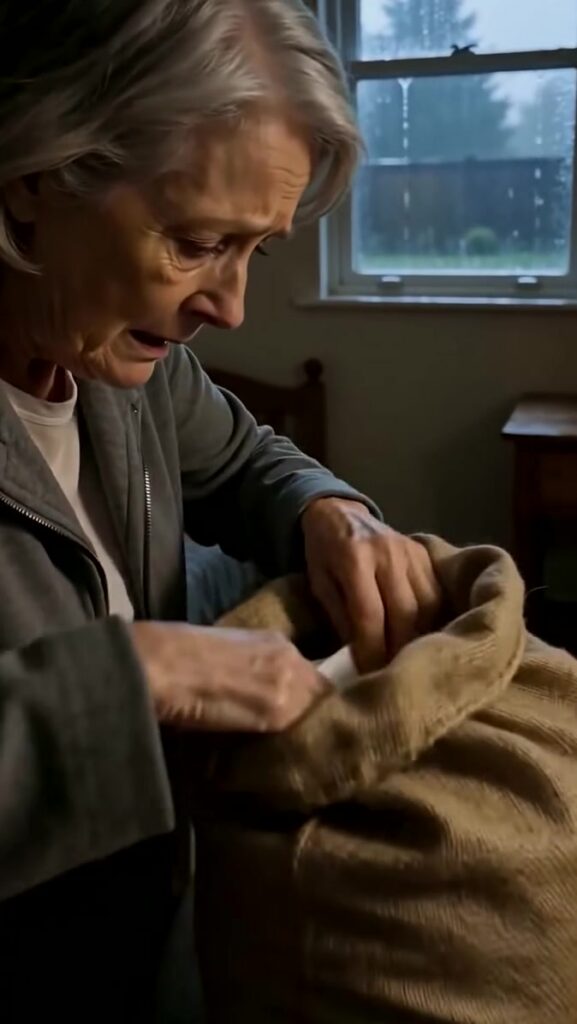
For a long moment she simply stared at it. Her fingers, stiff from cold, found the knot at the top and worried it loose. The twine gave way with a soft snap. She tipped the opening and waited for rice to spill out, for grains to scatter like tiny pale accusations across her floor.
Instead, a white envelope slid into her palm. It was thick, heavy in a different way. On the front, in handwriting she knew the way she knew her own name, was a single word: Mom. The sight of it made her throat tighten so suddenly she had to sit down.
She opened it with both hands. Inside was a stack of bills, more money than she’d held at one time in years, and a note folded twice, creased neatly as if it had been refolded again and again in an anxious pocket. Her fingertips trembled so much she nearly tore the paper.
“I’m sorry,” the first line read. The ink had bled slightly, as if it too had been in the rain. “I couldn’t say it where she could hear. I couldn’t let her see you as anything but a burden, because then she would ask questions I can’t answer without losing everything.”
The old woman pressed the paper to her lips. Tears rose in her eyes, not hot but aching, as if each one carried an old memory. She read on. “You were right about me marrying too fast. You were right about me borrowing money and lying about it. I’m trying to fix it. But I’m trapped in a house that only loves what it can control. If I show kindness, it becomes a weakness she can use. If I defend you, she calls it betrayal.”
Her breath hitched when she reached the last lines. “I sent this because you deserve more than my silence. Please don’t come back here again. Not until I can meet you at the gate and speak like a son, not like a stranger. I’m leaving soon. I have a plan. I just need time.”
She lowered the note and stared at the rain-speckled window, suddenly unable to bear the smallness of her room. She stood and stepped closer to the glass. The street below was a wash of water and headlights. Then she saw him—still there by the gate, a dark figure against the pale stone. He hadn’t gone inside. He hadn’t moved. He stood with his head bowed, rain running off his hair and jacket, his shoulders shaking with a grief he’d refused to show in the doorway.
Her hand flew to her mouth, a soundless cry caught between love and anger. She watched him lift one hand to his face, wiping at tears like a child who didn’t want anyone to notice. And then, as the wind shifted and the gate swung slightly, she saw something that cut sharper than the cold: the bare circle on his ring finger, pale where metal used to sit.
He looked toward the street, not toward her window—he couldn’t know she was watching—and for a heartbeat his face was naked with decision. Then he turned and walked away from the house, not toward the warmth inside but out into the rain, disappearing past the corner where the city swallowed him whole.
The old woman sank back onto the chair, the envelope of money heavy in her lap, the note dampening where her tears fell. Outside, the rain kept falling, indifferent and relentless, making everything look harsher than it already was. But in her hands, ink and paper proved what his mouth had not been allowed to say: that cruelty can be a disguise, and sometimes the truest love is the one forced to arrive in secret, delivered like contraband through a storm.