The Hidden “Dish Soap” in Your Food That Damages Your Gut
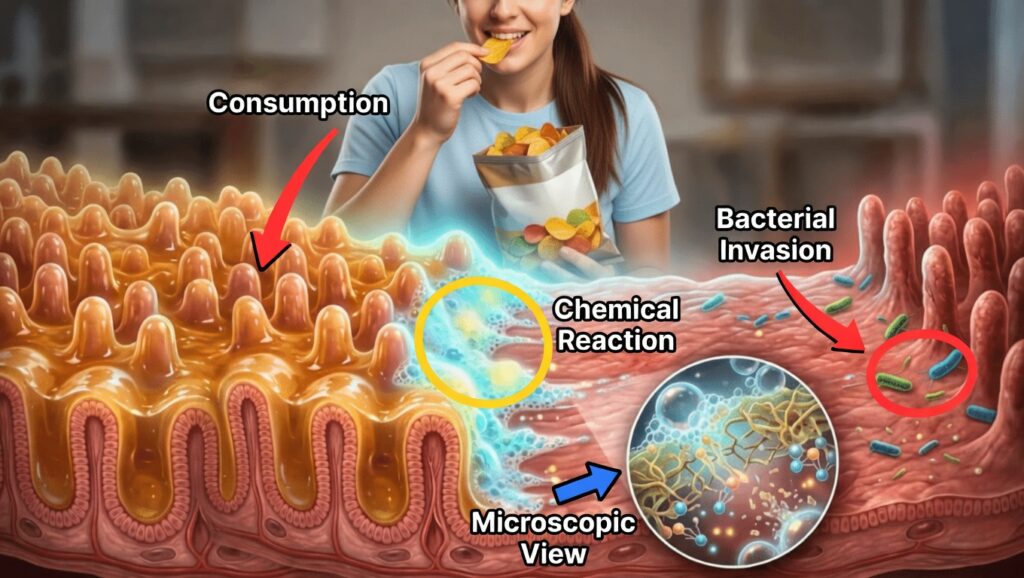
Imagine squirting dish soap onto a greasy pan. The grease breaks apart and washes away almost instantly. Now picture that same detergent-like action happening not in your sink, but along the fragile lining of your intestines.
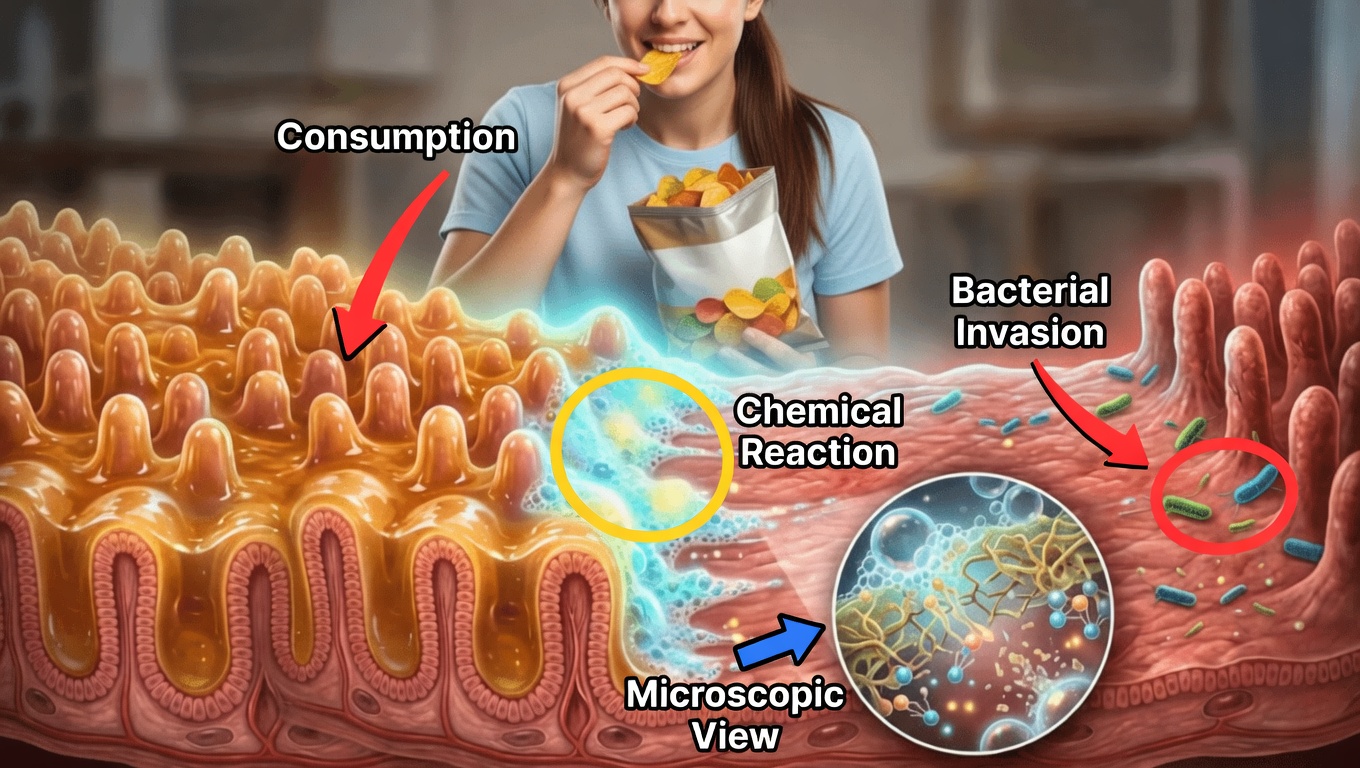
There is a group of food additives—so widespread that most people consider them harmless—that can dissolve the protective mucus coating in your gut in a very similar way. When this barrier is eroded, substances that should never cross into your bloodstream—such as bacteria, toxins, and partially digested food—can slip through. That breach is essentially what many experts refer to as a “leaky gut.”
The disturbing reality: you’ve probably been eating these additives day in and day out, often without realizing it.
These chemicals are not rare. They’re found in roughly 60% of the packaged items in the average supermarket. They hide in ice cream, chocolate, salad dressings, plant-based milks, bread, protein bars, peanut butter, and even baby formula. Collectively known as emulsifiers, these additives are slowly wearing down your gut barrier with every processed meal, contributing to health problems that go far beyond mild digestive discomfort.
It’s time to look closely at what emulsifiers are, why they’re everywhere, and how they may be undermining your gut health.
Key Takeaways
-
Emulsifiers Behave Like Detergents: Additives such as polysorbate 80 and carboxymethyl cellulose are used to mix oil and water in processed foods, but they also break down the protective mucus barrier in your intestines.
-
They Promote Leaky Gut: By eroding this mucus layer, emulsifiers allow bacteria and toxins to slip past the gut lining and enter your bloodstream, activating your immune system.
-
They Drive Chronic Inflammation: This immune activation leads to ongoing, low-level inflammation—a key factor in many modern illnesses, including IBS and autoimmune diseases.
-
They’re in Most Packaged Foods: Emulsifiers are estimated to be in around 60% of processed foods, including many products marketed as “healthy,” like dairy-free milks and protein bars.
-
Avoidance Is the Best Defense: The most effective way to safeguard your gut is to cut out ultra-processed foods and base your diet on whole, minimally processed, single-ingredient foods.
1. What Are Emulsifiers (and Why Are They in Your Food)?
If you’ve ever whisked oil and vinegar for a salad dressing, you know they naturally separate into layers. Emulsifiers are chemicals that force these ingredients to combine and stay mixed. Food manufacturers rely on them to improve texture, stability, and shelf life.
Emulsifiers:
- Make ice cream and mayonnaise smooth and creamy
- Keep salad dressings from separating
- Help bread stay soft and uniform
- Create a silky “mouthfeel” that keeps you reaching for more
From a manufacturing perspective, they’re extremely useful. But these are industrial additives—not real food.
On ingredient labels, emulsifiers often appear under technical, unfamiliar names such as:
- Polysorbate 80
- Mono- and diglycerides
- Carboxymethyl cellulose (CMC)
- Carrageenan
Most shoppers have no idea what these words mean. Their role is purely cosmetic and functional: to make processed products look better, feel better, and last longer. They contribute no nutritional value.
The trade-off is significant. In exchange for better texture and a longer shelf life, you’re exposing your gut lining—one of your body’s most crucial defense systems—to compounds that act very much like detergents.
2. Your Gut’s Natural Shield: The Mucus Barrier
To understand why emulsifiers are so problematic, it helps to know how remarkably your gut is designed.
The inside of your intestines is lined with a thick, specialized layer of mucus. This is not the same mucus you experience with a cold. It’s a highly organized, protective barrier.
On one side of this barrier is the chaotic world of your gut:
- Food particles
- Trillions of microbes that make up your microbiome
- Digestive enzymes and byproducts
On the other side, just beyond a single layer of intestinal cells, lie your bloodstream and roughly 70% of your immune system.
This mucus layer acts as a selective filter and bodyguard. Its job is to:
- Allow fully digested nutrients to pass through into your bloodstream
- Keep bacteria, large protein fragments, and toxins contained within the gut
- Maintain a clear separation between the “wild” environment of your intestines and the sterile, controlled inner body
When this barrier is robust and intact, your immune system can stay calm. When it’s thinned or damaged, your immune cells are suddenly exposed to things they should never see—and that’s when problems begin.
3. How Emulsifiers Strip Away Your Gut’s Defenses
This is where the dish soap comparison becomes uncomfortably accurate.
The very property that makes an emulsifier valuable in food production—its ability to blend oil and water—is what makes it so harmful to your intestinal barrier. Emulsifiers are surfactants, meaning they reduce surface tension and help fats disperse.
Your mucus layer is a complex, gel-like mixture with both water-loving and fat-loving components. Surfactants are specifically designed to disrupt such structures.
When you eat foods that contain emulsifiers:
- They don’t just glide harmlessly through your digestive tract.
- They interact with and break down the mucus layer.
- Over time, they thin and dissolve this critical barrier.
This is not an allergic reaction or sensitivity; it’s a direct chemical effect. You are effectively ingesting a mild detergent that can strip away your gut’s natural protective coating.
With repeated exposure—meal after meal, year after year—the mucus layer can become so eroded that it can no longer perform its job. The gut lining beneath it is left exposed and vulnerable.
4. The Domino Effect: From Leaky Gut to Chronic Disease
Once the mucus shield is compromised, the single-cell-thick epithelium underneath is left on the front line.
Bacteria that normally coexist peacefully in your gut can now get much closer to, and even pass through, this weakened wall. When these microbes, or their toxic byproducts, cross into the bloodstream:
- Your immune system detects them as harmful invaders.
- Immune cells launch an attack, marking them as threats.
- This response triggers inflammation.
Initially, this may show up as subtle, constant, low-level inflammation. You might notice:
- Mild bloating
- Fatigue
- General digestive discomfort
But if emulsifier intake continues, the immune system remains on high alert. The ongoing assault can:
- Damage and scar the lining of the colon
- Interfere with nutrient absorption, leading to deficiencies
- Contribute to conditions such as Irritable Bowel Syndrome (IBS), Crohn’s disease, and ulcerative colitis
Even more concerning, this chronic gut-based inflammation is increasingly recognized as a major driver of autoimmune diseases—conditions in which the immune system becomes confused and starts attacking the body’s own tissues.
In other words, what starts as a subtly damaged mucus layer can spiral into systemic, whole-body health issues.
5. What the Research Shows: The Growing Evidence
Most early research on emulsifiers and gut health was done in animals, but the findings are hard to ignore.
In multiple mouse studies, feeding animals common emulsifiers like polysorbate 80 and carboxymethyl cellulose led to:
- Weight gain and metabolic syndrome
- Blood sugar dysregulation
- Significant disruptions to the gut microbiome
- Increased inflammation and features of colitis
Food industry advocates often dismiss these findings by pointing out that mice are not humans. But newer human data are now backing up these concerns.
A controlled human trial published in 2024 gave participants a diet containing an emulsifier for just two weeks. The results were striking:
- The composition of the participants’ gut microbiomes changed measurably.
- Bacteria were observed moving closer to the intestinal wall—the first step toward a leaky gut.
All of this happened in only 14 days. It raises a serious question: what happens after 10, 20, or 30 years of daily exposure?
We don’t yet have long-term clinical trials spanning decades. However, population trends paint a troubling picture. Over roughly the same period that consumption of ultra-processed foods and emulsifiers has soared:
- Rates of IBS have roughly doubled
- Autoimmune disorders have increased dramatically
While this isn’t definitive proof of causation, the correlation is strong enough that many experts urge caution—and a serious rethinking of our reliance on ultra-processed foods loaded with emulsifiers.