Aging and Balance Loss: Why It Happens and How Exercise Can Help
Getting older is not easy. As the years pass, the body goes through many changes that can affect daily life in significant ways. Common age-related challenges include:
- A slower metabolism
- More difficulty with memory
- A greater risk of chronic illness
- Reduced balance and stability
Among these concerns, declining balance can be one of the most serious. Good balance is essential for walking, standing, turning, and carrying out everyday tasks safely. When balance starts to fade, independence often becomes harder to maintain.
This article explains why balance tends to worsen with age and shares practical exercises that may help improve stability and reduce the risk of falls.
Why Balance Declines With Age
There is no single cause of age-related balance problems. Instead, several physical and neurological changes can contribute to instability and falls in older adults.
Muscle Weakness
As we age, the body naturally loses muscle mass, a process often called sarcopenia.
When muscles become weaker, they are less able to support the body and respond quickly when a person stumbles or shifts unexpectedly. This makes it harder to recover from a loss of balance.
Although some muscle loss is associated with aging, many experts agree that strength training and regular movement can help slow this decline.
Joint Stiffness and Reduced Mobility
Joints contain synovial fluid, which helps lubricate movement and keeps the body moving smoothly.
Over time, synovial fluid may decrease, and joint cartilage can wear down. These changes often lead to:
- Joint discomfort
- Stiffness
- Limited flexibility
- Slower reactions during movement
When the joints cannot move freely, it becomes more difficult to make the quick adjustments needed to stay upright.
Reduced Proprioception and Kinesthetic Awareness
Two important systems help us understand where our body is in space: proprioception and kinesthetic awareness.
These abilities tend to decline with age. As a result, older adults may have more trouble sensing body position, especially in unfamiliar places or during new activities. This can greatly increase the likelihood of tripping, misstepping, or falling.
Vestibular System Changes
The vestibular system, located in the inner ear, plays a central role in balance.
With age, the fluid inside this system may thicken, making it less responsive to changes in head position and movement. This can affect stability and cause dizziness in some people.
A common vestibular problem is Benign Paroxysmal Positional Vertigo (BPPV). It affects many individuals every year, but the good news is that treatment by a physician or physiotherapist can often bring major relief.
Vision Loss
Vision also changes over time, and eyesight is one of the body’s main tools for maintaining balance.
When it becomes harder to clearly see the surroundings, the risk of:
- Tripping
- Losing balance
- Falling
goes up significantly.
Slower Reflexes
Reflexes are automatic responses that help the body react quickly.
For example, if something shifts your weight to one side, your body instinctively tries to correct itself. But when reflexes slow down with age, those corrective responses may not happen fast enough to prevent a fall.
Can Exercise Improve Balance in Older Adults?
Not every cause of age-related balance loss can be fully reversed. However, exercise can play a major role in improving strength, coordination, mobility, and stability.
Targeted balance exercises may help older adults stay active, reduce fall risk, and maintain independence for longer.
Below are some effective exercises that support better balance later in life.
Best Exercises to Improve Balance as You Age
1. Standing Hip Circumduction
The hips are vital for balance, walking, and body control. This movement improves hip mobility while also challenging single-leg stability.
How to do it
- Stand on your right leg.
- Lift your left knee toward your chest.
- Move your left hip outward, making a large circular motion.
- Complete the circle by bringing the knee back toward your chest.
- Reverse the direction and repeat.
- Perform 15 circles in each direction on each leg, once daily.
2. Single-Leg Romanian Deadlift
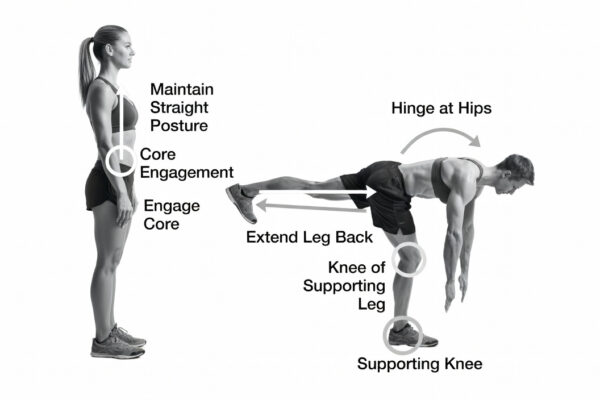
The Romanian deadlift is excellent for building strength and control. Doing it on one leg increases the challenge and helps improve balance even more.
If it becomes too easy, you can add light weight to progress gradually.
How to do it
- Stand on your left leg.
- Slightly bend the left knee.
- Hinge forward from the hips as your right leg extends straight behind you.
- Keep your back straight throughout the movement.
- Squeeze your glutes to return to standing.
- Perform 10 to 15 repetitions on each side, once per day.
3. Standing Hip Abduction
The hip abductors are especially important for stability in older adults. When these muscles are weak, the risk of falls and even hip fractures may increase.
Strengthening them can support safer movement and better balance.
How to do it
- Stand on your right leg.
- Lift your left leg out to the side in line with your body.
- Keep your toes pointing forward the entire time.
- Return to the starting position with control.
- Perform 10 to 15 repetitions on each side, once daily.
4. Skater Squats
This exercise helps build hip strength, mobility, and single-leg control. It also challenges coordination, making it useful for balance training.
Move slowly and stay within a comfortable range at first.
How to do it
- Stand on your left leg.
- Move your right leg behind and across your left leg, as if it were a tail.
- Lightly touch your right toes to the floor while bending slightly into a squat on the left leg.
- Return to standing, ideally without putting full weight on the right leg.
- Perform 10 to 15 repetitions on each side, once per day.
5. Single-Leg Catch
This exercise combines balance training with visual coordination and proprioception work. It is a simple way to improve body awareness while staying engaged.
How to do it
- Stand on your right leg.
- Hold a small ball in your left hand.
- Toss the ball a few inches into the air and catch it with the same hand.
- Repeat for 10 throws.
- Switch legs and hands.
- Perform 10 throws per hand each day.
Final Thoughts
Aging brings changes that can feel unsettling, especially when balance begins to decline. While it is impossible to control every effect of aging, it is possible to take steps that lower the risk of falling.
Daily balance exercises can help improve strength, coordination, and confidence. If you are already noticing balance problems, or simply want to stay ahead of them, starting a consistent routine may make a meaningful difference.
References
- van Beek, J. H., Kirkwood, T. B., & Bassingthwaighte, J. B. (2016). Understanding the physiology of the ageing individual: computational modelling of changes in metabolism and endurance. Interface Focus, 6(2), 20150079. https://doi.org/10.1098/rsfs.2015.0079
- Dellinger, A. (2017). Older Adult Falls