Are Statins Lifesavers or Overhyped?
If you or someone close to you takes a statin, you’re in very large company—an estimated 40 million Americans swallow these cholesterol-lowering drugs every day. Yet a crucial question often goes unasked: Are statins genuinely the powerful heart-protective tool they’re marketed to be, or has their reputation overshadowed deeper causes of heart disease?
Drawing on insights from Dr. Suneel Dhand, Dr. Peter Chiotellis, and Dr. Benjamin Levin, this guide unpacks the science, the history, and the controversy so you can make more informed choices about your heart health.
Key Takeaways
- Statins reliably reduce LDL (“bad”) cholesterol, but for many people—especially those without previous heart events—the actual reduction in risk is modest.
- The theory that cholesterol is the primary driver of heart disease has a complicated and controversial background.
- Food and pharmaceutical industry interests have strongly shaped public and medical opinion about cholesterol, fat, and heart disease.
- Many people are started on statins when sustained lifestyle changes might offer equal or greater benefit.
- Side effects such as muscle pain, weakness, and liver issues are more frequent than commonly acknowledged.
- Open, honest conversations with your healthcare provider are essential; you have every right to ask detailed questions about risks and benefits.
1. The Cholesterol Hypothesis: Main Culprit or Misunderstood Player?
You’ve likely heard the message for years: high LDL cholesterol is dangerous, full stop. Reality is more nuanced.
Cholesterol is not just “gunk in your arteries.” It is vital for:
- Building every cell membrane in your body
- Producing hormones
- Supporting brain health—around 60% of the brain’s dry weight is fat
Decades ago, some researchers raised the alarm about sugar and refined carbohydrates as key contributors to heart disease. However, powerful sugar industry groups financed research that shifted the blame primarily onto dietary fat and cholesterol. By deflecting attention away from sugar, this narrative helped cement cholesterol as the villain and opened the door for cholesterol-lowering drugs like statins to dominate the treatment landscape.
2. How Statins Took Over the Heart-Health Conversation
Statins entered the market after the LDL-focused view of heart disease became mainstream. Once LDL was labeled the central enemy, the goal became clear: lower that number at almost any cost.
Pharmaceutical companies developed statins to do exactly that. Over time:
- Lowering LDL became a primary target in guidelines.
- Physicians were encouraged, directly and indirectly, to treat “high numbers” aggressively.
- Statins grew into one of the most profitable classes of medication ever created, generating tens of billions of dollars annually.
The messaging was simple: “Lower your LDL, lower your heart attack risk.” But with hindsight, many experts are asking whether this narrow focus on LDL was truly justified.
3. Primary vs. Secondary Prevention: Where Do Statins Really Help?
Statins are generally prescribed for two distinct purposes:
- Primary prevention: To try to prevent a first heart attack or stroke in someone who has never had one.
- Secondary prevention: To reduce the chance of another heart attack or stroke in someone who already has a known cardiovascular event or established heart disease.
The actual benefit looks very different in these two groups:
- Primary prevention: Roughly 1 out of 200 people taking a statin long-term will avoid a heart attack or stroke they would otherwise have had.
- Secondary prevention: The benefit is larger but still limited—about 1 in 50 will avoid a repeat event.
Imagine 200 people taking a daily pill for years, with only one person clearly benefiting in terms of major events prevented. Those are not the odds many people assume when they start a statin.
4. Are We Treating Lab Results Instead of People?
Modern medicine often zeroes in on lab values—especially LDL cholesterol—almost as if the numbers themselves are the disease. But what really matters is not the lab report; it’s how long and how well you live.
When researchers look at outcomes such as:
- Overall life expectancy
- Quality of life
- Number of healthy years
they often find that, for individuals who have never had a heart attack or stroke, the impact of statins is small. In many cases, the best projected outcome is an average increase in lifespan of weeks to a few months over decades of use.
For some high-risk patients, that modest benefit may be worth it. For others, especially those with low to moderate risk, it raises serious questions: is the focus on achieving “perfect” numbers overshadowing more meaningful approaches to health?
5. Statin Side Effects: What You Need to Know
Statins are frequently described as “well tolerated,” but that doesn’t mean they’re side-effect free.
Commonly reported problems include:
- Muscle aches or soreness
- Weakness or fatigue
- Liver function abnormalities on blood tests
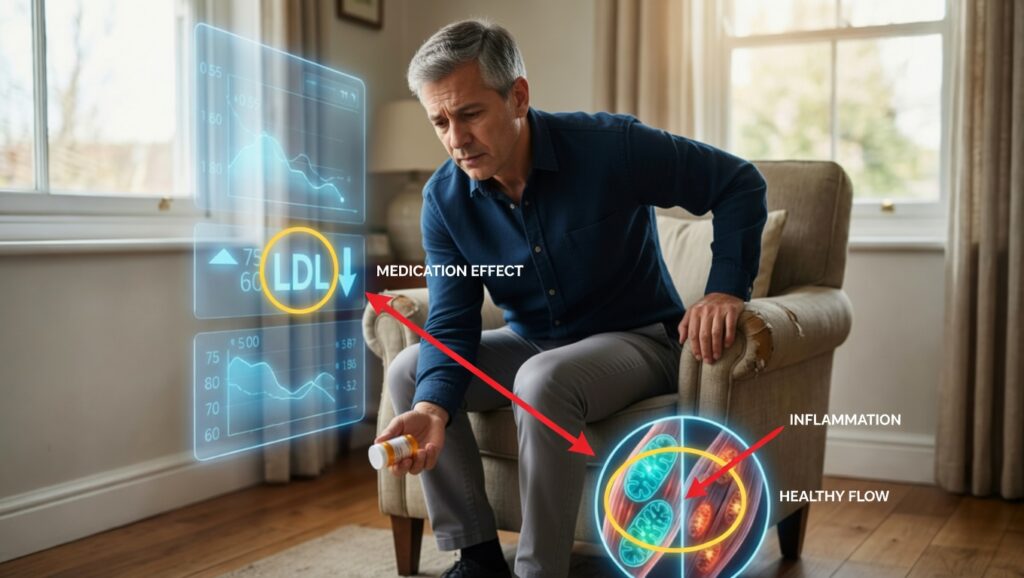
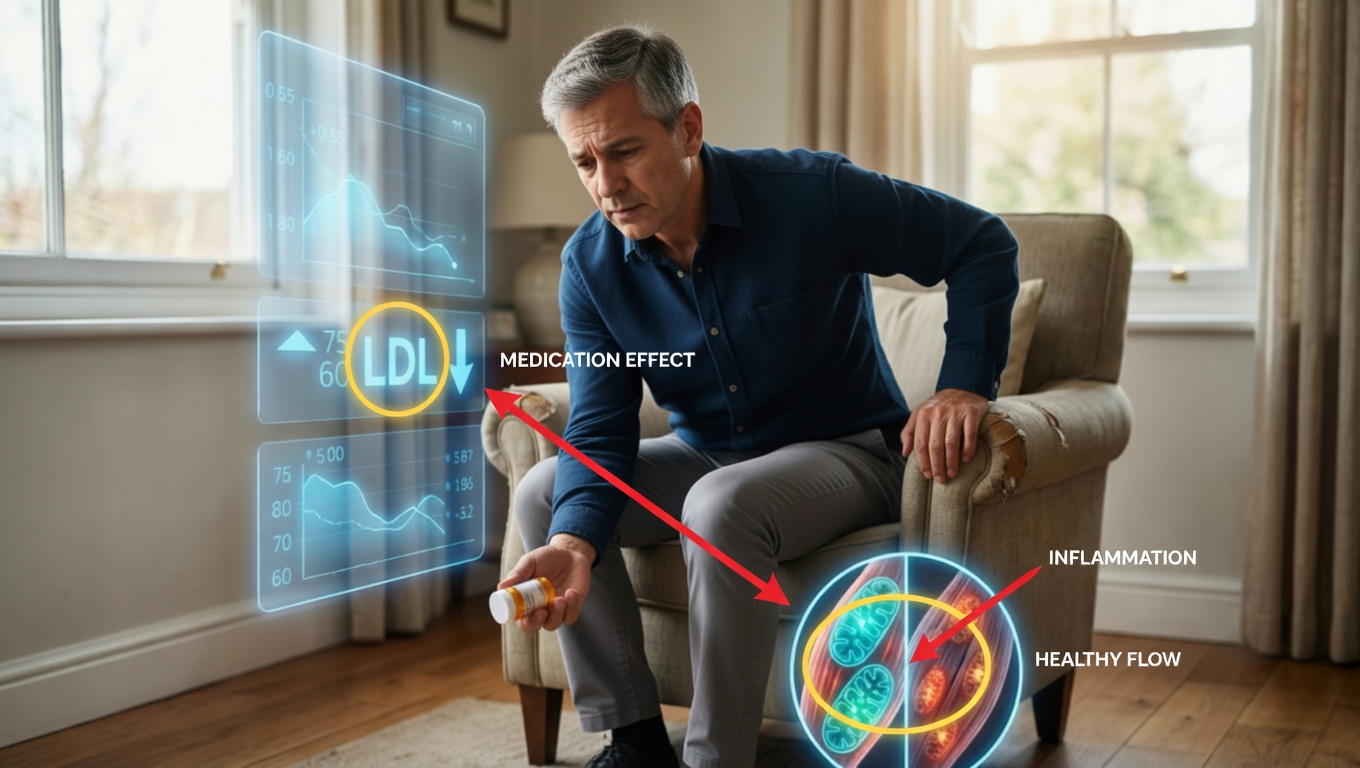
These side effects may affect up to 10% of users—a significant number when millions of people take these drugs. A key part of the issue is that statins can reduce levels of coenzyme Q10 (CoQ10), a substance your cells need to produce energy efficiently.
Despite this, many patients:
- Are never told about the potential drop in CoQ10
- Don’t learn about nutritional or supplement strategies that may help
- Have their symptoms dismissed instead of investigated
If you notice new muscle pain, weakness, or unusual fatigue after starting a statin, it is important to discuss this with your healthcare provider.
6. Sugar, Carbohydrates, and Inflammation: Are We Targeting the Wrong Enemy?
For decades, dietary fat and cholesterol were portrayed as the primary enemies of heart health. But increasingly, research points to a different pattern: highly processed sugars and refined carbohydrates appear to play a central role in:
- Chronic inflammation
- Insulin resistance and type 2 diabetes
- Metabolic syndrome
- The development and progression of heart disease
Heart attacks are not just about cholesterol clogging arteries; they are deeply connected to systemic inflammation and impaired blood sugar control. Statins mainly address cholesterol levels—a downstream marker—rather than the upstream root causes such as poor diet quality and metabolic dysfunction.
In other words, statins often treat a symptom of the underlying problem, not the problem itself.
7. The Illusion of Protection: Why Lifestyle Still Rules
Taking a daily pill can create a powerful psychological effect: the belief that you are “protected” and can safely ignore lifestyle factors. This is a dangerous misconception.
Extensive research shows that lifestyle changes can dramatically reduce cardiovascular risk:
- Cutting down on added sugars and refined carbs
- Emphasizing whole, unprocessed foods
- Maintaining a healthy weight
- Exercising regularly
- Getting enough sleep and managing stress
These changes can lower risk of heart disease by as much as 50% in some studies—far more than statins alone typically offer, especially for people without prior heart events.
Relying on statins while continuing to eat poorly and avoid exercise is not a winning strategy. Lifestyle remains the foundation; medications, where appropriate, are an add-on, not a substitute.
8. Why Are Statins Prescribed So Widely?
From the 1960s onward, conflicts of interest have heavily influenced what doctors, policymakers, and the public believed about heart disease.
Key forces include:
- Sugar industry funding that downplayed the harms of sugar and redirected blame toward fat and cholesterol.
- Pharmaceutical industry marketing that promoted statins as the essential solution to heart disease, often framing LDL as the central measure of cardiovascular risk.
As a result:
- Entire populations have been placed on statins, sometimes starting at relatively low levels of risk.
- Countries with lower statin use do not necessarily have higher rates of heart disease—in fact, some have better overall heart health outcomes.
This doesn’t mean statins never help. It does mean that non-medication strategies and broader lifestyle factors have frequently been overshadowed by drug-centered approaches.
9. Quality of Life vs. Extra Months: What Matters to You?
Especially in older adults, statin side effects can significantly affect daily living. Muscle pain, weakness, and fatigue may:
- Limit activity and exercise
- Reduce independence
- Diminish overall enjoyment of life
If a medication offers a small chance of adding a few months to your lifespan but causes years of reduced mobility or chronic discomfort, it’s reasonable to question whether that tradeoff is acceptable for you personally.
The answer will differ from person to person. That’s why it is vital to:
- Consider your individual risk of heart disease
- Discuss both benefits and harms in clear numbers, not vague reassurances
- Prioritize your values, preferences, and definition of a good life
10. What Should You Do Next?
If you’re considering statins—or already taking them—here are practical steps:
-
Ask informed questions
- What is my actual cardiovascular risk?
- How many people like me would need to take this drug for one to benefit?
- How much might it change my risk in real terms?
-
Prioritize lifestyle changes
- Focus on nutrient-dense, minimally processed foods.
- Reduce added sugars and refined carbohydrates.
- Move your body regularly and build strength.
- Work on sleep quality and stress reduction.
-
Watch for side effects
- Report new muscle pain, weakness, or fatigue promptly.
- Ask your clinician whether CoQ10 supplementation is appropriate for you.
- Revisit your prescription if side effects are affecting your daily life.
-
Consider a second opinion
- Especially if you are being started on statins for primary prevention (no prior heart attack or stroke), seeking another medical opinion is reasonable.
- Another doctor may offer a different view on your risk profile and options.
Conclusion: Statins—Useful Tool or Grand Illusion?
Statins are not magic bullets. For people who have already experienced major heart events, they can provide some protection—but the benefit is generally modest, not miraculous. For many others, especially those at lower risk, statins may offer limited advantage while creating a false sense of security and exposing them to side effects that are often underreported.
The most powerful defense against heart disease is not found in a pill bottle. It lies in your everyday choices: what you eat, how much you move, how you manage stress, and how you care for your metabolic health.
Stay curious, stay informed, and never hesitate to question standard narratives. Your heart—and your life—are worth the effort.
Source: Insights adapted from Dr. Suneel Dhand, Dr. Peter Chiotellis, and Dr. Benjamin Levin.