The restaurant breathed money. Not loudly—never loudly—but in the lacquered hush of it, the kind that made a fork’s whisper against porcelain sound like a purchase. Candlelight slid across crystal, and the air carried the careful perfume of truffles and restraint. Conversations stayed stitched into low, disciplined threads, as if the room itself charged a fee for every extra syllable.
Near the window, where the city’s rain smeared the glass into silver ribbons, sat a boy in a wheelchair. His hair was too light for the dimness, his face almost translucent, as if he belonged more to the reflection than the table. Beside him was his father—sharp suit, sharper jaw, a man who didn’t enter rooms so much as claim them. The boy’s hands rested on the armrests with the stillness of something set down and forgotten.
Most of the diners pretended their attention had nothing to do with them. They did their looking sideways, with the same practiced discretion they used for wine pairings and scandals. Everyone in this part of the city knew the story, at least the version printed in friendly papers: tragic accident, beloved wife lost, only son spared but changed. The boy had stopped speaking soon after. Sometimes he didn’t even blink when someone said his name.
The father cut his steak with controlled, economical strokes, as if he could slice grief into manageable pieces. “Eat,” he said—not unkindly, not kindly. It was an instruction, the way he gave everything: as if obedience could repair what fate had damaged. The boy did not move. The father’s lips tightened, and in that tightening the room felt colder.
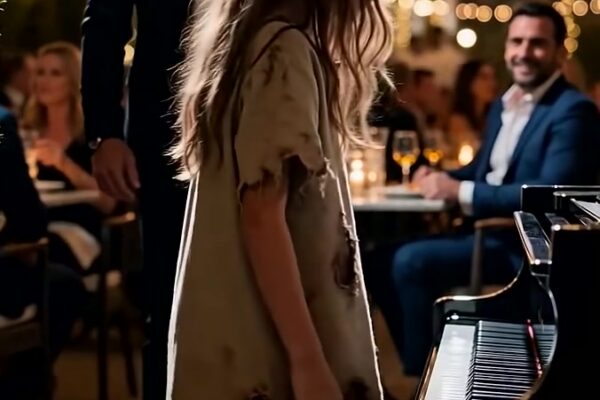
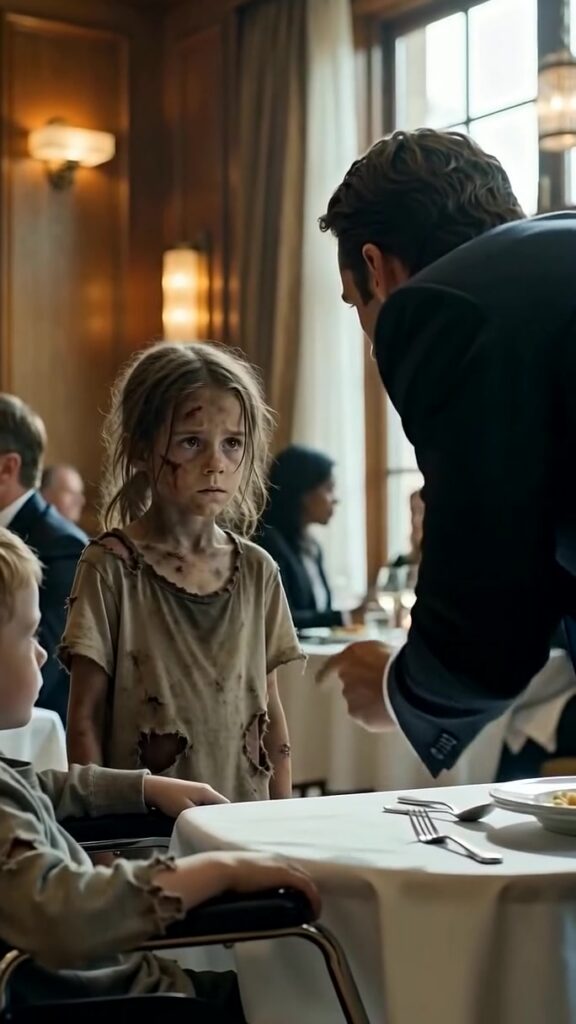
That was when the pattern of the evening broke. A figure slipped between tables where staff would never allow a wandering body, and yet no waiter intercepted her. She was small enough to be mistaken for a shadow, thin enough to look like she might fold in half if someone spoke too loudly. Her dress was a torn, faded thing that might once have been blue. Rain had pasted strands of hair across her forehead. Dirt clung to her knees. Hunger sat in her face like an accusation.
She stopped at their table with the strange steadiness of a person who had nothing left to lose. Her eyes—too bright, too awake—fixed on the father with a focus that seemed impossible for a child. “Give me food,” she said, her voice small but clean, each word placed carefully, “and I can make your son better.”
The father’s response was immediate, and it was the kind of laughter that didn’t rise from joy but from superiority. It cracked through the restaurant’s hush, turning heads like a thrown glass. “Make him better,” he repeated, savoring the absurdity. He leaned forward, pointing at her as if her presence were a stain he could indicate and have removed. “You’re a stray. You’re a story people tell to scare their children into eating. Go.”
For a heartbeat, the girl’s shoulders flinched. Her chin trembled as if the cruel sound had struck her in the ribs. The room waited for her to run. That was what they wanted—something predictable to restore the balance of the evening. But she didn’t flee. Instead, she turned away from the father like he’d become invisible and looked directly at the boy.
It was a simple thing, that shift of gaze, and it changed the air. The boy’s eyes, usually distant, were trained on her with a sharpness that made several diners forget to lift their forks. His fingers curled on the armrest. A faint squeak of rubber and metal rose from the wheelchair, suddenly loud in the polished quiet.
The girl took a half step closer, as if approaching a skittish animal. “If I’m nothing,” she murmured, words barely audible, “why do you look like you recognize me?” Her breath shook, but she held his gaze with stubborn courage. The boy’s mouth opened, then closed. Something flickered in his face—confusion, yearning, and beneath it a pain so old it had turned to stone.
The father’s smile died. He followed her stare to his son’s wrist, as if he’d only just remembered there was a boy attached to the tragedy he wore. Around that pale wrist was a narrow band of silver, scratched and dulled with time, a tiny charm hanging from it: a star, one point slightly bent.
The girl swallowed. Slowly, with fingers that trembled from cold and fear, she tugged up the frayed sleeve of her dress. A string was tied around her own wrist, knotted so many times it looked like someone had been afraid it might vanish. From it dangled another star—small, silver, worn in exactly the same way. Two pieces of one thought.
Color drained from the father’s face in a sudden, sick tide. His hand gripped the edge of the table, knuckles whitening. He knew those stars. He had seen them on an invoice years ago, a private indulgence his wife had ordered without telling him until the night she laid the little bracelets in his palm. One for each baby, she’d said softly, as if saying it too loud might frighten the future. Twins. Two stars, two hopes.
But only one child had been placed into his arms at the hospital. There had been paperwork, condolences, a tiny sealed box of ashes he’d never opened. A doctor with tired eyes had spoken of complications and mercy. His wife had cried without making sound. Then she had died later, leaving him with a son who wouldn’t speak and a grief he had smothered under wealth and routine, burying questions deep enough that even he couldn’t hear them.
The girl’s voice wavered, yet she forced it through. “My mother told me—if I ever found the boy with the other star—tell him she didn’t stop searching.” The words did not belong in this restaurant. They were too raw, too real. Chairs creaked as people shifted; someone near the bar stood without realizing it. A woman at the next table pressed a napkin to her mouth, eyes wide.
The father’s lips moved, but sound failed him. The girl turned her fierce gaze to him now. “They said I was gone,” she whispered, and in that whisper was a lifetime of cold nights and empty stomachs. “They took me away. They told you a lie because you had money and you were grieving and you would believe anything if it meant the pain could have an ending.”
Something in the boy broke free. His throat worked as if unused. Tears gathered, slow and disbelieving. He lifted one trembling hand off the armrest, the movement clumsy but determined, reaching across the white tablecloth toward the child who mirrored him in silver and starvation. His voice emerged like a fragile ember, the first warmth in a long winter. “S—” he tried, choking on it, then managed the word as if it cost him everything. “Sister?”
The girl’s face crumpled, not into weakness but into relief so fierce it looked like pain. She reached out too, and their fingers met above the untouched food. The father stared at their hands as though he were watching his own life split open, every controlled wall collapsing. The boy’s eyes stayed locked on the girl, and in them the deadened distance had shifted—just slightly—toward presence.
The girl glanced at the plates, then back to the father. “I said I could make him better,” she said, voice steadier now. “Not with magic. With truth. With a name he can say. With someone who knows what it feels like to be left behind.” She nodded toward the chair, toward the boy’s rigid legs. “The body follows the mind sometimes. And even when it doesn’t, the heart still can.”
The father’s throat bobbed. He looked around at the staring diners, the waiters frozen like statues, the polished room that had always obeyed him. For the first time, he seemed smaller than his suit. He reached for the girl’s empty hands and, with a trembling that embarrassed him, slid his own plate toward her. Then he stood, not to command, but to surrender something. “Bring her food,” he said to the staff, his voice hoarse. “Bring her everything.”
Outside, rain continued to write its private script on the window. Inside, the restaurant’s expensive quiet returned, but it had changed. It no longer felt like wealth. It felt like witnesses holding their breath. The boy’s fingers tightened around his sister’s, as if afraid a lie might snatch her away again. And in the space between two matching stars, a family began, painfully, to remember how to live.