The crowd came to see danger, and they bought it by the ticket—families in sun-bleached caps, teenagers already hoarse from yelling, old men with folded programs tucked into back pockets like prayers. They came for the crash of hooves and the brief illusion that bravery was something you could rent for eight seconds. The arena shimmered under late-day heat, a bowl of noise and metal bleachers and dust that rose from the ground like smoke from an invisible fire.
In the pens behind the chutes, the main event waited. The bull was black as a bruise and thick with old scars, the kind of animal people talked about the way they talked about storms—half terrified, half reverent. The stock contractors called him Ranger because he watched everything with a hard, measuring eye, and because he never seemed lost, not even in chaos. He had a reputation that made riders swallow twice before nodding for the gate: nobody got a clean second chance with him. Not a second ride. Not a second mistake.
The announcer, all polish and bright suit, worked the crowd like a conductor. He threw jokes into the air and caught cheers back, promised a show big enough to make their guts flip. The band played a few bars; vendors shouldered through the aisles. And the sun dropped lower, turning every grain of dust into a floating ember.
Then something small moved where it didn’t belong.
A shape slipped through a gap near the front railing—so quick at first it looked like a tossed hat, like someone had dropped a glove and leaned too far. But it was a child. A boy no older than eight, in a denim jacket over a gray hoodie, knees knocking as he hit the dirt and rolled once, palms scraping the ground. For a heartbeat the arena made no sound at all. It was as if everyone had inhaled and forgotten how to exhale.
“Hey—hey! Somebody get that kid!” the announcer barked, the microphone catching the sharp edge of his fear. People surged at the rails. A woman screamed a name that might have been the boy’s, might have been a prayer. The gate crew looked like they’d been struck dumb. In the pen, Ranger shifted, the metallic clank of chain and steel suddenly loud in the silence.
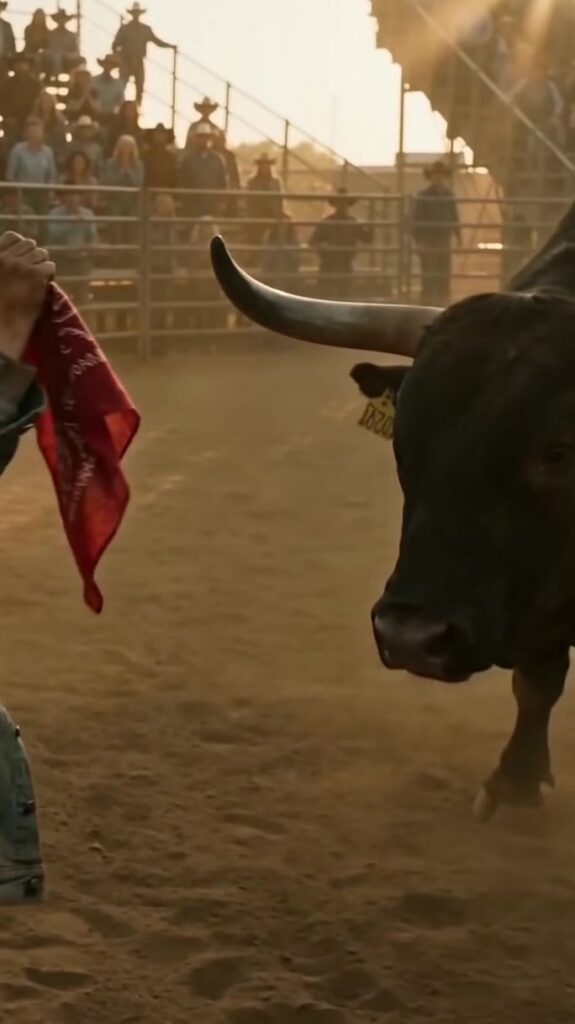
The boy didn’t run. He pushed himself upright with shaking elbows and faced the far end of the ring as if he’d stepped into a courtroom rather than an arena. In his fist he held a scrap of red cloth, faded like old blood washed too many times. He raised it carefully, the way you raise something fragile near a flame.
Ranger turned. One heavy hoof dragged a slow crescent in the dirt. His head came up, nostrils flaring, the white of one eye flashing as the world narrowed to the tiny figure in the open. The crowd—who had come for danger—realized all at once that they had been given it too honestly.
“Please,” the boy said. It wasn’t loud, not meant for the bleachers, but his voice carried anyway, thin as wire. “Please look at me.”
He opened his hand. The cloth dangled from his fingers, frayed along the edges, with initials stitched into one corner in uneven thread: J.M. The moment the letters showed, something shifted in Ranger’s posture. He was still coiled power and muscle, still the kind of creature that could break a man like a stick, but the hard line of his neck softened—just enough to be real, just enough to be terrifying in a different way.
“My dad said you’d know this,” the boy whispered, and his chin trembled though he held his arm steady. “He said you’d remember.”
One by one, the shouts died. The front row quieted first, then the bleachers, then even the announcer, who lowered the microphone as if it had suddenly become rude to speak. In the sudden hush, the sounds came sharp: Ranger’s breath, the faint rattle of a loose gate latch, the boy’s sniffling swallow as he fought his own fear into submission.
“He loved you more than anything,” the child said. Tears spilled down his cheeks and darkened the dust on his face. “And I… I don’t have him anymore.”
Ranger began to move.
His first step was slow, the way a landslide is slow at the start. His second step dug deeper, sending dust puffing up around his hooves. Somewhere in the stands a man shouted for the boy to run, his voice cracking. Another voice cried, “Open the gate!” Someone else sobbed. The boy didn’t flinch. He stepped forward too, as if meeting the bull halfway could somehow make the truth gentler.
“If you remember him,” he said, every word breaking on the next, “don’t leave me too.”
Ranger charged.
The crowd screamed as one body. Dust erupted in a golden wall. The force of the bull’s movement made the air feel as if it had been punched. The boy’s eyes squeezed shut for a single instant—only that—then opened again, wide and shining, locked on the thunder coming toward him. He held up the bandana like a flag no one else could read.
Ranger closed the distance in a heartbeat and stopped so close the boy’s hair lifted in the bull’s hot breath. The animal’s massive head hovered over the child, muscles quivering under hide, horns angled like punctuation to a sentence nobody wanted finished. The silence afterward was not relief; it was disbelief.
“Ranger,” the boy breathed, his voice barely there. “It’s me. I’m… I’m Jacob’s.”
The bull released a deep, trembling snort and lowered his head—not to gore, not to toss, but to press the broad weight of his forehead into the boy’s chest. It wasn’t gentle the way a pet is gentle. It was enormous and careful, like something trying not to shatter what it touched. The boy made a sound that was half sob, half laugh, and he folded his free arm around the bull’s face as far as he could reach, as if hugging a mountain.
From the announcer’s platform, an old ranch hand named Wade Cochrane went the color of ash. His fingers locked on the railing so hard his knuckles whitened. He’d been around long enough to recognize stitches the way some men recognize handwriting. He’d seen that bandana before—in a locker, in a fist, knotted around a wrist on nights when Jacob Miller rode like he had nothing to lose.
Wade stumbled down the stairs, nearly missing a step. When he reached the dirt, his boots kicked up dust as he ran toward the boy and the bull—toward the impossible sight of danger choosing not to be dangerous. The gate crew moved at last, creeping closer, but Wade lifted a hand, stopping them with a single gesture that carried years of authority.
The boy looked up over Ranger’s lowered head, eyes red and furious. He held the bandana out so Wade couldn’t pretend not to see it. His small voice cut through the arena like a knife.
“You lied to my dad before he died,” he said.
Wade froze, the words landing on him heavier than any bull. Around them, the crowd held its breath again, waiting for the next kind of impact—one you couldn’t measure in seconds.
“Kid,” Wade managed, and the name sounded like gravel in his throat. “What’s your name?”
“Miller,” the boy snapped, as if the answer were an accusation. “Jesse Miller.” His hand shook now, not from fear of Ranger, but from something older and sharper. “My mom said my dad had no family. You told everyone he didn’t. But he left me this.” He lifted the bandana higher. “And he left me a bull that remembers him. So don’t stand there and act like I’m a story.”
Wade’s eyes flicked to Ranger, who stood like a black statue with his head still resting against the boy, as if guarding him. Then Wade’s gaze went past the arena fence, past the bleachers, to the dusty parking lot where the past always waited. His mouth opened, closed, and opened again.
“Jacob,” Wade said softly, as if speaking to a ghost, “you swore you didn’t want the boy anywhere near this.”
Jesse’s face tightened. “He didn’t get to choose what I’m near,” he whispered. “You did.”
Wade’s shoulders sagged, and in that sag the crowd felt the shape of something they’d never paid to see: a man collapsing under a secret he’d been carrying too long. “I told him,” Wade admitted, voice shaking, “that if he rode Ranger again, he wouldn’t walk away. I told him it would kill him. And he said—” Wade swallowed, eyes wet—“he said he’d rather die on his own terms than live like the world owned him.”
Jesse flinched as if struck. Ranger lifted his head slightly, breathing against the child’s jacket, and Jesse’s fingers dug into the bandana as though it were the only solid thing left.
“So you erased him,” Jesse said, quieter now, more wounded than angry. “You erased me.”
Wade shook his head. “I tried to protect you,” he said, and the words sounded pathetic in the open air. “I tried to keep you out of the rodeo’s mouth.”
Jesse looked at Ranger, at the massive animal who had been sold as entertainment, labeled as menace, made into a legend for strangers. The bull’s eye was dark and steady, fixed on the child like recognition could be a promise.
“Then help me now,” Jesse said. “Don’t let them turn him into a monster just because it sells tickets. Don’t let them forget my dad. Not again.”
Wade’s gaze swept the silent stands, the stunned announcer, the workers hovering at the edges. He saw the crowd that had come for danger and found, instead, a boy standing in the middle of it with a piece of red cloth and a name everyone had buried. Wade drew in a breath that looked like it hurt.
“All right,” he said. “We stop the show.”
Gasps rippled outward. The announcer protested weakly, then fell quiet under Wade’s look. Wade stepped closer, slow, and Ranger didn’t move to strike; he only angled himself, placing his bulk between Jesse and the world.
Wade reached out, not to the child first, but to the bull. His hand hovered, then rested on Ranger’s neck, feeling the tremor of strength beneath the hide. “Easy,” Wade murmured. “Easy, old boy.”
Jesse wiped his face with his sleeve. “He stopped for me,” he said, wonder leaking into his voice despite everything. “He stopped.”
Wade nodded, blinking hard. “Because he knows,” he said. “And because maybe—” His voice broke. “Maybe Jacob left you the only thing in this place that tells the truth without opening its mouth.”
In the golden light, with dust drifting down like ash, the gates finally opened—not with the rush of men to seize a child, but with a careful, reverent slowness. Wade guided Jesse step by step toward the exit, Ranger walking beside them like a shadow that had decided to be a shield. The crowd watched, silent and changed, as danger left the ring without taking anything this time—except the lie that had been living there for years.
Outside the arena, beyond the noise and metal, Jesse clutched the bandana to his chest and looked back once at the place that had taken his father. Ranger paused at the threshold, turning his head as if listening for a voice only he could hear. Jesse lifted his chin.
“I’m still here,” he whispered, not sure who he was talking to. “I’m still here.”
And for the first time that day, the crowd—who had come to see danger—understood they were watching something far more frightening than a charging bull: the moment a buried truth claws its way back into the light.