Adrian had only wanted ten quiet minutes with his daughter—ten minutes where no one asked about invoices, court dates, therapy schedules, or why the lock on the upstairs pantry had to be replaced again. Ten minutes where the world did not feel like a courtroom waiting for him to choose a side. In the park, the light came through the maples in stained-glass shards, and the benches wore a soft coat of fallen leaves as if autumn had been carefully tucking everything in.
Rina sat close enough that the sleeve of his coat brushed her elbow. Dark glasses covered her eyes; her white cane lay across her lap like a fragile bridge. She was nine and had mastered stillness in a way that hurt him. Her chin tipped toward the sun, as if she could taste warmth with her face. Adrian watched her fingers worry the edge of her mitten and tried to believe—tried, fiercely—that calm could be real.
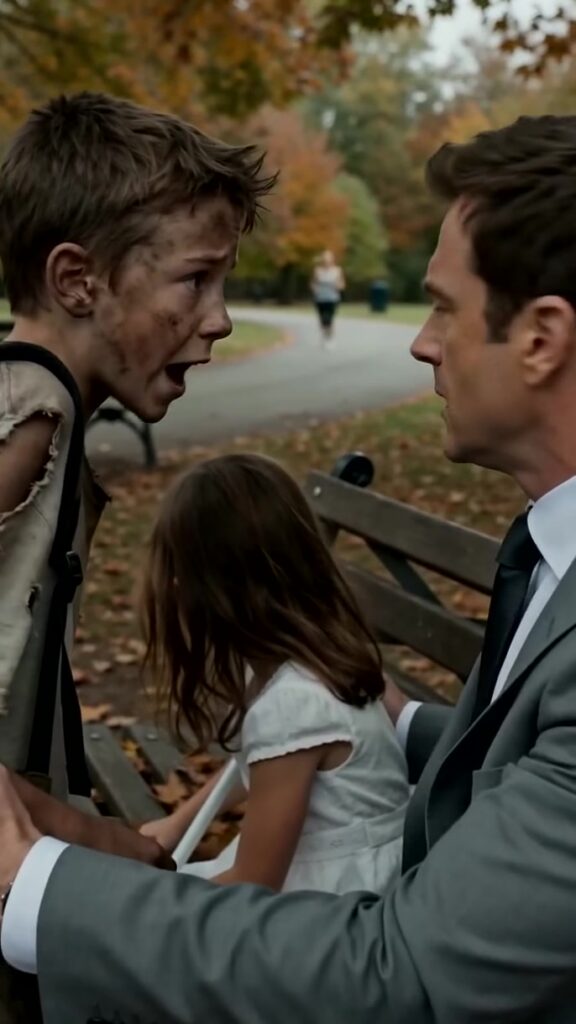
He heard the footfalls before he saw the boy. A scuffing run, too fast for a stroll, too panicked to be play. The boy appeared at his side like a startled animal, all elbows and frayed fabric, a backpack gaping with loose papers and something metallic that flashed and disappeared. He seized Adrian’s sleeve with fingers that shook so hard the fabric trembled with them. His eyes—muddy brown, too old for his narrow face—flicked to Rina, then back to Adrian as if the trees might be listening.
“Sir,” he rasped, and his voice was so thin it almost vanished. Adrian’s patience, already strained by months of worry, snapped into a hard line. “Let go,” he started to say, but the boy leaned closer, breath smelling of cold air and stale bread. “Your kid—she isn’t what you think.” The sentence came out broken, but it hit with the force of a thrown stone.
Adrian turned sharply, the world narrowing to the boy’s mouth. “What did you just say?” The boy’s grip tightened. “She can see,” he said, and his gaze darted toward Rina as if apologizing to her. Adrian felt heat rise up his neck, the familiar anger that had carried him through doctors and specialists and endless reassurances. Rina remained motionless. A leaf spiraled down in the quiet space before her face. He watched it without meaning to, trapped by the simple physics of falling.
Rina’s head turned. Not the slow, uncertain turn Adrian had learned to accept, but a clean follow, as exact as a compass needle. Beneath the glasses, her gaze tracked the leaf’s lazy descent. The cane began to slide from her lap, and her hand shot out—quick, sure—to catch it before it could clatter to the ground. She froze again, as if she had stepped off a line and instantly tried to step back. Adrian’s stomach dropped so violently he had to swallow to keep from making a sound.
The boy released Adrian’s sleeve at last, but he didn’t run. His shoulders shook as though the cold had finally found him. “I saw her look,” he insisted, and his eyes shone with something that wasn’t triumph. It was fear. Adrian’s mind stumbled over a dozen explanations—practice, accident, wishful thinking—but none of them fit the crispness of what he had just witnessed. He lifted his gaze past the boy, down the path that curved through the trees, and saw a woman jogging toward them in a bright running jacket.
Elena. His wife. Her stride was smooth, practiced. She wore that expression Adrian used to love: focused, determined, cleanly resolved. She waved as she drew closer, smile already forming. The boy’s voice dropped until it was nearly swallowed by the rustle of leaves. “I sleep behind the garages near your street,” he whispered, as if confessing a crime. Adrian’s heart began to batter his ribs. “What did you see?” he asked, and his own voice sounded like it came from someone else.
The boy pointed with a trembling hand, not at Elena exactly but at the idea of her approaching. “At night,” he said. “She goes into the kitchen. She opens a little bottle and measures it like she’s baking. Not much. Just… enough. She stirs it into something sweet. I saw her wipe the spoon and put it away. Then in the morning she acts like she’s helping.” The boy swallowed hard. “It’s for your daughter.”
Adrian’s thoughts scattered. Images collided: Elena packing lunches with careful precision, Elena insisting on certain vitamins, Elena correcting him when he offered Rina juice instead of tea. The memory of Rina’s diagnosis—‘sudden onset,’ ‘rare,’ ‘maybe stress-related’—flared like a match in his head. He remembered the night Rina had screamed that the room had gone dark, and Elena had held her too tightly, whispering, “It’s okay, it’s okay, just let it happen.” He remembered the faint, bitter scent in the porridge Elena always made: cinnamon, she’d said. But cinnamon didn’t bite the back of the tongue.
Beside him, Rina slowly turned her face toward the path. Her lips parted. Her voice came out as a tiny fracture in the cold air. “Daddy,” she said, and the word sounded older than nine. “Please don’t tell her I can see today.” Adrian’s breath stopped. Today. As if it had been an on-and-off miracle. As if sight were something she sometimes dared to borrow. Rina’s gloved hand found his coat with aching certainty and squeezed, hard. “If she knows,” Rina whispered, “she’ll fix it.”
Elena’s jog slowed into a walk a few yards away. She lifted her hands in a cheerful shrug, the picture of a mother arriving to join them. “There you are,” she called, voice bright as glass. Then she noticed the boy. Her smile faltered, not with surprise but with calculation—an instant of assessing threat. “Who’s this?” she asked, still pleasant, still careful. Adrian felt the park tilt. The quiet he had wanted turned into a cavern where every sound mattered: Elena’s breath, the boy’s ragged inhale, the scrape of a twig under someone’s shoe.
Adrian stood, placing himself between Rina and Elena without knowing he’d moved. He kept his hand over Rina’s fingers, holding them against his palm like an oath. “He says he saw you,” Adrian said, and the words tasted metallic. Elena’s eyes flicked to Rina’s cane, to the dark glasses, then to Adrian. A slow softness spread across her expression, a practiced tenderness. “Adrian,” she began, stepping closer, “don’t listen to—”
“Stop,” Adrian said, and the command came out sharp enough to slice the air. He looked down at his daughter. “Rina,” he asked, forcing his voice to steady, “how long?” Rina’s shoulders quivered. She did not lift her glasses. She didn’t have to. “Since spring,” she admitted. “I could see a little at first. I told Mommy. She said it was dangerous. She said if anyone knew, they would take me away to a place where they hurt kids to make them ‘normal.’ She said the drops would keep me safe. She said the dark was safer than the truth.”
Elena’s face tightened, just for a heartbeat, and Adrian saw something he had never named before—a hunger for control so absolute it masqueraded as love. She took another step. Adrian stepped back, drawing Rina with him. The boy hovered near the bench like he wanted to vanish into the leaves. “You were poisoning her,” Adrian said. “Why?” Elena’s eyes shone, and for a moment her voice lost its sweetness. “Because you were leaving,” she said, each word clipped and clean. “You were going to take her. You were going to prove I wasn’t needed. A blind child needs her mother. A blind child stays.”
The confession landed with a terrible simplicity. Adrian felt something in him crack, not with anger but with grief so deep it emptied him. He took out his phone with a hand that barely obeyed. Elena’s gaze darted to it. She reached out—fast—toward his wrist. Rina’s cane struck the ground between them with a sharp tap, a small weapon of sound. Rina had raised it. Not blindly. Deliberately. Elena stopped as if the tap had shocked her.
Adrian dialed emergency services. His voice, when he spoke, was quiet and unwavering. He gave the location, described his wife, his daughter, the boy’s account. Elena’s breath came ragged now, her composure peeling away like wet paper. “Adrian,” she pleaded, stepping back, palms open, “I did it for us.” Adrian looked at Rina, at the child who had been forced to live in darkness to keep an adult’s lie alive. “No,” he said. “You did it to keep us from having a choice.”
When the sirens finally threaded through the trees, the park seemed to exhale. The boy sat on the edge of the bench, trembling less now, as if the act of speaking had anchored him. Adrian pulled Rina close and, with gentle fingers, lifted her glasses. Her eyes were there—wide, brown, unmistakably seeing. They darted to the blazing leaves, to the sky, to Adrian’s face as if she were terrified of the privilege. Adrian pressed his forehead to hers. “You can look,” he whispered. “You can look all you want.”
Rina blinked, and a tear rolled down, catching the pale light. “Will she be mad?” she asked. Adrian watched Elena as officers approached, heard her protesting voice fracture into sobs. “She’ll be held responsible,” he said. Then he looked at the boy, at his torn sleeves and frightened eyes, and he made a decision that felt like the first true thing he had done in a year. “And you,” Adrian said softly, “you’re not going back behind those garages tonight. We’re going to get you somewhere warm.”
The ten quiet minutes were gone. In their place was a harsher, louder world—one that demanded action and truth. But as Rina turned her uncovered eyes toward the drifting leaves and watched them fall with open wonder, Adrian understood something: quiet had never been the goal. Safety was. And safety, he realized, was sometimes the sound of sirens arriving in time.