Lena had been crying for so long that her hands no longer trembled when they touched the cold stone. The chill of it seeped into her palms as if the grave itself were drinking her sorrow, the way the earth drank the rain that slicked the autumn leaves. She didn’t lift her face. She didn’t need to. She knew every line of the headstone by touch now—the carved crest at the top, the groove where the mason’s chisel had slipped, the shallow oval where the portrait had been set like an eye that never blinked.
Marcus knelt beside her, his coat dark with damp, his breath rising in thin, angry threads. In the portrait, two boys smiled with a confidence that only children could afford. Samuel, taller by a head, with a stubborn chin. Theo, narrower, leaning in as if he could borrow his brother’s courage. Three years. Three years since smoke had swallowed them and the river had carried the rest away. Grief hadn’t softened. It had only learned to walk quietly behind them, a familiar shadow in every room.
The voice came from the path like a sudden cut. “They stay with me at the orphanage on the East side.”
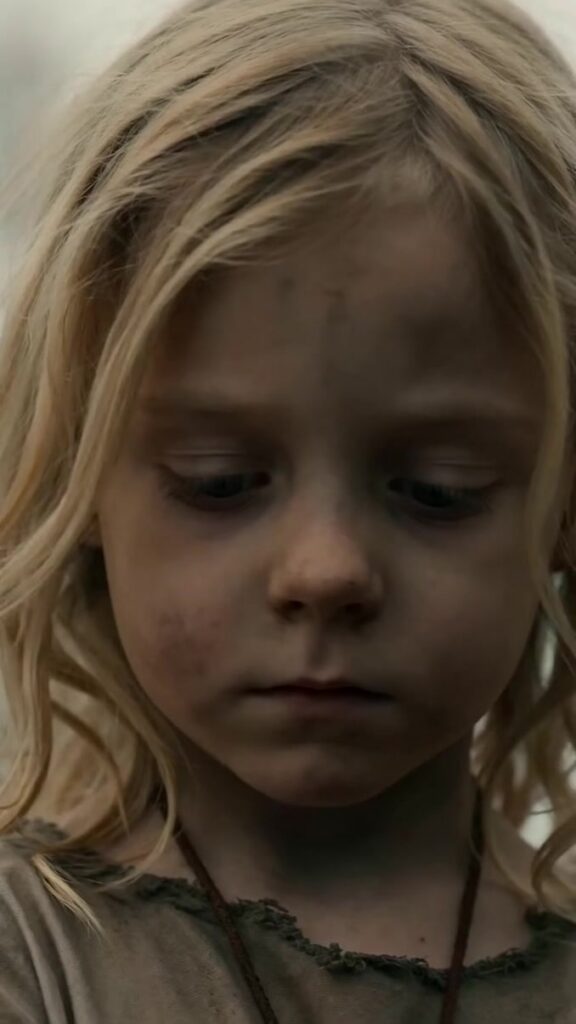
Lena lifted her head, the motion slow, the way you rise from deep water. Across the grave stood a child in a torn smock, bare feet mottled with mud, pale hair caught with leaves. Her stare didn’t wander the cemetery. It was fixed on the photograph, and her finger hovered between Samuel and Theo as if she could press them back into the world.
Marcus pushed up from his knees, the movement stiff, as though his joints had turned to hinges of rust. “What did you say?” His voice sounded unfamiliar to Lena—thinned by fear, scraped raw.
The girl didn’t flinch. She only spoke as if reciting a fact that had always existed. “The little one cries at night,” she said softly. “The taller one tells him to hush, because he says your mother will hear.”
Lena’s throat closed. The cemetery tilted. That detail—the way Samuel had always shushed Theo by promising that Lena could hear him through walls, through storms, through anything—had belonged to their home alone. Not even Marcus had known how often she’d stood outside their bedroom door, hand on the knob, listening to their whispered councils and tiny sobs. Secrets like that didn’t travel. They were supposed to die with the people who made them.
“Who are you?” Marcus demanded, but it wasn’t anger now; it was a pleading disguised as command. The girl lowered her hand and, for the first time, Lena saw the pendant glinting at the child’s throat—old silver, dulled at the edges. It bore the same crest as the headstone, the same curling stag with a broken antler that Marcus’s family had stamped on letters and locked into wax.
Lena stood, legs unsteady. “Marcus,” she breathed, and the name came out like a warning.
The girl’s fingers rose protectively to the pendant, as if she’d been told to guard it with her life. “The boys said if I found you here, you’d know me.” Her voice wavered for the first time, not from cold but from the burden of what she carried.
Marcus took a careful step around the grave, as though the stone were a line he couldn’t cross too quickly. “Know you how?”
Sadness flickered across the child’s face. “The woman at the orphanage says I was left there the same winter they came.” She swallowed hard. “They don’t talk about the fire. But sometimes, when they think I’m asleep, they count the nights like prisoners.”
The winter of the fire. Lena tasted ash in her mouth. She saw again the lanterns bobbing by the river, the blackened ribs of the overturned carriage, the priest’s hand firm on her shoulder as he told her not to look, not to hope, not to tear open what God had closed. She remembered how obedient she had been, how desperate to believe that agony could be contained by rituals and clean words. If this child was right, then obedience had not been virtue. It had been abandonment.
“What are their names there?” Lena whispered, as if speaking too loudly might fracture the fragile thread between this moment and whatever lay beyond it.
“They call them Sam and Thomas,” the girl said. “But in their sleep, they still say Samuel and Theo.”
A sound cracked out of Marcus—half gasp, half grief, the noise of something breaking that had been held together by will alone. He dropped into a crouch to be level with the girl, his hands clenched as if he feared they might reach out and shake her until the world made sense. “If you’re telling the truth,” he said, each word dragged from deep inside him, “why come now?”
The child’s eyes flicked toward the cemetery gates, toward the line of trees beyond which the town crouched in its own secrets. “Because tomorrow a man is coming,” she said.
“What man?” Marcus asked.
“He wears black gloves,” the girl replied, and shivered as if even the memory of them touched her skin. “The boys are scared of him. He told the headmistress that after tomorrow, no one will ever find them again.”
The wind rose and sent leaves skittering across the stones like fleeing insects. Lena grabbed Marcus’s sleeve, nails biting through wet fabric. “Marcus,” she said again, and this time the word was a rope thrown to pull him back from the edge of collapsing. But Marcus’s face had already changed; grief had folded away to reveal something hard beneath it—a father’s ferocity, sharpened by years of helplessness.
“Where is it?” he asked, voice low, dangerous. “The orphanage.”
The girl pointed beyond the iron gates, toward the East side where the river cut the town from its poorer half, where buildings leaned together as if to share warmth. “Past the tannery,” she said. “The house with the boarded windows. They keep the children quiet there. They say noise makes people curious.”
Marcus’s jaw worked. Lena watched him assemble himself, piece by piece, into a man who could move, who could act, who could burn down a world if it meant finding his sons. “And this man,” he said, “why do you think he matters?”
The girl’s chin trembled. She looked directly at Marcus, and the grief in her small face was too heavy to belong to a child. “The older boy told me one more thing,” she whispered. She held Marcus’s gaze as if it pained her to deliver the last blade. “He said the man coming tomorrow… has your eyes.”
For a heartbeat, the cemetery was silent. Even the wind seemed to pause, waiting. Lena felt the cold stone behind her and understood, with a sudden clarity that made her sick, that the danger wasn’t only outside their family. The crest on the pendant, the insistence on secrecy, the way the priest had urged them not to look—these were not accidents. They were decisions made by someone who had authority, someone close enough to shape the story of that night.
Marcus stared past the girl, past the grave, into a distance only he could see. When he finally spoke, it wasn’t to her. It was to the boys in the photograph, to the ghost of the father he’d been forced to become. “Then he’s either kin,” he said, voice rough as gravel, “or he’s wearing my face.” He stood and offered Lena his hand. This time, her fingers did tremble when she took it—not from grief, but from the fierce, terrifying resurrection of hope.
The girl stepped back onto the path, barefoot in the wet leaves. “Don’t wait,” she said. “He comes early. Before the bells.” She touched her pendant once, then turned and ran, vanishing between the stones like a rumor carried by wind. Lena watched the empty space she left behind, and then she looked at the headstone. The carved crest stared back at her, no longer a memorial but a mark—proof of ownership, proof of a claim.
Marcus squeezed her hand until it hurt. “We’re going now,” he said.
Lena nodded, tears starting again, but they were different tears. They were hot, furious, alive. She leaned forward and pressed her forehead to the cold stone one last time, as if taking an oath from it. “Hold on,” she whispered to the smiling boys. “If you’re out there, hold on.” Then she straightened, and together she and Marcus walked out of the cemetery, leaving the quiet dead behind to chase the ones who had been stolen.”