In Marrow Creek, time did not pass so much as it repeated itself. Tuesday was always the same day in the same diner off Route 19, where the neon sign buzzed like a tired insect and the window glass held years of fingerprints and sun-bleached advertisements. At noon, as reliable as the whistle of the train that never stopped there, the old man arrived.
He never asked for a menu. He never looked at the specials on the chalkboard. He slid into Booth Seven—second row, by the window that faced the highway—and nodded once as if answering a question no one had spoken aloud. A single black coffee would appear, no sugar, no cream, and he would rest his worn wooden cane against the seat beside him like it was a companion, not an object. Then he would stare outside with a quietness that pulled the room down a half-step, making strangers keep their voices low without understanding why.
The waitresses called him Mr. Hale. It wasn’t because he introduced himself. It was because one morning, years ago, a letter had fallen from his jacket when he reached for a wallet, and the name had been visible on the corner of an envelope: Hale, in block print. That was all it took. In a town like Marrow Creek, a name was a hook; people would hang stories on it whether it could bear the weight or not.
Mr. Hale was not unfriendly. He was simply sealed shut, like a room whose key had been thrown away. He tipped in exact change. He drank half the coffee. He stayed fifteen minutes, sometimes twenty, then tapped his fingers once on the table as if concluding a meeting, rose with care, and left.
On a Tuesday in late autumn, the air carried that thin, metallic cold that warned of snow. The diner was half full, a typical noon crowd: a few road crew men, a mother with a toddler, a couple of retirees splitting pie. Mr. Hale sat in Booth Seven at exactly twelve o’clock, his cane propped beside him, steam from his coffee lifting like a small ghost.
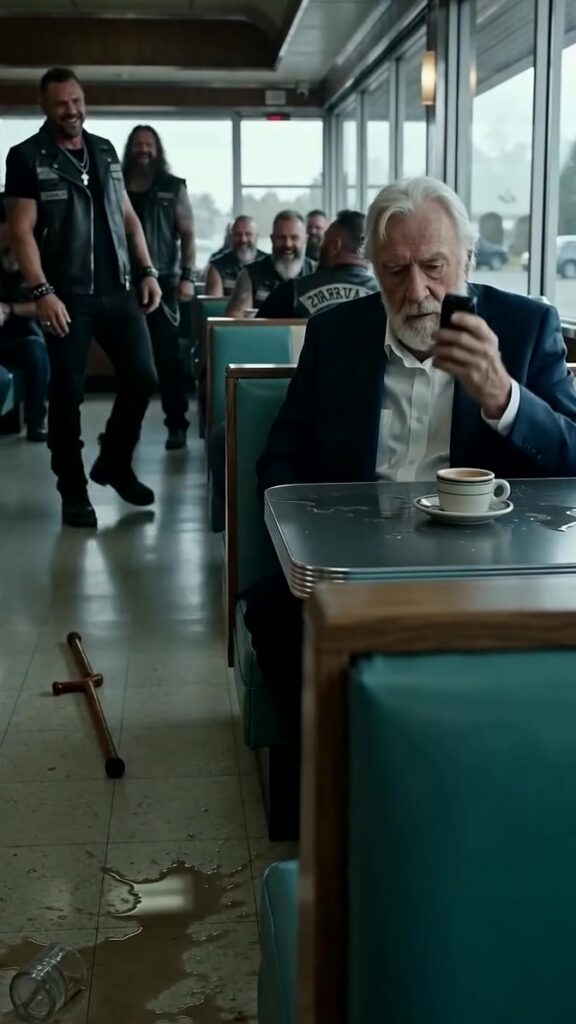
The bell over the door rang hard, not with one polite jingle but with a series of impacts as if the door had been struck. Six bikers entered, wearing leather and noise. Their laughter came first, then the smell of gasoline and cold wind, then the heavy stomp of boots against tile. Heads turned. Forks paused midair. The mother drew her child closer. Even the fry cook leaned forward from his grill, eyes narrowed.
Their leader stood out by sheer mass. He had shoulders like a doorway and a beard that made his grin look carved. His name—people would learn later—was Rex. He scanned the room like it belonged to him. And then he saw Booth Seven.
Something about the old man’s stillness caught in Rex’s throat like an itch. Quiet dignity has a way of provoking men who mistake volume for strength. Rex sauntered down the aisle with his crew spreading behind him in a loose semicircle, spectators in their own show.
He planted a hand on the top of Mr. Hale’s booth and leaned in, close enough that his breath fogged the window. “Look at this,” he said, loud enough for the room. “A man sitting like he owns the place.”
Mr. Hale did not look up. He did not flinch. His gaze remained trained on the highway, as if he were listening for something approaching from far away.
The bikers chuckled. Rex’s smile sharpened. He reached down, seized the cane, and pulled it free with a quick jerk. The motion rocked the small table. A water glass tipped, hit the edge, and shattered on the tile with a bright, ugly crack. A few diners gasped. The waitresses froze, hands full of plates.
Rex lifted the cane overhead as if it were a banner. “Careful!” one biker called, and the others roared. “The old man might need that to run away!”
Mr. Hale remained seated. His hands lay flat on the table, palms down, as steady as paperweights. He looked at the spreading puddle of water, the glittering shards, the way the diner lights caught on broken edges. Then he turned his eyes—slowly, deliberately—to Rex.
Rex’s laughter continued, but it lost a fraction of its ease when he noticed the change in the old man’s expression. It wasn’t anger. It wasn’t fear. It was recognition, the kind that lands like a verdict.
Rex dropped the cane. It clattered to the floor, rolling toward the base of Booth Seven. “What,” Rex scoffed, though the word came out less confident than he intended. “Got something to say now?”
Mr. Hale’s eyes moved, not to Rex’s face, but to the inside of his leather collar, where a faded patch had been stitched in a place most people wouldn’t look. A silver hawk, wings outstretched, old thread worn almost white. The sight of it seemed to tighten the air around Booth Seven. For the first time in years, the old man’s mouth hardened into a line that carried history in it.
He slipped his hand into his jacket and withdrew a small, black key fob. It looked ordinary—cheap, even—except that the old man held it with the ease of habit, like a man used to pressing it when decisions had already been made.
Rex barked a laugh. “What’s that, grandpa? You calling a taxi?”
Mr. Hale pressed a button.
Nothing dramatic happened inside the diner. No alarm. No flashing lights. Just a soft click from the fob, as intimate as the sound a lock makes when it opens. Mr. Hale lifted the device to his ear and spoke in a voice so calm it forced everyone within earshot to listen.
“It’s Hale,” he said. A pause. Then two words, quiet as a prayer and heavy as a command. “Bring them.”
He lowered the fob and placed it on the table next to his coffee cup, precisely aligned with the edge as if even that small detail mattered. Rex’s grin wavered, trying to keep its shape. “Who exactly are you calling?”
Before Mr. Hale answered, the sound arrived through the window: tires screaming against cold asphalt. Heads turned as if pulled by a string. Outside, three black SUVs swung into the lot at speed, not drifting like reckless teenagers but moving with practiced aggression, sliding into positions that blocked the diner’s exits. Their headlights flared through the glass, bleaching faces pale.
The diner went silent, the kind of silence that doesn’t belong to a building but to an event. Doors opened. Men stepped out. Not in biker leather, not in sheriff uniforms—dark suits, short haircuts, earpieces catching the light. They moved with purpose, spreading like a net, hands near their coats without theatrics. The bell over the diner door jingled as the first of them entered, and suddenly that harmless sound felt like a gavel strike.
Rex swallowed. His crew shifted, bravado draining into wary calculation. “What the hell is this?” Rex asked, but the question was weaker now, aimed more at the room than at the old man.
Mr. Hale finally picked up his cane from the floor and set it upright beside him, as if reclaiming a part of himself. His eyes returned to the patch. When he spoke, his tone did not rise. It did not need to.
“That hawk,” he said. “You don’t wear it unless someone handed it to you. Someone who earned it.”
Rex forced a scoff, but his voice cracked. “It was my old man’s. So what?”
One of the suited men halted behind Rex, close enough that Rex could feel his presence without turning. Another stood near the door, eyes scanning, evaluating angles like a man measuring risk. The diners sat frozen, caught between the instinct to flee and the sense that any movement might snap something in the air.
Mr. Hale’s gaze lifted to Rex’s face. The old man’s eyes were pale and sharp, and in them was not hatred but certainty—cold, complete, and unafraid. “Your father,” he said, “didn’t wear that patch. He carried it.”
Rex’s brow furrowed. “How would you know anything about—”
“Because I stitched it back together after it came off in a fight overseas,” Mr. Hale replied. The words did not sound like a boast. They sounded like the reading of a record. “Because I stood beside the man who first wore it when he swore an oath that cost him more than you’ve ever risked.”
Rex’s mouth opened, then closed. His eyes darted, searching for an exit that did not exist.
Mr. Hale tapped the table once, the same small motion he made every Tuesday when he finished his coffee. “If that patch came from the person I think it did,” he said, “then you didn’t just come in here to amuse yourself.”
He leaned forward a fraction, and in that slight shift the entire booth seemed to become a courtroom. “You took your grandfather’s cane,” Mr. Hale continued, “and you raised it like a prize.”
Rex’s face drained of color. “That’s—” he began, but the word died when he saw the suited men’s expressions: not surprise, not confusion, but recognition. They weren’t here because of noise or broken glass. They were here because of the name Hale spoken into a device and obeyed without question.
Mr. Hale’s voice softened—not with mercy, but with something like sorrow sharpened into steel. “I came here every Tuesday because your grandfather used to meet me at this booth,” he said. “Same time. Same coffee. Same window. He said if anything ever happened to him, I’d know which face would come looking for his shadow.”
Rex’s jaw trembled. The tough posture collapsed into something smaller, younger, frightened. The patch at his collar suddenly seemed less like a trophy and more like a brand.
Mr. Hale stood. It was slow, careful, but not weak. The diner held its breath as he straightened to his full height. He did not raise his voice. He did not threaten. He simply looked at Rex the way a man looks at a door he has decided to close.
“You’re going to sit,” Mr. Hale said, “and you’re going to listen. Then you’re going to tell me where you got the patch, and what you did with everything that belonged to the man who gave it to you.”
The suited men stepped closer, the circle tightening without a single hand laid on a weapon. Rex’s crew glanced at each other, calculating, but the room had changed. Power had entered and settled like gravity.
Rex lowered himself into the booth opposite Mr. Hale, his knees bumping the table. For the first time since he had walked in, he looked less like a king and more like a grandson caught stealing from a grave.
Outside, the highway continued to hum with passing cars that never slowed. Inside, Booth Seven finally held the meeting it had been waiting for—one that didn’t end in coffee and silence, but in truth dragged into the light, and a legacy reclaimed one trembling breath at a time.