Snow came down in patient flakes, the kind that made the city look gentle while it quietly punished anyone left outside. Cars hissed through slush. Boots struck the pavement in a hurried rhythm. Faces stayed aimed at phone screens, collars, or the invisible point just beyond the next obligation.
On a bench near the mouth of the subway, a young woman sat as if she’d been placed there and forgotten. Not old, not even worn-out by years—worn-out by something sharper. Her coat was the wrong season and the wrong size. One shoe had gone missing days ago; the other was a thin, split thing, soaked through. She held her hands together, not to pray, but to keep the last heat from escaping. Her eyes were open, yet she watched nothing. Asking required breath, and breath felt expensive.
People passed and practiced the same trick: they softened their gaze until she became part of the street furniture, a shadow stitched into winter. A teenager glanced at her, then quickly looked away as if attention might be contagious. A man in a business coat stepped wide around the bench. A couple laughed too loudly, the sound snapping in the cold.
Then a child stopped.
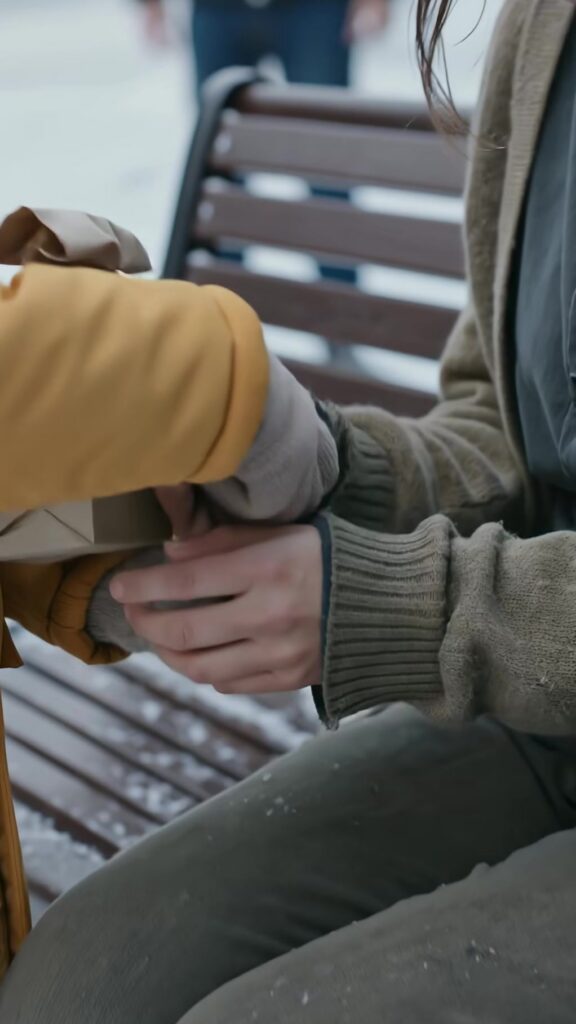
She was small, bundled in a bright yellow coat that looked almost indecent against the gray. Her boots were new. Her hat had a pom-pom. Her mittens were the thick kind that made her hands into round paws. She held a brown paper bag against her chest with both arms, as if it were precious or heavy. The bag released a faint, buttery warmth into the air.
The woman barely moved at first. Children were dangerous in their innocence; they could point, ask loud questions, call adults over. But the girl only stepped closer until the tips of her boots nearly touched the bench.
“Are you cold?” the child asked.
The question landed like a stone in still water. The woman looked up slowly, careful not to hope for anything. The girl’s face was red from the weather, her lashes dusted with snow. Her eyes were watchful in a way that didn’t belong to someone that young.
“A little,” the woman managed. Her voice sounded cracked, as if it had been folded away and forgotten for a long time. “But I’m okay.”
The girl frowned at the answer, as if it didn’t fit the evidence. She thrust the bag forward with both mittened hands. “These are for you.”
The woman stared at the bag. “You should keep them,” she said automatically. “Your parents—”
“My dad bought them,” the girl cut in, quick and sure. “He thinks I get hungry after school. But you look like you didn’t eat today.”
Inside, through the thin paper, the warmth was undeniable. The woman took the bag carefully, her fingers shaking so badly she nearly dropped it. The smell of cinnamon rose up and hit her with a sudden, brutal memory: a kitchen she used to stand in, flour on her wrists, laughter in her throat. Her eyes burned.
“Thank you,” she whispered, and meant it.
That should have been the end. A child’s small mercy, a stranger’s gratitude, the world continuing. But the girl didn’t turn away. She remained planted, studying the woman’s face with a concentration that made the woman’s skin prickle, like she’d been recognized by someone she’d never met.
The child tilted her head. “You need a home,” she said, the words as plain as blocks. “And I need a mom.”
The woman’s breath snagged. “What did you say?”
Hope flooded the girl’s expression so fast it looked painful. “My dad says moms can disappear and still come back. He says God can fix anything if He wants to. He says not to stop waiting.” She swallowed hard, then lifted her wrist, tugging the mitten back just enough to reveal what she wanted the woman to see.
A frayed blue thread bracelet circled the girl’s skin. It was faded now, the color bleached by time and washing and play. But the braid pattern—three strands tucked into a tight, stubborn twist—was unmistakable.
The woman’s throat closed. The bench, the street, the snow all seemed to fall away. She reached out without realizing, fingers hovering over the bracelet as if touching it might erase it. She knew that braid. She’d made it in a hospital bed with trembling hands, because she’d had nothing else to give. She’d tied it around a tiny wrist and promised, silently, that she would stay alive long enough to see it again.
She hadn’t.
Not because she’d wanted to leave. Because the world had decided for her.
Footsteps approached—adult, steady, urgent. The girl’s attention flicked over the woman’s shoulder. “Daddy,” she called, relief blooming. “Come here. Please.”
The woman turned, and the paper bag slipped from her numb fingers, tumbling onto the snow. A pastry rolled out and broke open, steam dying instantly in the cold.
The man who came into view looked older than the memory she carried, as everyone did when time had dragged its knuckles across them. His hair was darker at the temples with premature gray. His coat was respectable, his scarf neatly tied, but his eyes were the eyes of someone who had learned to live with a hollow place inside his chest. He paused when he saw the woman on the bench, annoyance ready on his face—another delay, another risk in the city—until his gaze locked on hers.
He stopped like he’d walked into a wall.
“No,” he breathed, and the word came out as if it had been ripped from him. His pupils widened, searching for a trick, a resemblance, a cruel coincidence. “It can’t be.”
The woman felt something break in her, a seam that had held for years. “Evan,” she said, and his name tasted like blood and sugar. “It’s me.”
The girl looked from one to the other, face shining with vindication. “I told you,” she whispered. “I knew it was her. I knew.”
Evan took a step forward, then another, but he moved like someone approaching a wild animal that might bolt. “You died,” he said hoarsely. “They told me—” His jaw clenched so hard a muscle jumped. “I held a box of ashes. I signed papers. I—”
“They lied,” the woman said, and the words fell out in a rush she couldn’t stop. “Or they made it easy. I woke up in another hospital. Different name on my wristband. They said I’d had a breakdown, that I was no one’s wife. They said my baby didn’t survive. I believed them because I was drugged and drowning and alone.” She looked at the girl again, at the bracelet, at the impossible proof. “I looked for you later. When I remembered enough to know I’d been robbed. But you had moved. And then… everything went wrong.”
“Why didn’t you come?” Evan demanded, grief tipping into anger because it had nowhere else to go. “All these years—why didn’t you come to the house?”
“I tried,” she said, voice cracking. “I came once. I stood across the street and watched the windows like a thief. And then a woman opened the door—someone else—carrying groceries like she belonged there. I thought you’d already replaced me. I thought I was a ghost haunting a life that went on without me.” She swallowed, tasting the bitter sting of her own cowardice. “So I ran. I’ve been running ever since.”
The child reached down, small mittened fingers closing around the woman’s wrist with startling firmness. “You don’t have to run now,” she said, as if stating a rule. “I saw you, and I remembered you, even though I wasn’t supposed to. Your face is in my dreams. And you make bracelets.”
The woman let herself hold onto that tiny grip. It was warm, alive, real. “What’s your name?” she asked, though she already knew she was asking for something sacred.
“Lila,” the girl said. Then, softer: “But I can call you Mom if you want.”
Evan’s eyes filled, the anger collapsing into something trembling. He knelt in the snow, ignoring the wet that would soak his trousers, and picked up the fallen bag. He gathered the ruined pastry too, as if even that mattered now. “Come home,” he said to the woman, the words heavy with fear of disappointment. “If you’re real… if you’re here… then come home.”
The woman looked at the bench she’d been welded to by shame, at the passersby who still didn’t see, at the snow trying to erase footsteps as soon as they were made. She thought of all the nights she’d imagined a child’s hand in hers and had woken to nothing.
“I didn’t give her food because I’m good,” Lila added suddenly, as if confessing. She lifted her chin, stubborn and brave. “I gave it to you because I thought you were mine.”
The woman’s tears finally spilled, hot and humiliating. She nodded once, because speech was impossible. She rose on unsteady legs, and Evan stood too, close enough now to catch her if she fell. Between them, Lila held on like an anchor.
The city kept moving, indifferent as ever. Snow kept falling. But where the bench sat, something that had been buried under years of official lies and private despair pushed up through the cold, insisting on its shape. And for the first time in a long time, the woman stopped pretending she could survive without being found.