The cemetery was a town of stone and breathless names, a place where the living spoke in lowered voices as if sound could bruise what was already gone. That night, the fog came in like a slow tide, swallowing the iron gate, softening the angles of the headstones, turning the paths into pale rivers. Somewhere between the older graves that leaned with age and the newer ones that still looked too clean, a child lay curled against white marble as though he could melt into it and be kept.
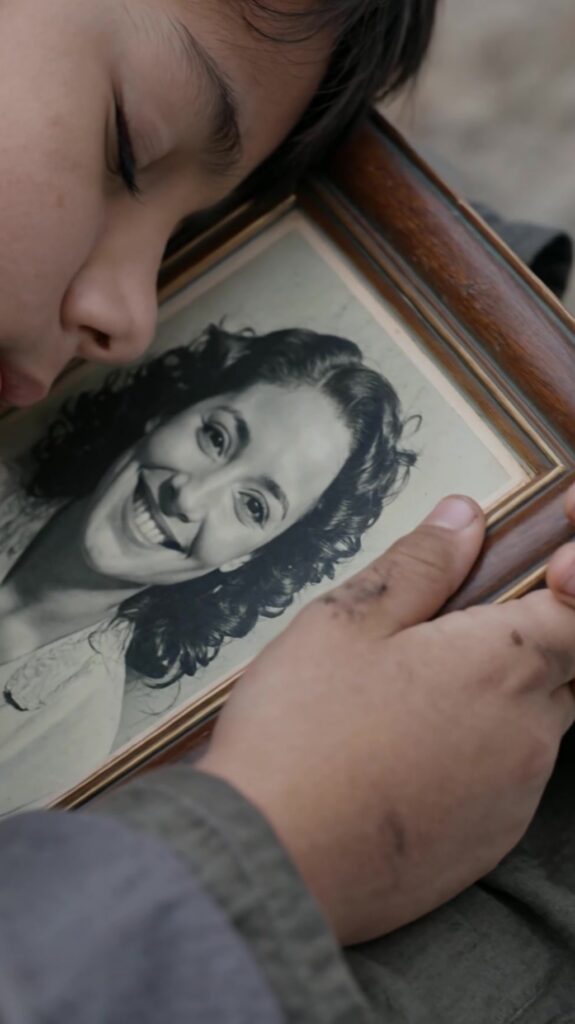
His cheek rested on the cold surface. His knees were drawn to his chest, bare feet tucked beneath him for warmth. The hem of his shirt was frayed; his fingers were chapped and stained with soil. He clutched an old photograph in a cracked frame, the glass scratched in one corner. A woman smiled from the picture—dark hair, bright eyes, the kind of face that made you think she had once laughed in sunlight without fear of shadows.
In his sleep, his mouth moved, shaping words he did not seem strong enough to carry while awake. “I’m sorry,” he whispered to the stone. “I tried.” The wind sifted through the dead leaves, and the leaves replied with a brittle sound like paper being torn.
Across the path, half-hidden by mist, a man stood perfectly still. His trench coat was dark enough to disappear into the night; his hat brim cut his face into secrecy. He had watched the boy for long minutes without moving, as if motion might turn the scene into something else—something ordinary, something he could dismiss. But the child’s small body pressed to the grave, the photograph held like a lifeline, made dismissal impossible.
The man took one step, then another. His boots made no real sound on the wet gravel. When he reached the grave, the name carved there showed through the fog like a confession: Olivia Whitman. The sight of it tightened his chest until he could barely breathe.
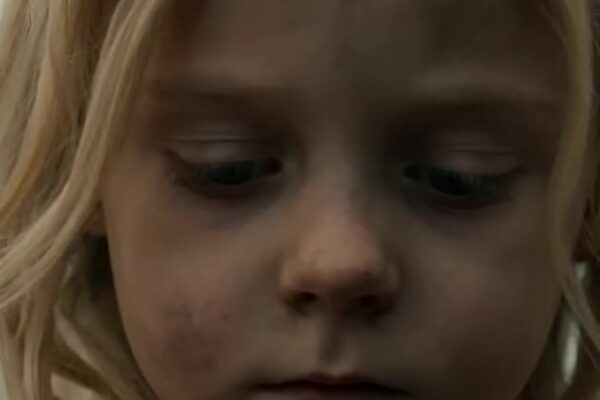
He knelt, and the cold seeped through his trousers. Close up, the boy looked younger than he had from a distance—no more than eight, perhaps nine. His eyelashes were damp, his lips pale, his hair a messy nest that had forgotten combs. Under the child’s arm, tucked between the frame and his thin ribs, was a folded piece of paper, softened by rain and dirt, edges worn from being opened and closed too many times.
The man hesitated. Taking it felt like stealing. But leaving it felt like letting a knife remain lodged where it could fester. He slid the paper free with two fingers, careful not to wake the boy, careful not to disturb the photograph. On the outside, written in a hand he knew so well it made his throat burn, were words that turned the world sharp: For his father, if he comes.
His hands began to shake. Not the tremor of cold—something worse. Something that belonged to years of running and refusing to look back. He unfolded the letter, and the damp paper sighed open.
“Caleb,” it began, and the man flinched as though she had spoken aloud. “If you’re reading this, then I’m not there to stop you from being brave too late. I don’t know what story you’ve told yourself to survive. I don’t know what you’ve decided you’re allowed to feel. But I know you, even after all these years. You will tell yourself you’re not needed. You will tell yourself that leaving was mercy. You will tell yourself that you don’t deserve to be remembered as anything but a ghost.”
The man’s jaw tightened. The fog pressed against him, cold and wet, like a hand insisting he stay.
“His name is Eli,” the letter continued. “He has your eyes when he’s angry, and he tries to hide them like it’s a sin. He still believes promises are real, which is something you and I both lost too early. I haven’t told him what happened between us—not the whole truth. I told him his father got lost. It was the gentlest lie I could manage. Maybe you will hate me for it, but I wanted him to grow up without your absence shaping him into someone hard.”
Caleb’s vision blurred. He wiped his eyes with the heel of his hand and left a smear of dirt across his skin, as if grief could be scrubbed into something useful.
“If you’re standing at my grave,” Olivia’s handwriting went on, “then you’ve already met the part of him I worried about most: the part that believes he’s to blame for everything he can’t fix. Don’t let that take root. Don’t let him sleep on stone because he thinks he doesn’t deserve a bed. Don’t let him apologize to the dead like it will keep the living from leaving too.”
The boy stirred at that moment, a small sound in his throat. Caleb froze, letter clenched between his fingers. Eli’s eyes fluttered open—wide, wary, bright with feverish exhaustion. For a heartbeat, he stared at the stranger kneeling by the grave as if trying to decide whether to run or bite or disappear.
“Don’t,” Eli croaked, and his hand tightened around the photograph. “Don’t take her.”
Caleb’s throat felt packed with ash. “I’m not taking anything,” he said softly. His voice sounded strange to him, like a door that hadn’t been opened in years. “I just… I saw you.”
Eli pushed himself upright, shoulders hunched like he expected a blow. He glanced at the letter in Caleb’s hand and his expression sharpened. “That’s mine.”
“It was meant for me,” Caleb said before he could stop himself.
The boy’s eyes narrowed. “My mom didn’t have—” He swallowed. The word “father” seemed to hurt his tongue. “She didn’t have anyone.”
Caleb took a slow breath, tasting wet air and old regret. “She had me,” he said. “And I left.”
A gust of wind pushed fog between them, briefly hiding Caleb’s face, as if the night wanted to offer him one last chance to be a stranger. When the mist thinned again, Eli was still staring, still clutching the photo like it might bite back.
“You’re lying,” Eli whispered, but his voice shook, not with certainty—only with need.
Caleb unfolded the letter again, careful, reverent, as though the paper were a fragile bridge. He held it out, letting Eli see the flowing curve of Olivia’s handwriting. “She wrote this,” he said. “For you. For me. For both of us, I think.”
Eli stared at the page. His chin trembled. He tried to speak, failed, tried again. “She said… she said you were lost,” he managed, and anger rose in him like a shield. “So if you’re here, then you found your way. Too late.”
Caleb nodded because denial would be a second abandonment. “Too late for her,” he said, voice breaking. “Not too late for you, if you’ll let me.”
Eli’s gaze flicked to the grave beneath him, then to the fog-laced paths beyond, where the world waited with all its indifference. He looked down at his bare feet, at the dirt ground that had been his only home for days, at the letter meant to catch a man who had spent his life dodging responsibility. When he spoke, it was barely louder than the leaves. “Do you have a place?”
Caleb’s chest tightened again, but this time the pain came with purpose. “I can,” he said. “I will.” He opened his coat, and the gesture felt like tearing away armor. “Come here. You’re freezing.”
Eli hesitated, then inched closer, still suspicious, still braced to be disappointed. Caleb wrapped the coat around him, careful, gentle, as though the boy might shatter. Under the borrowed warmth, Eli’s eyelids drooped, his stubbornness fading into fatigue. But before he slipped back toward sleep, he reached out and pressed the photograph against Caleb’s hand as if sharing a weight neither could carry alone.
Caleb looked down at Olivia’s smiling face and finally let grief have its full voice—silent, shaking, relentless. He tucked the letter into his pocket, close to his heart, and lifted Eli into his arms. The boy was lighter than he should have been, all bone and hunger and hope scraped thin.
As Caleb carried him through the fog toward the gate, the cemetery stayed behind—rows of names, sealed stories, and one white stone that had held a child like a cradle. The wind followed, whispering through leaves, but Caleb did not look back. He had spent too long walking away from the living. Tonight, he walked toward them, with his son asleep against his shoulder and Olivia’s final words burning like a promise he could not afford to break.