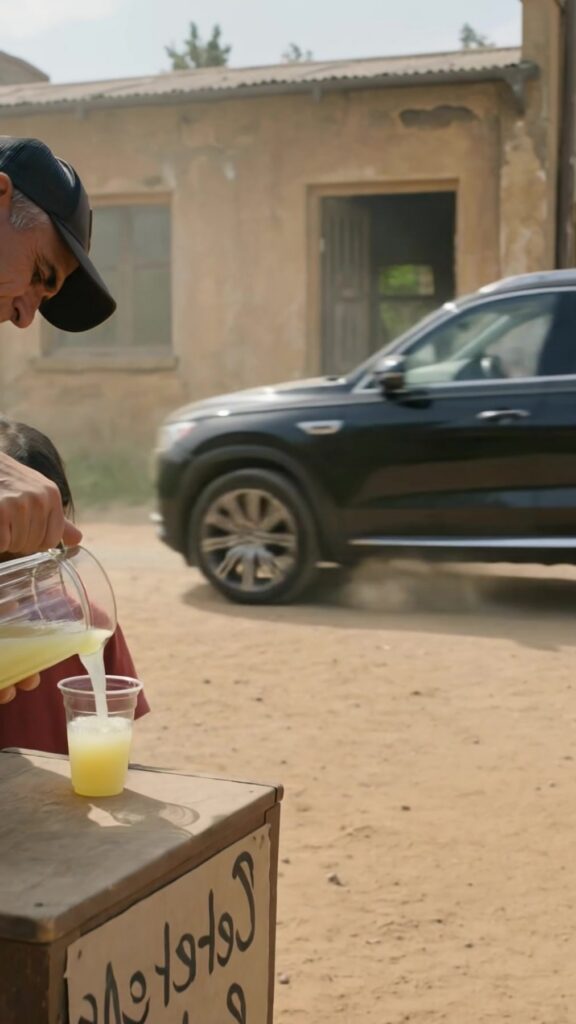
By late afternoon the highway shimmered like a blade left too long in the sun. Eli Mercer stood in its heat with his palms resting on a warped wooden table he’d patched more times than he could count. The stand sat where county asphalt surrendered to gravel, a forgettable bend between cornfields and a shuttered gas station. People drove past and kept their lives. A few slowed, flicked coins into his jar, and took a cup as if kindness were just another roadside purchase.
His sign—cardboard, crooked letters—said LEMONADE. It didn’t mention that he made it too tart on purpose. Sweetness, he’d learned, made people careless. A sharp drink woke them up.
The girl appeared from the shoulder as if the road had exhaled her. She couldn’t have been more than eight or nine. Dust clung to her calves, and her hair stuck to her forehead in dark strings. She wore a red shirt that had once been bright and was now the tired color of dried roses. She didn’t run. She didn’t bounce or point. She walked with the careful economy of a child who had learned to take up as little space as possible.
She stopped at the table and lifted her eyes. They were too steady for her age. “Mister,” she said, and her voice had the practiced softness of someone asking for permission to exist, “could I have some? I’m really thirsty.”
Eli didn’t answer right away. Not because he doubted her, but because the request hit a part of him that still bruised easily. He saw a hundred summers compressed into her posture. He reached for the pitcher, the glass sweating in his grip, and filled a plastic cup nearly to the rim. He slid it across without looking at the coin jar.
Her hands wrapped around the cup as if it were heat she could hold. “Thank you,” she whispered. The words were small, but her relief was loud. She drank in careful sips like she’d been told not to take too much of anything, even water.
“Slow,” Eli murmured. It was the only advice he ever gave. Drink slowly. Live slowly. Don’t let the world rush you into places you can’t get out of.
The sound of tires on gravel cut through the cicadas. A black SUV rolled in, too clean for that road, too deliberate. It stopped beside the stand with the kind of precision Eli associated with men who measured everything—distance, time, people. The driver stayed inside. The rear door opened and a woman stepped out, heels sinking slightly into dust that did not belong on her. Her suit was a deep green that looked expensive even under the sun, and her posture had the hard polish of someone used to rooms where others waited for her to speak.
She took one step toward Eli and stopped as if she’d run into an invisible wall. Her sunglasses hid her eyes, but her face changed—mouth tightening, chin lifting, breath caught in a way that was not fear. Recognition. It landed between them like a dropped glass.
“You,” she said, the word sharp with disbelief. Then her voice broke, softening into something that sounded like a long-held ache. “You gave me a drink once. When I was… when I was nothing but bones and dust.”
Eli’s mind struggled to assemble the woman into someone he knew. He had served thousands of cups. He had seen faces vanish down the road, swallowed by miles and the quiet cruelty of forgetting. But then she took off the sunglasses, and the eyes underneath pulled the past forward like a hook.
He remembered another day. Another summer baked into the same stretch of highway. A child collapsed near the shoulder, skin hot, lips cracked. A man in a hurry had said, “Not my problem,” and stepped over her like she was debris. Eli had carried her into the thin shade of his umbrella, poured lemonade into her mouth a teaspoon at a time, and torn his sandwich in half so she could chew without choking. He had pressed a ten-dollar bill into her palm because she’d whispered, barely audible, that someone was waiting at the bus station and she had to get there.
Eli’s throat tightened. “You were… that little girl,” he said, and it didn’t feel like a sentence so much as a door opening in his chest. “You made it.”
The woman nodded, but the nod was heavy. “I made it,” she agreed. “Not because the world was kind. Because you were.” She reached into her purse and withdrew something sealed in clear plastic. She set it gently on the table as though placing a relic on an altar.
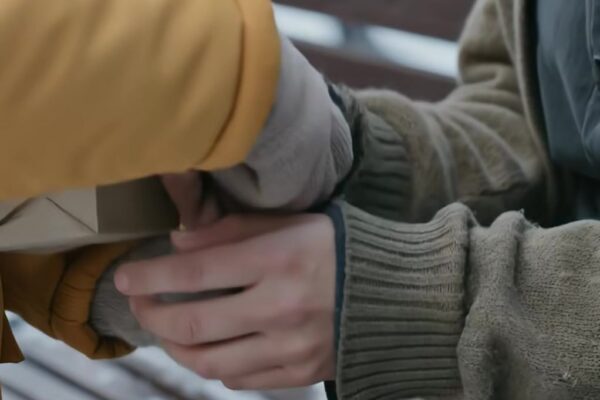
It was a bill, old and worn, the paper soft with age. Eli knew it before he truly saw it. The back held faded ink, a childish attempt at neat letters. His own handwriting, smaller than it used to be, pressed into memory: When life turns sweet again, come back.
Eli’s hands began to shake. “I wrote that to make you smile,” he said, voice thin. “I didn’t—”
“You didn’t know,” she finished for him. Her eyes shone, but something hardened behind the shine. She turned her gaze from Eli to the girl beside the stand. The child had stopped drinking. Her fingers clenched around the cup, the ice rattling once and then stilling.
“That’s about the age I was,” the woman said quietly. “The day someone traded me for a bus ticket.”
The sentence didn’t land—it detonated. Eli’s stomach dropped. He looked at the girl again, and details he’d ignored now screamed for attention: the faint bruise on her wrist shaped like fingers, the way she flinched when the SUV’s engine ticked, cooling, the way her eyes kept darting toward the driver’s seat as if she could feel being watched.
Eli’s breath came shallow. “Honey,” he said gently, forcing calm into his tone, “are you here with someone?”
The girl’s lips parted, then closed. Her gaze slid toward the SUV. The driver’s window was up, but Eli saw the outline of a man’s head, motionless, as if he were listening. The girl’s fingers whitened around the cup.
The elegant woman—no, not just elegant; dangerous in the way a storm is dangerous—stepped closer to the table and lowered her voice. “My name is Maris Hale,” she said to Eli, but her eyes stayed on the SUV. “I run the foundation that just bought the land at this junction. Officially, we’re building a clinic.” Her jaw tightened. “Unofficially, I keep track of what moves along roads like this. And sometimes I come myself.”
She lifted her phone, already unlocked. Her thumb hovered, then pressed. Eli didn’t hear what she said into it—only the tone, the clipped certainty of someone accustomed to being obeyed. The driver in the SUV shifted, a subtle twitch. The engine turned over, too quick.
Maris raised her voice, letting it carry. “Sir,” she called toward the SUV, “you’ve taken a wrong turn.”
The SUV jolted backward, gravel spitting. The man inside tried to swing the vehicle around. Eli’s heart hammered so hard he tasted metal. The girl took a half-step away from the car without seeming to decide to. She was trembling now, the cup sloshing.
Eli moved between her and the SUV, every old instinct dragging him into place like a shield. “Get behind the table,” he said, and his voice was no longer gentle. He didn’t know what he could do with a pitcher of lemonade and two hands, but his body offered itself anyway. It always had.
Maris stepped to the other side, her heels planted. A second car appeared at the far end of the bend—a plain sedan, dusty, fast. It blocked the road cleanly. The SUV braked, trapped between the stand and the new arrival. The driver’s door flew open, and a man in a baseball cap jumped out, looking for a gap that wasn’t there.
“Stay where you are,” Maris said, and the command sounded like it had been practiced in courtrooms. Two people emerged from the sedan, moving with coordinated speed. Not police, Eli realized, but professionals. One held up a badge anyway, and for once, the symbol seemed to mean something.
The man hesitated. His gaze flicked to the girl, then to Eli, then to Maris. He calculated, and whatever he saw in their faces made him surrender to the math. His hands rose slowly.
The girl behind the table made a sound—small, strangled. Eli turned and saw tears cutting clean lines through the dust on her cheeks. She still held the cup. Her knuckles were white with effort, as if dropping it would mean dropping herself.
Eli crouched to her level. “You did right,” he told her. “You asked for water. That’s not a crime.” His own voice wavered. He wanted to promise her safety, wanted to swear it on everything he had left, but he’d lived too long to offer lies as comfort.
Maris knelt beside them, the expensive fabric of her suit meeting dirt without hesitation. “What’s your name?” she asked the girl, her tone careful, like someone approaching a frightened animal or a memory.
The child swallowed. “Nina,” she whispered.
Maris nodded once, as if sealing a vow. “Nina,” she said, “I was you. Someone once stood where he’s standing and chose to see me. We’re going to choose to see you, too.”
Eli stared at the ten-dollar bill on the table, the message bleeding through time. When life turns sweet again, come back. He had written it as a hope, a fragile joke, a way to pretend the world could be edited into something kinder.
Maris had come back, not as proof the world was kind, but as proof that one act could echo hard enough to return with reinforcements.
The sun slid lower, and the shadows lengthened across the gravel. Eli picked up the pitcher, poured a fresh cup, and held it out to Nina with both hands this time, as if the offering were sacred. “Slow,” he repeated.
Nina took it, and for the first time since she’d arrived, she drank without flinching at every sound. The road still hummed with danger. But beside the crooked table, under a patched umbrella, three lives formed a small barricade against it—and for that moment, sweetness was not the lie Eli had feared. It was the beginning of something earned.