The bell above the pawn shop door gave a tired little jingle, like it had been rung too many times by people with too few options. Rainwater slid from Maren’s hair onto the linoleum as she stepped inside, holding her son’s hand as if the world might pry him away if she loosened her grip.
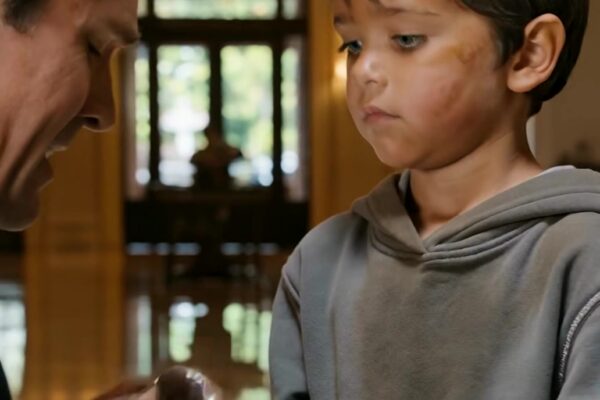
Felix kept his eyes down. At seven he had already learned a dangerous kind of quiet, the kind that came after you’d asked for dinner once too often and watched your mother pretend not to hear because she had nothing to offer but another story. His stomach had been empty long enough to make him careful with his words.
Maren’s other hand curled around the chain in her coat pocket. Thin gold. Light as a promise. It had rested against her chest for most of her life, a circle no bigger than a coin, the center carved with a symbol that never looked the same twice: a knot, an eye, a wheel, depending on the angle. Her mother used to press two fingers to it before leaving the house, as if checking it was still there, as if it kept the rest of her from falling apart.
Never let it go, her mother had whispered, mouth dry and fierce on the pillow, the hospital room bright with indifferent light. Never, unless you have nothing left to sacrifice.
Maren had laughed then, because who talked like that unless they’d lived in some old book? But her mother’s eyes had been wet and lucid for the first time in months, and her hand had held Maren’s wrist with surprising strength.
Now Maren had nothing left.
The man behind the counter looked like he’d been carved from walnut and cigarette smoke. His hair was silver, his hands broad, his apron stained with years of metal polish and other people’s desperation. He didn’t greet her. He didn’t have to. People like Maren walked in and out every day, leaving behind rings, guitars, heirlooms, excuses.
Glass cases flanked the narrow aisle: watches lined up like obedient soldiers, rows of tarnished bracelets, a camera with a missing lens cap, a violin that looked lonely. Somewhere in the back a radio murmured about traffic and a storm front.
Maren cleared her throat. “Sir.” Her voice came out smaller than she meant. “I need to pawn something.”
The man finally looked up. His eyes were pale, restless, as if they were always watching for trouble to enter before it announced itself. “What’ve you got?”
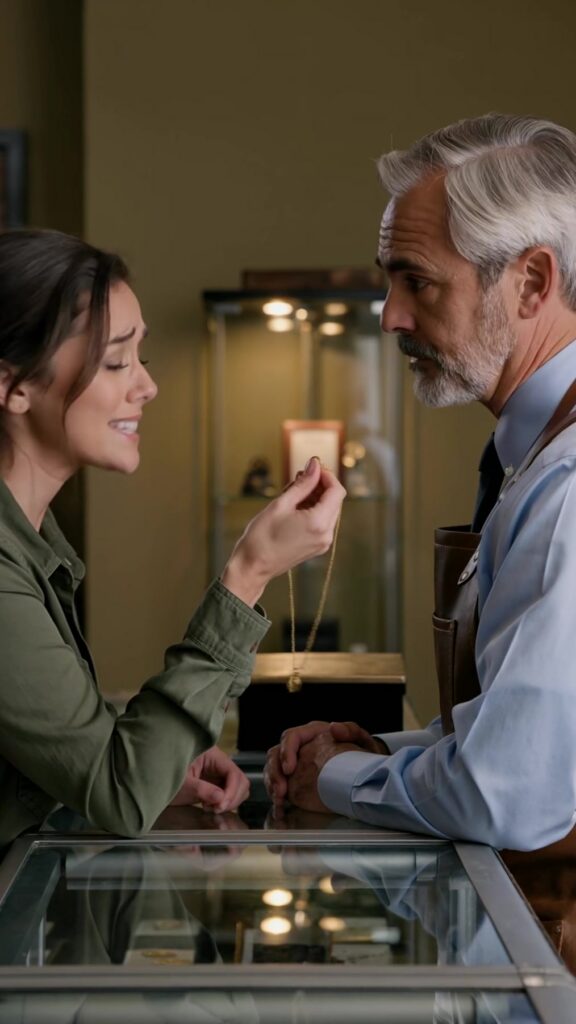
Maren drew the chain from her pocket and laid it on the counter. The pendant slid across the glass with a soft, traitorous sound.
Felix leaned in, staring at it. “Mom—” he began, then stopped, because he remembered the rule about questions.
Maren forced herself to meet the pawnbroker’s gaze. “I just need enough for food,” she said, hating the way her voice shook. “He hasn’t eaten since yesterday.”
The man’s expression didn’t change. Not at first. He lifted the necklace with a practiced pinch, weighed it in his palm, checked the clasp. Routine. Calculating. His lips pursed. “Gold’s thin,” he said. “Pendant’s worn. I can do…” He paused, already reaching for a scale, already prepared to reduce her crisis into a number. “Thirty-five.”
Maren’s throat tightened with relief and shame all at once. Thirty-five would be bread and eggs. A small box of cereal. Something warm. Something she could place in front of Felix without lying about what it was.
“Okay,” she breathed. “Please.”
The man’s thumb brushed the carved symbol.
He went still so suddenly the air seemed to stiffen around him. The scale hung half-lowered in his other hand, forgotten. His pupils tightened as if he’d seen a flash of bright light, or a gun.
“Where did you get this?” he asked.
Maren’s pulse thudded loud in her ears. “It was my mother’s.”
“Your mother,” he repeated, slower. His gaze flicked from the pendant to Maren’s face, to the shape of her cheekbones, to the slight notch in her left eyebrow from a childhood fall. The way he looked at her wasn’t polite curiosity. It was recognition that didn’t want to be real.
“She gave it to me before she died,” Maren said, defensive now, and angry at herself for needing to explain anything. “Is it fake?”
“No.” His voice cracked on the word. He set the necklace down like it might burn through the glass. “No, it’s not fake.”
Felix shifted closer to Maren’s side. “Mom, can we go?” he whispered.
Maren wanted to scoop him up, to run, to pretend this was nothing. But the man’s hands were trembling, and men like him did not tremble over cheap gold.
“I don’t want it,” he said, and it wasn’t bargaining. It sounded like a warning. “Not like this.”
Maren stared. “Then give it back and I’ll go somewhere else.”
“No,” he said quickly. “Listen to me.” He leaned forward, voice dropping until it slid beneath the radio’s murmur. “Don’t sell it. Take something else. I can… I can give you money. Food. But not that pendant.”
Maren’s stomach lurched. Charity from a stranger was almost worse than the offer. “Why?” she demanded. “What’s wrong with it?”
The pawnbroker’s jaw worked as if he was grinding words between his teeth. He glanced toward the windows, then toward the back room, as if expecting someone to step from the shadows and overhear. “That marking,” he said, tapping the symbol without quite touching it. “It was never meant to pass through hands like mine.”
“It’s just a necklace,” Maren snapped, but her voice faltered. Her mother’s fear had never been logical, either.
“It isn’t,” the man said, and now his eyes were bright with something that looked like old grief. “It’s a key. A claim. Proof.” He swallowed hard. “And it belongs to one line. One family.”
Maren’s mouth went dry. “What family?”
He hesitated, then made a decision that seemed to cost him. He turned and crouched beneath the counter, rummaging through a metal cabinet that squealed when he opened it. When he stood again, he held a dented cash box as if it were heavier than it should be.
He set it on the counter and clicked the latches. Inside were papers wrapped in twine, a ring in a scrap of cloth, and a photograph with curled edges.
He slid the photograph across the glass toward Maren.
The image was black-and-white, washed out with age. It showed a younger version of the man, his hair dark, his face sharp with a nervous tension that time hadn’t softened. Beside him stood a woman with dark hair pinned back, her smile wide enough to look like defiance.
Around her neck hung a thin gold chain.
The same circular pendant.
Maren’s fingers hovered over the photo, afraid to touch it, as if contact would make everything in her life rearrange itself. The woman’s eyes in the photograph—those eyes—were like looking into a mirror that remembered a different name.
“Who is she?” Maren asked, and her voice sounded like it belonged to someone else.
The pawnbroker’s breathing was shallow. His gaze lifted, and when it met Maren’s, it carried the weight of years that hadn’t been spoken out loud. “I knew her,” he said.
Maren’s heart hammered. “You knew my mother?”
He nodded once, sharply, as if surrendering. “I knew her when she came to me begging the same way you’re begging now.” His hand hovered near the pendant, then pulled back. “I watched her walk out of this shop with that necklace pressed to her throat like it could stop bullets.”
Maren’s knees felt loose. “That can’t be. She died—”
“Twenty years ago,” he finished, and the words hit the shop like a slammed door.
Felix made a small sound, confused and frightened. Maren tightened her hold on his hand, anchoring herself to his warmth. “You’re lying,” she said, but there was no conviction in it. Only the desperate wish that lies could be safer than truth.
The pawnbroker’s eyes glistened. “I helped put her in the ground,” he said, voice raw. “I saw the dirt hit the coffin. I stayed after everyone left because I couldn’t stop shaking.” He swallowed again, and when he spoke, his words were careful, like he was stepping around broken glass. “So either you’re holding something that shouldn’t exist… or the woman you called mother survived something she never told you about.”
Maren stared at the pendant, then at the photograph, then at the man who looked like he’d been waiting two decades for the universe to finish a cruel joke.
“What does this necklace open?” she asked.
Outside, thunder rolled low and long, like an answer being dragged across the sky.
The pawnbroker reached into the cash box and took out the ring, turning it so the inner band faced up. Something was etched there, small and precise, the same looping symbol as the pendant. “It opens doors people spend lifetimes trying to find,” he said. “And it closes mouths. Your mother knew that.” His gaze dropped to Felix, and something softened in his face. “And if you walked in here hungry, they’ve found you again.”
Maren felt fear bloom, cold and alive, but beneath it, something else—an anger she hadn’t let herself feel, anger at eviction notices and empty cupboards and the invisible hands that kept tipping her life over. She closed her fingers around the pendant and lifted it from the counter.
“Then feed my son,” she said, voice steady now, “and tell me what you know.”
The pawnbroker nodded, once, like an oath. He slid his register drawer open, but instead of counting bills, he reached for the phone under the counter—the one he hadn’t sold when times got hard. His eyes stayed on Maren as he dialed.
“We don’t have much time,” he said quietly. “And if you’re going to keep that promise to your mother… you’re going to need to learn why she made it.”
Maren pressed the pendant to her palm until its edges bit her skin, as if pain could prove she was still awake. Felix leaned against her hip, trusting her without knowing what trust might cost.
The bell over the door trembled when another gust of wind struck the window, and for the first time since she’d stepped inside, Maren understood: she hadn’t walked into the pawn shop to sell jewelry.
She’d walked in because the past had finally decided to collect what it was owed.