The lobby of the Meridian Hotel was built to make reality feel negotiable. Light spilled from chandeliers like melted honey. The marble floor reflected every polished shoe, every silk hem, every confident stride. People moved through it as if the world had been designed to get out of their way.
Graham Voss moved that way too—at least, he had taught himself to. Dark suit. Perfect tie knot. A face that never showed hunger, not anymore. He had just finished a quiet conversation with the manager about “discretion” and “late-night deliveries,” and he was walking toward the revolving doors when something small touched him.
Not a shove. Not a collision. A tug, almost polite, on the edge of his jacket sleeve.
Graham turned with the irritated patience of a man who paid for his own time. He expected a bellman asking about luggage, or a tourist asking for directions.
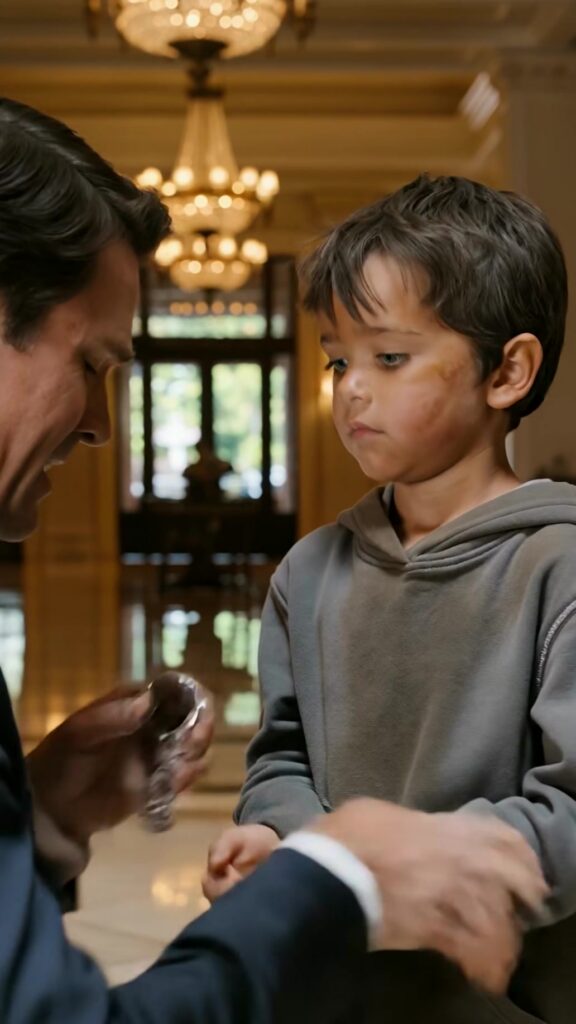
Instead, a little boy stood beneath the chandelier’s glow like someone who had taken a wrong turn out of a harder world. He wore a gray hoodie stained at the cuffs, jeans rubbed pale at the knees, and shoes that had learned too many puddles. His hair was damp in places as if he’d recently been caught in rain or sweat or both. Yet his eyes—strangely bright, startlingly calm—looked straight at Graham without flinching.
“That watch,” the boy said, voice low, careful, as if any louder would break something. “It’s like my dad’s.”
Graham’s hand went to his wrist on instinct, shielding it. The watch was understated, silver-faced, clean lines, a thin scratch near the crown. He’d worn it for years like a promise he couldn’t afford to forget.
“Who are you?” Graham asked, the words coming out sharper than he intended.
The boy swallowed, then steadied himself. “My name’s Eli.” He nodded toward the watch again. “My dad said it would be here.”
A cold pinch traveled up Graham’s spine. He fought to keep his expression smooth. “What’s your father’s name, Eli?”
The boy’s lips pressed together first, like he’d been warned not to hand out the answer easily. Then: “Scott.”
The sound hit Graham with the force of a door slamming shut behind him. Scott Hale. The name belonged to a man who had once slept beside him on a warehouse floor in winter, breath making ghosts in the dark. A man who had learned how to laugh while bleeding. A man who could take a beating and still make a joke to keep the fear from spreading. A man who’d vanished after a deal went wrong and a fire turned night into an orange scream.
Everyone said Scott never made it out.
Graham’s knees bent without permission. He found himself level with the boy’s face, ignoring the concierge’s startled glance, ignoring the rustle of expensive bodies moving around them. “Where did you hear that name?” he asked, and his voice betrayed him by breaking on the last word.
Eli’s gaze didn’t waver. “I didn’t hear it. It’s his. He’s my dad.”
Graham’s throat tightened. He unfastened the watch with fingers that suddenly remembered shaking, and placed it in the boy’s hands. The watch looked too heavy for such small fingers, too much history in such a simple circle of metal.
“Keep it,” Graham whispered. “He—Scott—he saved me when I didn’t deserve saving.”
Eli stared down at the watch, not with wonder but with recognition, like he’d seen it in a photograph that had been folded and unfolded a hundred times. He traced the faint scratch with his thumb. His eyes shone, but he didn’t smile.
That absence of a smile was the first real warning Graham felt.
Children didn’t look at gifts like evidence.
Eli raised his eyes again. “He said I should ask you something.”
Graham’s breath came shallower. “Ask.”
The boy’s voice grew even quieter, as if the lobby itself had ears. “Do you still keep promises?”
The question was a knife sliding into an old scar.
Years ago, behind a loading dock, Scott had grabbed Graham by the collar and yanked him into the shadow as headlights swept the alley. The night had smelled like diesel and fear. Scott’s mouth had been split, his teeth red, but he had still managed to speak with a strange calm.
If I ever disappear, and someone comes to you with proof—don’t interrogate them first. Help them first. Promise me.
Graham had promised. He’d meant it. He’d also spent years breaking smaller promises to survive the larger one.
“Yes,” Graham said now, forcing the word out. “Yes, I do.”
Eli’s shoulders loosened a fraction, and Graham saw how tightly the child had been holding himself together. “Then you have to come,” Eli said. “Right now.”
Graham glanced around. Two men in tailored coats stood near the bar, not drinking, scanning the lobby in a way that didn’t belong to leisure. Graham knew that scan. He had paid men to do it. He had been the man to be found.
His pulse stumbled. “Who brought you here?”
Eli shook his head. “Nobody. I walked. I followed the plan.”
“What plan?”
“Dad’s plan.” Eli clutched the watch, then opened his other hand. Inside his palm was a keycard—plain white, a handwritten number on it: 1719. “He said you’d know what to do if I showed you this.”
Graham’s mouth went dry. Room 1719 was in the older wing—one of the few floors that still had service corridors behind the guest rooms. Corridors that connected to the loading dock. Corridors that could keep you invisible if you knew which doors stuck.
He looked into Eli’s face and saw something that didn’t belong on a child: determination sharpened by too many nights of listening to grown-up whispers.
“Is your father—” Graham began, then stopped. The last time he’d asked a question too early, a man had ended up dead. Scott had paid for Graham’s impatience once. Graham had never forgiven himself.
So he swallowed the question and stood, taking Eli’s hand as if it were the simplest thing in the world. “We’re going upstairs,” he said, voice calm enough to borrow authority from the chandelier light. “Stay close to me. Don’t look at anyone.”
Eli nodded. His fingers were cold, but his grip was strong.
They moved toward the elevators, Graham’s mind already mapping exits, threats, and the distance between a promise and a confession. As they passed the bar, one of the scanning men turned his head slightly, noticing the boy too late. His hand dipped toward the inside of his coat.
Graham felt the movement like a ripple in a dark pool.
He didn’t change pace. Panic was a scent. He refused to wear it.
The elevator doors opened with a soft chime. Graham guided Eli inside and pressed the button for the seventeenth floor. As the doors began to close, Eli whispered, “Dad said you’d be scared.”
Graham kept his eyes on the narrowing slice of lobby. “Your dad knew me well.”
“He said being scared means you still care.” Eli’s voice trembled at last. “He said if you cared, you’d come.”
The elevator sealed them away from the gold light. The hum of ascent filled the silence between them. Graham looked down at the watch in Eli’s hands and felt time rearrange itself: the years since the fire compressing into a single, brutal question he could no longer avoid.
“Eli,” he said gently, “listen to me. Whatever happens, you do exactly what I say, understand?”
Eli nodded. “Dad said to trust you.” Then, as if confessing a secret he’d carried in his teeth: “He also said you wouldn’t like what you find.”
The seventeenth floor arrived with a muted ding. The doors slid open to a hallway carpeted in quiet. No chandeliers here—only dim sconces and the faint smell of cleaning chemicals.
Graham stepped out, drawing Eli with him. The boy lifted the keycard like a talisman and pointed down the hall. “This way.”
They walked. Each step sounded too loud. Graham’s mind counted them like seconds.
At 1719, Graham took the card from Eli. His hand hovered at the lock. He could feel the promise tightening around his ribs, pulling him forward whether he wanted to go or not.
“Before we go in,” Graham murmured, “tell me one thing.” He met Eli’s steady blue gaze. “Is your father alive?”
Eli’s fingers closed around the watch again, and his face hardened with the weight of a rehearsed truth. “He’s not dead,” the boy said. “But they’ve made sure he can’t come to you himself.”
Graham slid the keycard through the slot.
The light on the lock turned green.
Somewhere behind the door, something shifted—metal against metal, a soft scrape that might have been a chair moving or a chain tightening. Graham pushed the handle down. The latch gave with a reluctant click.
Eli leaned in close, voice barely there. “Dad said you’d recognize his voice,” he whispered. “Even if it’s not coming from him the way it used to.”
Graham opened the door, and the dark inside breathed out like a held secret, ready to cash in every year of silence all at once.
He stepped over the threshold with the boy at his side, carrying a watch, a promise, and the sudden understanding that whatever waited inside room 1719 had been planned for a long time—and that the Meridian’s golden lobby had only been the beginning.