Rain hammered the diner windows like someone was throwing handfuls of pebbles at the glass. It was the kind of storm that turned the highway into a ribbon of black oil, the kind that kept travelers inside and secrets buried. The neon sign outside—EAT HERE, like an order—flickered and buzzed as if it, too, was nervous.
We were close to closing. I had my rag in my hand and the same thought I always had at the end of a shift: get the last cups washed, get home before the roof starts leaking again. Rooster and his crew were at the counter, as they often were on Thursday nights—six men built like armored doors, jackets soaked with old miles and newer trouble. They didn’t bother me. They paid in cash. They didn’t let anyone get handsy with the waitresses. They sat with their backs to the wall as if the room owed them that courtesy.
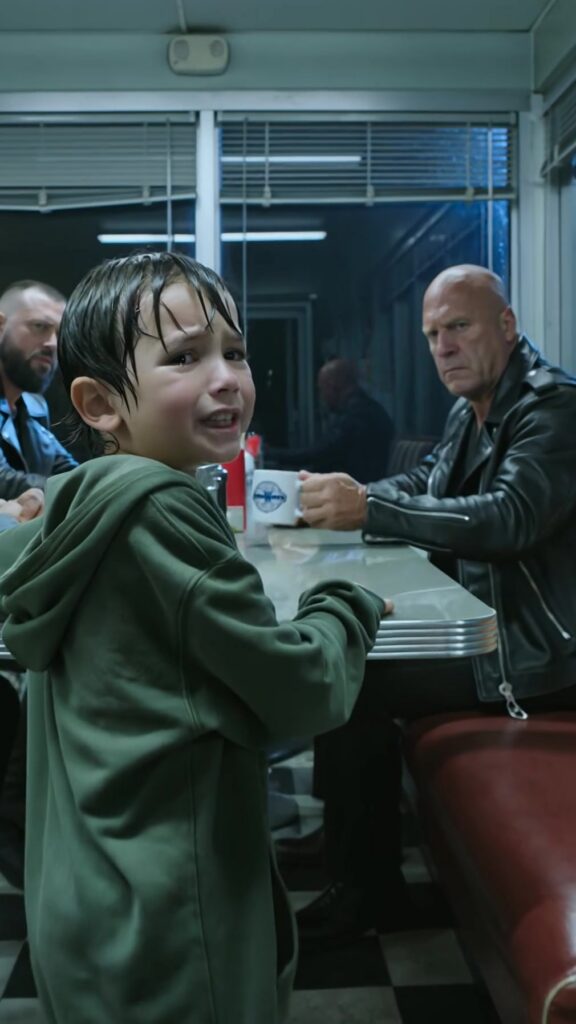
The bell above the door screamed when the kid burst in. Not rang—screamed. A gust of rain and cold followed him, and for a moment the diner smelled like wet asphalt and fear.
He was little, seven maybe, barefoot in one sock, the other missing. His knees were scraped raw and shining with blood diluted by rainwater. His hoodie was too big and torn at the seam, like he’d been dragged by it. He planted both hands on the counter and tried to speak, but his breath hitched and folded into itself.
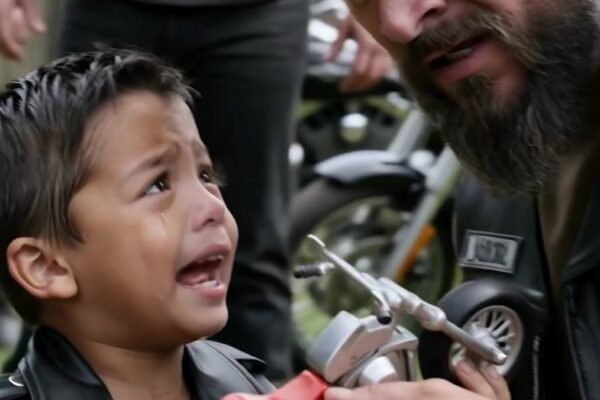
Then he looked at Rooster and the men beside him, and the words came out like they were breaking glass on the way up. “Please,” he said. “Please don’t let him take me.”
The diner went silent in the way a forest goes silent when a predator passes through.
Rooster didn’t move fast. He moved careful. He set his coffee down like it mattered, like it was the last ordinary thing he intended to do tonight. “Sit,” he told the kid, voice low. Not kind. Not cruel. Commanding, the way you talk to someone teetering on a ledge.
The boy slid onto the stool and immediately curled inward, like he was trying to disappear into the vinyl. His eyes were fixed on the window, on the sheets of rain, as if something out there was a face pressed against the dark.
Headlights swept across the glass. A car rolled into the lot without the squeal of brakes, smooth as a thought. Black. Not just paint-black—absence-black. Its lights stayed on, washing the diner in pale beams.
The boy made a sound that wasn’t a scream. It was smaller than that. It was the noise a child makes when he has begged before and learned what begging costs.
Rooster stood. The men beside him shifted with a single shared motion, chairs scraping. Even the cook, Hector, leaned from the pass-through, spatula frozen in midair.
Outside, the driver’s door opened. A silhouette unfolded from the car. Too straight to be tired. Too patient to be harmless.
The boy grabbed Rooster’s jacket in both fists. “He said,” the kid whispered, so quiet I had to lean closer, “he said if I ran nobody would believe me. He said people like him make the rules.”
Rooster’s scar—an old white line across his face—tightened as if the memory beneath it had woken up. “Who’s he?” Rooster asked.
The boy didn’t answer. He reached into the torn lining of his hoodie, fingers trembling, and pulled something out wrapped in plastic that had once been a sandwich bag. Water had seeped in. The paper inside was damp and creased and precious.
He unfolded it with the care of someone handling a match near gasoline and held it up.
I was close enough to see it before Rooster took it. A photograph, old enough to have soft edges, the colors faded like a bruise healing. A younger Rooster stared out from it, clean-shaven, smiling—an expression I had never seen on his face in all the months he’d been coming in. His arm was around a woman with dark hair and tired eyes, holding a newborn wrapped in a hospital blanket.
Rooster’s fingers closed around the picture, and something left his face. Not color. Something deeper. Whatever it was, it took the air with it.
On the back, in thin, slanted handwriting, were words that made my throat constrict: IF ANYTHING HAPPENS, FIND HIM.
The boy’s voice came out in pieces. “Mom said if he ever found us, I had to find the man in the picture. She said you’d know what to do.”
Rooster stared at the baby’s face like it was a mirror holding up a life he’d thrown away. Then he looked at the boy. Really looked. The boy’s eyes were the same gray as Rooster’s, a stormy pale that didn’t belong to most children.
“Kid,” Rooster said, and his voice wasn’t deadlier now. It was damaged. “Who told you your mother was dead?”
The boy swallowed. “The man in the car,” he whispered. “He told me she… she couldn’t run forever. He said she made a deal and broke it.” His small jaw clenched, trying to be brave. “But I heard her talking last week. In the closet. She said she had one more night to get me away.”
Outside, the silhouette started walking toward the diner, slow steps through the rain as if he wasn’t bothered by being soaked. The headlights turned the raindrops into needles.
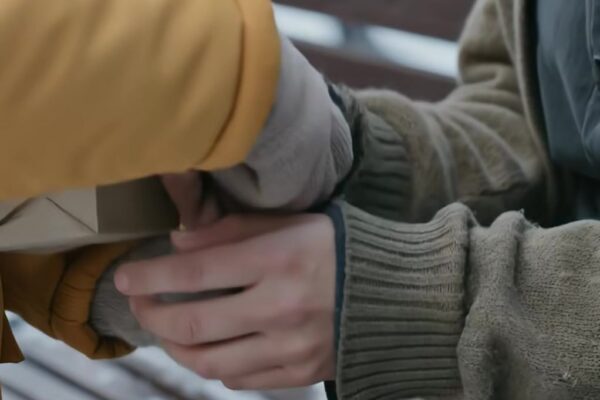
Rooster handed the photo back to the boy and did something I’d never seen him do: he touched the kid’s shoulder, gentle and steady. “What’s your name?”
“Eli,” the boy said.
Rooster’s throat bobbed. “All right, Eli. You’re staying here.” He looked at me. “Lock the door.”
My hands were clumsy, but I obeyed. The bolt slid into place with a sound too small for what it meant.
Rooster’s crew fanned out without being told. One went to the back, probably to the emergency exit. Another moved to the windows, watching the man approach. Rooster walked behind the counter and opened the drawer where we kept the cash. He didn’t take money. He took the phone and dialed with the calm of someone who’d rehearsed this nightmare years ago.
“It’s me,” he said when someone answered. “He found them.” A pause, his eyes on Eli like the boy was a candle in wind. “Yeah. Tonight. Send everyone.”
The man reached the door and tried the handle. It didn’t give. He leaned in and looked through the glass. When lightning flashed, I saw his face clearly: clean-cut, middle-aged, the kind of handsome that belongs in campaign posters. But his eyes were flat, reflecting nothing.
He rapped on the glass with one knuckle, polite as a lawyer. I couldn’t hear him through the rain, but I saw his mouth shape words: Hand him over.
Rooster walked to the door and stood inches from the glass. Rain slid down the outside like tears the storm couldn’t stop. They stared at each other, the biker and the suited man, as if the diner was a courtroom and the boy was the verdict.
Rooster’s voice carried even through the door. “You don’t get him.”
The suited man smiled, small and practiced. He lifted his hand, palm up, and for a second I thought he was surrendering. Then I saw the glint of metal. A badge. Official. Not a cop badge—something worse. Something that opened doors without sirens.
He pointed at Eli through the glass, then pointed at Rooster, and mouthed: You owe.
Rooster didn’t flinch. He lifted his own hand and showed nothing but an old ring on his finger, worn silver, the kind men keep when they’ve lost everything else. His lips moved: Not anymore.
Thunder cracked. In the distance, engines answered—multiple, rumbling like a coming storm of their own. The suited man’s smile faltered as he heard it too. He stepped back, scanning the lot, the highway beyond.
Eli clung to my apron now, small fingers digging into fabric. “Is he going to take me?” he asked, voice shaking so hard it barely held together.
I crouched beside him, my heart thudding against my ribs like it wanted out. “Not tonight,” I told him, though I didn’t know if that was truth or prayer.
Rooster turned, eyes fierce and wet all at once. “Listen to me, Eli,” he said. “Your mom didn’t die. She hid you. She hid you from men like that.” He nodded toward the glass. “And she left you a map.”
He tapped the photograph. “Because she knew I’d spend my life trying to forget I ever smiled.”
Outside, the first motorcycle pulled into the lot, then another, headlights cutting through rain. The suited man retreated toward his black car, suddenly less patient. He opened his door, glanced back once, and for a heartbeat I saw something like anger—cold and offended—as if he’d been denied a rightful purchase.
Rooster watched him with a stillness that promised violence if the door opened again. “This place,” Rooster murmured, more to himself than to us, “was supposed to be neutral ground.” He looked at Hector. “Get the back room ready.”
Then he knelt in front of Eli, bringing his scarred face level with the boy’s. “You did good,” he said. “You ran. You found me.” His voice dropped. “Now I’m going to do what I should’ve done a long time ago.”
The black car’s tires spun in the wet gravel as it sped away, taillights smearing red across the rain. The diner remained locked, lit, and trembling with the aftershock of fear.
Eli let out a breath like he’d been holding it his whole life. He pressed the damp photograph to his chest, and Rooster’s hand stayed on his shoulder, heavy with promise.
Outside, the storm kept pounding at the windows. But inside, for the first time all night, the sound didn’t feel like gravel.
It felt like cover.