The red-and-blue lights filled my rearview mirror like a spreading bruise, swallowing the last clean stretch of highway between me and home. I eased onto the shoulder and shut off the radio, letting the night settle into its natural sounds—the faint hiss of tires on wet pavement, the distant groan of a truck shifting gears, my own breath in the small space of my car.
Broken taillight, he would say. It was always something small, something that sounded reasonable to anyone listening later. I watched him approach in the side mirror: tall, deliberate, one hand resting near his belt as if he was already rehearsing the moment he’d need it. His flashlight swept over my backseat, my purse, my hands.
He didn’t look at the taillight. Not once.
When he reached my window, he leaned in too close. His eyes slid across my face, pausing like he was measuring my fear. “Evening,” he said, smooth as oil. “License and registration.”
I handed them over with the calm that had taken years to learn. Calm was a shield; panic was permission. I had learned that from watching my mother shake in our kitchen when the news showed another arrest, another “lucky find,” another life rearranged by a single plastic bag.
The officer glanced at my license as if it were a menu he’d already memorized. He didn’t read my name. He looked at my hands again. “Step out of the car,” he said, tone sharp enough to cut the word please out of the air.
My door opened with a soft sigh. I stepped onto gravel and kept my posture loose, my shoulders low, my arms hanging at my sides. He directed me to the front of my car. The patrol vehicle’s spotlight pinned me there, flattening me into a silhouette. I could feel his gaze behind me, then the sound of him circling my sedan as though it belonged to him now.
“Do you know why I stopped you?” he asked.
“No,” I answered. “But you’re going to tell me.”
A small laugh, the kind that carried no humor. “Broken taillight,” he said, on schedule. Then, with the ease of someone slipping into a familiar suit, he added, “Mind if I take a look inside?”
“Do I have a choice?”
He smiled as though I’d complimented him. “If you’ve got nothing to hide, you won’t mind.”
I didn’t answer. I didn’t need to. His hand was already on my passenger door.
The search was theater. He rummaged in the glovebox with exaggerated care, opened the center console, flicked through a couple of receipts like they were evidence. He let the silence stretch until it felt like the point. Then he crouched by the passenger footwell, blocking my view with his body. His flashlight moved in tight circles, and for a moment the only thing I could see was the trembling oval of light.
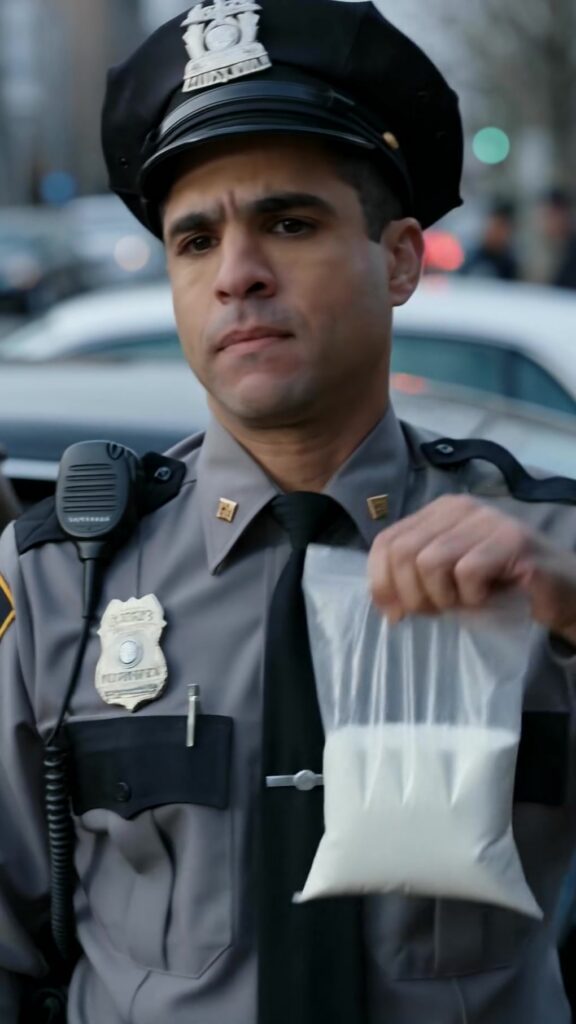
When he stood up, he held a clear plastic bag between thumb and forefinger. White powder clung to the sides in soft drifts, innocent-looking as sugar. The bag might have been a prop bought at a party store, if not for how his smile widened like a door opening.
“Well,” he said, turning it so the spotlight caught it just right. “What do we have here?”
His confidence wasn’t loud. It was worse—quiet and practiced, the calm of a man who’d already pictured me in cuffs, already heard my protests fade into paperwork. His grin had the smug warmth of a hunter posing with a trophy.
I let him enjoy it for one breath. Then I tilted my head and spoke softly, as if we were sharing a secret. “Do you want to frame me before or after you check the hidden camera under my dashboard?”
The word camera didn’t land like an accusation. It landed like a sudden loss of gravity.
His hand jerked. The bag rattled faintly. The smile tried to hold, but it cracked at the corners. He stared at me as if I’d changed shape in the spotlight. “What did you say?”
“Under the dash,” I repeated, nodding toward the windshield. “It’s angled low. You missed it when you leaned in at my window.”
His eyes snapped to my car. For half a second, I could see his mind racing—calculating angles, timestamps, bodycam audio, the story he’d tell if someone else arrived. His fingers tightened so hard the plastic crinkled. The white powder shifted inside like a small snowfall.
“Ma’am,” he said, voice tightening, “you should be very careful what you say next.”
“I’ve been careful for six years,” I replied. “Careful looks like this.”
I reached into my coat pocket slowly, the way you’re taught to during traffic stops, the way people do when they want to survive. His shoulders rose; his free hand hovered closer to his holster. I pulled out a folded photograph and held it out between us.
His eyes locked on it before I even unfolded it. He knew his own posture the way criminals recognize the shape of their own crime. When I opened the photo, the patrol spotlight lit his face in glossy print: the same uniform, the same jaw set just so, the same kind of satisfied smile. Beside him, another officer. In his hand, another clear bag. In the background, a different car. And on the curb, a woman with her head bowed, hair falling like a curtain, hands already cuffed.
The officer in front of me went still. His throat worked, swallowing something too sharp. “Where did you get that?” he demanded, but the authority drained out of the words.
“It’s from my mother’s case file,” I said. “The parts they didn’t think anyone would look at. The parts no one could afford to fight.”
His gaze flicked over my face as if searching for family resemblance, for the proof that I wasn’t a random driver. The shaking returned to his hand, fine and uncontrollable now, traveling from his fingers up his wrist like a current. The plastic bag quivered with it.
“Who are you?” he whispered, and the question wasn’t procedural. It was fear pretending to be curiosity.
“The daughter of the woman you did this to,” I said. “Six years ago. You took her job, her apartment, her name. You gave her a number instead.”
His lips parted, then closed. The night felt closer, the darkness pressing in around the spotlight. Somewhere down the road, a vehicle passed, its sound rushing by like a wave that couldn’t reach us.
“You can’t prove—” he started.
“The camera can,” I said. “It records to the cloud. It streams live.” I paused and let the weight of it settle. “My attorney’s watching. So is Internal Affairs. And the local station has a tip line that will love this footage.”
He stared at me, and the practiced mask on his face began to slip, revealing something raw and ordinary beneath it: a man who’d built his life on the assumption that no one like me would ever be prepared.
“Turn around,” he said suddenly, a reflex, a last attempt to put me back in the old script. His hand twitched toward his radio.
“Go ahead,” I answered, voice steady. “Call it in. Say you found it. Say I confessed. Say whatever you want.” I nodded toward the windshield again. “Just remember the camera sees your hand come out of my passenger footwell holding a bag that wasn’t there a minute ago.”
His radio crackled softly—someone else asking if he was okay, if he needed backup. He didn’t respond. The silence from him was its own confession.
For a long moment, we stood in the light: him holding his planted proof like it had turned into a live snake, me standing with my hands empty, my heart pounding in a rhythm that sounded like my mother crying behind a closed bedroom door.
Then he did something that surprised me. He lowered the bag, slowly, as if gravity had finally asserted itself. His shoulders sagged a fraction. He looked past me into the darkness, as though hoping the night itself might erase what it had witnessed.
“You don’t know what you’re doing,” he said, but his voice had lost its edge.
“I do,” I replied. “I’m ending what you started.”
His hand trembled again, worse this time, and I realized it wasn’t just fear of getting caught. It was fear of being seen—truly seen—for the first time. Not as a badge. Not as authority. Just as a man who’d made a sport of ruining strangers.
In the distance, another set of headlights appeared, cresting the hill, slow and deliberate. A second patrol car. He watched it approach with the expression of someone hearing the first notes of his own funeral march.
I didn’t move. I didn’t gloat. I simply waited, letting the camera drink in every second, every tremor, every faltering breath.
When the new cruiser’s lights joined the scene, doubling the glare, he finally looked at me again. The smile was gone. In its place was something smaller and uglier: the knowledge that the story he’d planned to write with my life had been taken out of his hands.
And as the other officer stepped out and walked toward us, I raised my chin and spoke loud enough for the microphones—mine and theirs—to catch every syllable. “Officer,” I said, pointing to the bag in his shaking hand, “tell them where you really found it.”