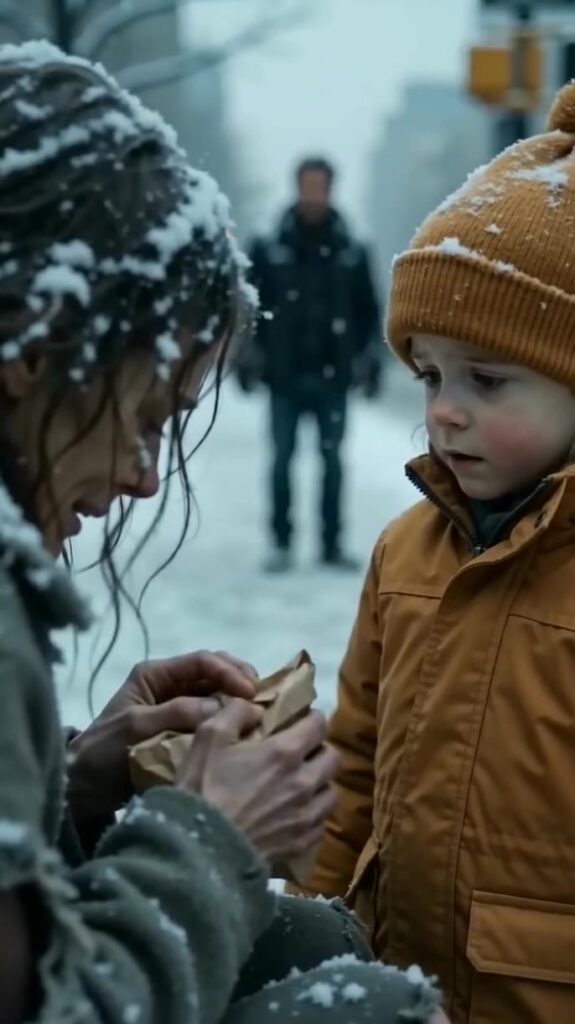
Snow drifted slowly through the gray afternoon as little Mia crossed the sidewalk in her mustard-yellow parka, both hands wrapped around a small brown paper bag. The street looked like it had been sketched in pencil—everything softened and muted, the storefronts blurred by falling flakes and exhaust. Mia’s boots made small squeaks on the salted pavement as she walked with a solemn purpose that didn’t fit her six years.
Her father, Daniel, followed a few paces behind. He’d been trying not to hover, trying not to be the kind of man who turned every errand into a lesson. But he couldn’t help it today. The cold carried memory in it—sharp, metallic, like the edge of a key against the teeth—and the city had a way of hiding trouble in plain sight.
On a bench beside the bus shelter sat a woman wrapped in torn gray layers. Her feet were bare on the wooden slats, toes mottled and red, trembling so hard the bench complained with each shiver. Snow had landed in her hair and stayed there, as if even the weather had decided she belonged to the elements. Her face had the hollowed look of someone who had used up all the easy parts of hope. When she lifted her eyes, they were not blank; they were exhausted in a way that made Daniel’s throat tighten.
“Mia,” he called quietly, keeping his voice gentle. “Don’t get too close.”
Mia didn’t turn. She stopped in front of the woman as if the bench had been waiting for her. She held out the paper bag with both hands like an offering she’d rehearsed. “Hi,” she said, and her voice didn’t have fear in it—only concern. “Are you cold?”
The woman blinked slowly, surprised to find a child’s face at the level of her own knees. “A little,” she whispered, as if admitting it might cause the whole world to collapse. “But I’m… fine.”
Mia’s forehead creased with a seriousness that made Daniel ache. “No you’re not,” she said, not unkindly. Then she nudged the bag forward. “This is for you. Daddy bought it for me, but you look like you need it more.”
The woman’s shaking hands closed around the bag as if it might evaporate. The paper crinkled; a faint smell of warm bread slipped into the cold air. She stared at it, then at Mia. Something in her expression fractured—pride, maybe, or the last brittle piece of denial—and tears gathered without permission. “Thank you,” she said, and the words sounded like they hurt to say.
Mia did not step back. She studied the woman’s face the way she studied puzzles at the kitchen table, turning the pieces in her mind until they belonged somewhere. “You shouldn’t be out here alone,” Mia said. “People shouldn’t be alone when it’s like this.”
The woman tried to smile, but her mouth trembled too hard. Daniel took a careful step closer, ready to intervene if the woman startled or lashed out. Yet something held him—an instinct, a pinprick behind his ribs. The woman’s voice, thin as it was, carried a familiar cadence, like an old song played too slowly.
Mia took a breath, and Daniel saw the moment she decided to be brave. “You need a home,” she said plainly. Then, as if saying it out loud would make it real and manageable, she added, “And I need a mom.”
The air seemed to pause. Even the traffic noise softened under the snowfall. The woman’s hands tightened around the bag; her knuckles went white. She stared at Mia with a look that was not confusion but recognition—too sharp, too immediate.
“What did you say?” the woman asked, and her voice cracked like ice under a shoe.
Mia pointed behind her without looking away. “My daddy is right there,” she said. “He’s nice. He makes pancakes shaped like stars when I have nightmares.”
The woman’s eyes lifted, slowly, reluctantly, as if she were terrified of what she would find. When she saw Daniel, the faint color that remained in her face drained away. Her lips parted; her spine went rigid. For a heartbeat Daniel didn’t understand why he was suddenly struggling to breathe. Then he saw it: not just the way she stared, but the way the world seemed to tilt toward her, as if some missing piece had clicked back into place.
“No,” she whispered. “No, it can’t be—”
Daniel stopped moving. Snow collected on his shoulders; he didn’t feel it. He stared at the woman’s face, trying to map it onto memory—trying to tell himself it was coincidence, that grief could make strangers look like ghosts. But the line of her cheek, the small scar near her eyebrow, the shape of her mouth when she tried to form the next word—those were not inventions of longing. Those were facts.
Mia’s bag sagged open in the woman’s lap. A sandwich wrapped in wax paper slipped into view, an apple, and a folded napkin. Mia had drawn on it in blue crayon: a stick-figure man, a stick-figure girl, and a blank space between them. Over the empty space, in crooked letters, she had written a single word with the fierce certainty of a wish: MOM.
The woman’s breath hitched. She stared at the drawing as if it had been pulled from her own ribs. Then, with fingers that could barely obey her, she reached under the collar of her coat and fished out a thin silver chain. At the end of it hung a ring—scraped, bent, and split at the band, but unmistakable.
Daniel made a sound he didn’t recognize from his own throat. He knew that ring the way he knew the shape of Mia’s laughter. He had slid it onto Elena’s finger in a warm church with fogged windows, promising forever while snow fell outside like a blessing instead of a warning.
“Daniel,” the woman whispered, and the name carried three years of silence in it, three years of unanswered calls and police reports and nights he’d spent staring at the ceiling, bargaining with God and then hating Him.
His knees went weak. “Elena?” he said, and the word felt like tearing open a scar. He took another step, close enough now to see the frostbite marks at her ankles, the bruised shadows under her eyes, the way hunger had carved her cheekbones. “Where—” His voice failed him. “Where have you been?”
Elena clutched the paper bag to her chest as if it were a life vest. “I tried to come back,” she sobbed, and snow melted on her lashes, turning her tears into something that looked like rain. “That night… the storm. The highway. The car spun. I woke up in a clinic with no name, no phone, no memory that stayed. They moved me. I worked when I could. I ran when I couldn’t. Every time I got close to home, something happened—shelters full, papers wrong, my mind fogging again. I kept the ring because it was the only thing that felt true.”
Daniel’s hands hovered, unsure whether touching her would shatter her into nothing. “We buried you,” he said hoarsely. “We held a service with an empty casket. Mia asked me where you went, and I lied because the truth was too ugly.”
Mia looked from one face to the other, her small body suddenly very still. “Daddy,” she whispered, voice wobbling. “Why does she look at me like that?”
Elena’s gaze dropped to Mia—really dropped, as if she was seeing her for the first time and also remembering her all at once. Her expression was agony and wonder braided together. “Because you’re mine,” Elena said, barely audible. “I didn’t know… I didn’t remember until I saw his face and your eyes.”
Daniel swallowed hard. The world around them kept moving—buses sighed to stops, doors opened, people hurried past with scarves up to their noses—but for Daniel everything narrowed to the bench, the ring, the child between them. “Mia,” he said, and his voice shook. “This is… this is your mom.”
Mia stared at Elena as if measuring the word against the woman’s torn sleeves and bare feet. Then she stepped forward and pressed her small mittened hand against Elena’s cheek. “You’re cold,” Mia said, as if that was the most important truth in the universe.
Elena leaned into the touch and broke all the way open. Daniel finally knelt, closing the distance with a care that felt like prayer. He wrapped his coat around Elena’s shoulders, then pulled both women—one small, one shattered—into his arms. Mia fit under his chin. Elena’s sobs shook through him.
“We’re going home,” Daniel murmured, not as a question but as a vow he would enforce with his entire life. “We’ll do doctors and paperwork and all of it. But first, we go home.”
Snow kept drifting, quiet and relentless, covering the hard edges of the city. On the bench, beneath the gray afternoon, a family that had been broken by winter found itself stitched together again—not neatly, not easily, but undeniably. And in Mia’s blue-crayon drawing, the empty space between the stick figures no longer felt like a hole. It felt like a place that had finally been found.