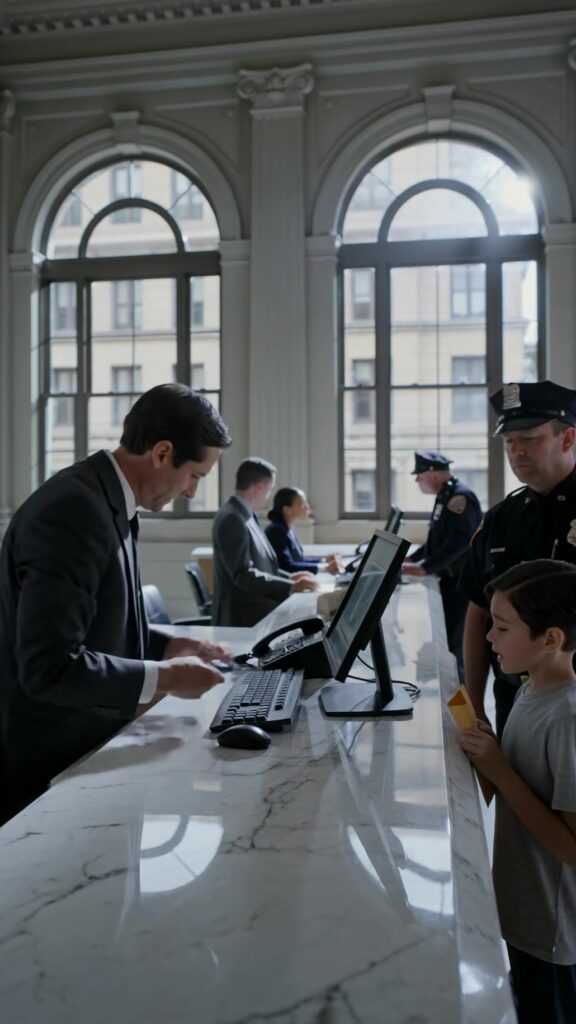
The doors of Harrow & Slate Bank sighed open as if even the air inside cost money. Marble shone under chandeliers that looked like frozen fireworks. A guard in a crisp uniform glanced down—and then looked away, as though acknowledging a child might invite trouble.
The boy stepped onto the polished floor in shoes that were too thin for the season. He held a brown envelope tight to his chest, both hands wrapped around it like a life vest. He was small enough that the counter seemed built for someone else’s world, and quiet enough that the bank’s humming lights sounded loud by comparison.
At window three, Caleb Morrow tapped his pen and watched him approach. Caleb had worked seven years behind that counter. He had seen forged checks scribbled on napkins, desperate men trying to cash cashier’s drafts with trembling hands, and teenagers with stolen debit cards. A child walking in alone didn’t mean innocence. It meant someone older was waiting outside.
“Next,” Caleb said, without lifting his eyes from the monitor.
“I want to check my account,” the boy replied. His voice was soft, as if he were asking permission to breathe.
Caleb finally looked up. The boy’s hair was freshly cut but uneven, like someone had done it in a hurry. A faint bruise curled along his jawline, half-hidden by the angle of his face. Caleb’s stomach tightened in the way it always did when he smelled trouble. “You need an adult,” he said flatly. “This isn’t—”
The boy slid a black card through the slot in the glass, keeping his fingers on it until Caleb reached for it. The card wasn’t the usual plastic; it had a dull, heavy sheen. No bright logos. No cheerful colors. Just a subtle embossed crest and a string of numbers that made Caleb’s eyebrows lift despite himself.
Caleb snatched it back as though it might burn him. “Where did you get this?”
“It’s mine,” the boy said. “My grandmother left it for me.”
“Sure,” Caleb muttered. He nodded toward the uniformed officer stationed near the lobby’s velvet rope. Officer Duran had been hired after a string of ATM skimmers, and he looked bored until he saw the card in Caleb’s hand. Duran’s attention sharpened. He shifted closer, just enough to hear, not enough to startle the child into running.
Caleb typed in the number, ready to trigger the routine: decline, alert, confiscate, call security, hand the kid over to whoever came storming inside. He waited for the screen to confirm his suspicion.
Instead, the monitor blinked and the world tilted.
The account populated so fast it seemed as though the bank had been waiting for this exact sequence. A banner across the top read: LEGACY TRUST — RESTRICTED ACCESS. Caleb’s permissions should have been rejected, but the system didn’t reject him. It simply… opened, like a door that recognized the sound of an approaching footstep.
Caleb felt the blood drain from his face. The name attached to the account was not the name of a wealthy client he’d ever seen escorted to the private conference rooms. It was the name the boy had spoken to the receptionist when he’d walked in: Noah Kellan.
Below it, in internal notes stamped with an executive seal, were words that made Caleb’s throat go dry.
Release only when the child appears in person.
Noah watched him through the glass with steady eyes that didn’t blink often. Caleb tried to swallow and found his mouth had turned to sand.
“What is my balance?” Noah asked.
Caleb stared at the figure and nearly laughed, not because it was funny but because his mind refused to accept it. Numbers like that belonged in newspaper scandals or on the screens of CEOs. The balance was more money than most people would see in a lifetime, more than some of Harrow & Slate’s best clients held in liquid form. It wasn’t a child’s savings. It was a fortress.
His hand hovered over the print button. He could give the boy a statement. He could call a manager. He could do what the bank trained him to do. But his eyes dropped to the next line in the notes, and the air seemed to vanish from the booth.
A final message, not typed in a cold corporate font but scanned in from a handwritten note, slanted and unmistakably human.
If my grandson comes alone, call the police. It means I was killed.
Caleb’s gaze snapped to Noah. The boy’s calm wasn’t confidence. It was the stillness of someone who had already burned through his fear. “Noah,” Caleb said, softly now, using the name like a lifeline, “where is your grandmother?”
Noah’s eyes flicked down to the envelope as if it weighed more with every second. “She said to give this to the bank,” he whispered. “She said if anything happened, I should come here and not stop for anyone. Not even… not even Uncle Grant.”
Officer Duran stepped closer, his hand resting near his radio. “You said ‘Uncle Grant’?” he asked. His voice had lost its bored edge.
Noah nodded once. “He came to the house last night. He was yelling. Grandma told me to go to my room. I heard glass break. Then it got quiet.” The boy swallowed. “She didn’t answer me this morning.”
Caleb’s stomach turned. He had handled suspicious transactions and false IDs, but this—this was a living warning trapped behind glass. He clicked a hidden internal extension number, the one managers used when something was bigger than a dispute over overdraft fees. His fingers shook as he dialed, then steadied. “This is Caleb at window three,” he said. “I need compliance and security. Now. Legacy trust flagged, minor present. And call the police—uniformed response, immediately.”
Officer Duran’s eyes narrowed. “I’m police,” he said. “But I’m calling for backup.” He spoke into his radio, his posture suddenly coiled and alert. “Possible welfare check turned homicide. Child witness. Request units.”
Noah flinched at the word homicide, but he didn’t run. He simply stood there, fingers whitening around the envelope. Caleb wanted to reach through the slot and take it gently, to reassure him. He knew better. Children learned quickly who to trust, and Noah’s trust looked rationed.
Caleb unlocked the side gate of the counter and stepped out—against protocol, against every rule that said a teller stayed behind the glass. He crouched so he was level with the boy. “Noah,” he said, “you did exactly what you were supposed to do. You’re safe here. Do you understand?”
Noah’s lips trembled, the first crack in the composure. “She told me to be brave,” he whispered. “She said the bank would know what to do.”
Caleb glanced at the envelope. The paper was wrinkled, as if Noah had gripped it through the entire walk. “Can I see it?” Caleb asked.
Noah hesitated, then slid it into Caleb’s hands.
Inside was a second card, sealed in plastic, and a letter written in the same slanted hand as the note in the system. Caleb read quickly, his heart hammering.
It wasn’t just money. It was instructions—names, dates, a list of shell companies, and a warning that her own family would come for the trust the moment she was gone. The letter named Grant Kellan not as a grieving son but as the person she feared most. It included a phrase that made Caleb’s skin prickle: “If he learns the child can authorize release, he will not leave the child alive.”
Caleb looked up. Noah stood very still, watching his face for the truth he couldn’t put into words. Behind them, the bank’s lobby continued its polite rhythm—clients murmuring, pens scratching, the distant click of heels—like a stage play unaware that the plot had turned.
Sirens rose faintly outside, growing louder, and Caleb felt a terrible clarity settle over him. The card wasn’t stolen. It was a key. And the boy holding it wasn’t a petty thief.
He was the lock that had been designed to open only once—if he survived long enough to turn it.
Caleb folded the letter carefully and slipped it back into the envelope as if it were a fragile bone. Then he put himself between Noah and the glass doors, between the child and the world that had already reached for him once. “Stay close to me,” he said. “No matter who comes in here and what they say.”
Noah nodded, and for the first time his voice rose above a whisper. “They’ll come,” he said, not as a guess but as a memory. “Grandma said they always do.”
Caleb heard the front doors open again, felt the draft. He didn’t turn quickly. He waited, listening for footsteps that moved with purpose, for a voice that sounded too sure of itself. He watched Officer Duran’s hand hover near his holster. He watched the security guard tense. And he watched Noah’s small shoulders set like stone.
The bank had always been a place where money spoke louder than people. But now, in the hollow space between marble and glass, it was a child’s name on a screen that had finally forced everyone to listen.