The train hissed to a stop like it was exhaling a secret it had carried too long. Jonah Kincaid stepped down onto the platform with a duffel bag cutting into his shoulder and the taste of coal smoke in his mouth. He had returned in pieces—some visible, some not—and yet one thing had remained whole through the months of mud and artillery and the ringing quiet that followed every blast: the image of his front door and the life waiting behind it.
He had rehearsed it until it felt less like a hope and more like a promise. He would turn the knob. The hinges would complain the way they always did. Mara would look up from whatever she was doing, her face changing as recognition hit, and she would cross the room so fast her feet would barely touch the floor. He would hold her long enough to convince himself he was real again. He would smell soap instead of smoke.
The street was the same, but different in the way a face changes when grief sharpens it. The elm tree in front of their house had lost a limb. Someone had painted the fence. Jonah’s boots sounded too loud on the walkway. He paused with his hand on the doorframe, a man suddenly afraid of the answer to the smallest action. Then he stepped inside, blinking against the warm lamplight, his eyes adjusting to the normal world as if it were a foreign country.
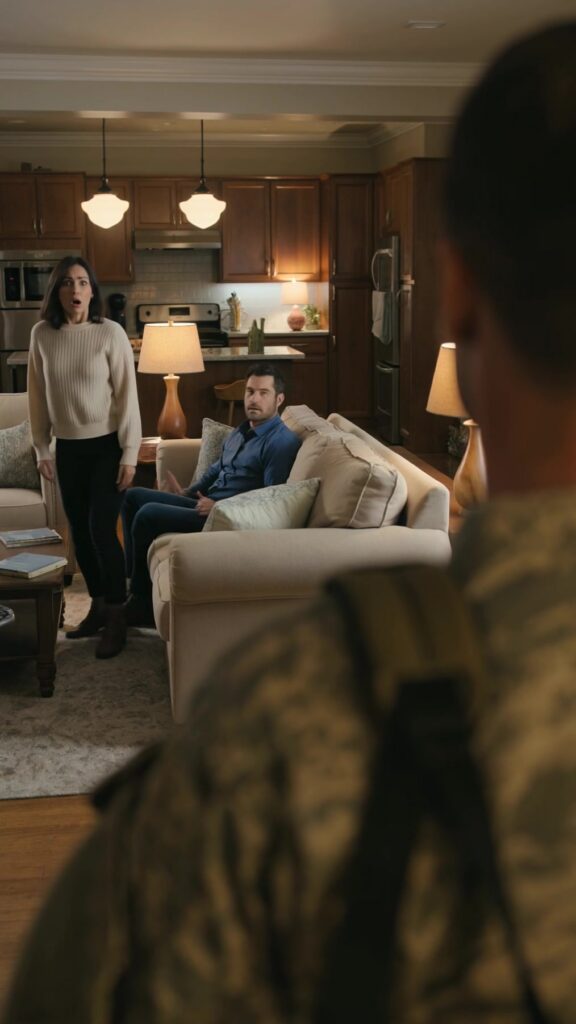
There were voices. The soft murmur of conversation, the scrape of a glass on wood. Jonah’s heart lifted for one reckless second—Mara was there. Then he saw the couch.
Mara was sitting in the corner of it, turned slightly toward a man in a blue work shirt. Their knees were angled close, the posture of people who had shared too many evenings. The radio was low, some crooner’s voice barely above a whisper. A folded blanket lay across the backrest as if it belonged there. There was a bowl with apple peels on the table. The room did not look like it had been waiting. It looked like it had been living.
Mara’s eyes met Jonah’s and went wide, the color draining from her cheeks as though someone had pulled a plug. She stood so abruptly her cup tipped, coffee spilling in a dark crescent across the table. “Jonah,” she said, and his name sounded like something torn in half. “I can— I can explain.”
He could not make his throat work. Not for anger, not for questions. The feeling that rose in him had no heat to it. It was a cold, airless silence, the kind that had pressed on his chest in foxholes before dawn. His fingers tightened around the duffel strap until his knuckles burned. He stared at the man in blue, at the careful way he rose too, hands open at his sides as if to show he carried no weapon. Jonah had seen that posture in villages where men expected retaliation.
“You should let her talk,” the man said. His voice was low and controlled, like a medic trying not to spook a wounded soldier.
The words sliced cleaner than any insult could have. Jonah had survived long months of being told where to go, when to move, when to sleep, when to kill. He had crossed an ocean to stop being ordered around. Now there was a stranger in his living room telling him what he “should” do.
Jonah’s gaze dropped to the coffee table, to the mess of spilled coffee and something else—envelopes. A small, neat stack, edges aligned as if someone had arranged them more than once, then set them down again. His breath snagged. The stamps were military, the handwriting his own. He recognized the slant of his “M,” the way his pen pressed hard on the downstrokes when his hands shook. Letters he had written in a tent lit by a single bulb. Letters he had written when men around him screamed in their sleep. Letters he had been told were delivered.
All of them were unopened.
Jonah looked at Mara, and in that glance a whole world cracked. Not the world where she had replaced him—something worse. A world where his voice had never reached her at all. “Why?” he managed, the word raw and small.
Her mouth trembled. Tears came fast, streaking down as if they had been waiting behind her eyes for months. “I didn’t get them,” she whispered. “Jonah, I swear—I didn’t.” She moved toward the table, then stopped, as if she feared stepping closer would shatter him. “They started showing up last week. All at once. Just… left on the porch.”
Jonah’s mind tried to make the math work and couldn’t. If she hadn’t gotten the letters, then she hadn’t gotten the pieces of him he’d mailed home: the reassurances, the plans, the confessions he’d never dared to say aloud. If she hadn’t gotten them, she’d been alone with rumors and casualty lists and the cruel arithmetic of war. The room tilted. He gripped the back of a chair to steady himself and felt the wood beneath his palm, real and ordinary, like a cruel joke.
The man in blue cleared his throat and reached for a folder near the envelopes. His movements were slow, deliberate, as if Jonah might bolt or break. “I’m not here because of what you think,” he said, and Jonah heard fatigue under the calm. “I’m here because your daughter is asleep in the next room.”
The sentence hit Jonah harder than the sight of the couch. His daughter.
He had left when Mara’s belly was barely a swell beneath her dresses. He had a blurred memory of the doctor’s office, the smell of antiseptic, Mara’s hand in his. He had kissed her forehead and promised to be back before the baby walked. Then the war stretched and stretched, devouring time. Jonah swallowed, tasting iron. “My—” The word wouldn’t form. “She’s here?”
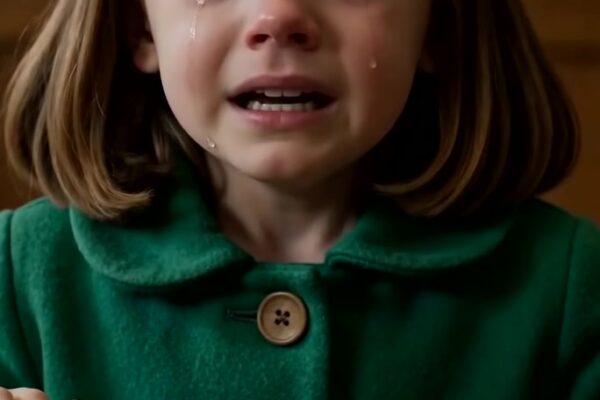
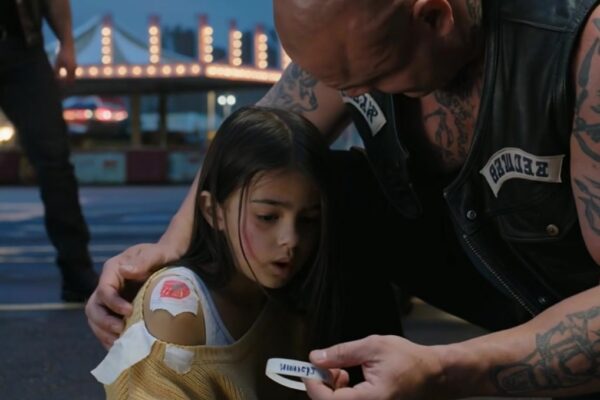
Mara nodded, pressing her fingers to her mouth as if to keep herself from sobbing. “Lila,” she said. “She’s two. Jonah, she—she knows your face from the picture on the mantel. She points and says ‘Da’ sometimes, but… I didn’t know if you were coming home. I didn’t know.”
Jonah’s eyes went to the hallway. The door to the back room was ajar, and a slice of darkness lay across the floor like a quiet warning. In that shadow, a child was breathing, dreaming, existing—an entire person Jonah had never held. His chest ached in a way the battlefield had never taught him to endure.
“Who are you?” Jonah asked the man, though his voice lacked accusation now. It carried only exhaustion and the need for something solid.
“Elliot Voss,” the man replied. “County office. I was assigned to help with… benefits and paperwork. When the notice came through that you were listed as missing and presumed dead, Mara didn’t have much. The pension was delayed. The landlord threatened eviction. I did what I could.” He hesitated, then added, quieter, “And when someone started interfering with mail from the base, I started asking questions. That’s why the letters are here.”
Mara flinched at the word interfering, like it had teeth. Jonah’s gaze returned to the envelopes, and suddenly they weren’t simply undelivered; they were stolen. A thief had reached into the thin lifeline between Jonah and home and severed it, letter by letter, leaving Mara to make decisions in a silence she never chose.
“Who?” Jonah asked. The war had taught him that every wound had a hand behind it.
Elliot’s jaw tightened. “Your father-in-law,” he said. “Mara’s father. He runs the post office route on the east side. He admitted he’d been ‘protecting’ her. His word. Said you were gone, that you’d never come back the same, that she deserved stability. When she refused to move in with him, he kept the mail anyway. Held it like leverage.”
Mara’s shoulders shook. “He told everyone you’d stopped writing,” she whispered, voice breaking. “That you’d forgotten us. He made me feel… stupid for waiting.” She looked at Jonah like a drowning person clinging to a plank. “Elliot helped me file complaints. He helped me keep the house. He helped—” Her eyes flashed to the hallway. “He helped Lila have shoes that fit.”
Jonah closed his eyes. He saw his own handwriting buried in a drawer somewhere, months of devotion turned into dust. He imagined Mara at the window, watching the road, then turning away, day after day, her hope eroded by the absence of proof. The fury he’d expected finally arrived, but it had nowhere to land on Mara. It searched for a target and found an older man’s selfishness instead.
Jonah opened his eyes and released the chair. His hands were steady now in a way they hadn’t been moments earlier. He set the duffel down with care, as if placing something fragile on the floor. “Where is he?” he asked.
Elliot shook his head. “Not here. He left when I told him you’d been spotted in town. I’m not sure if he’s hiding or running to spin another story. But I brought the letters back as soon as I got them. I thought… you should have them in front of you. The truth should be in the room.”
For a long moment, no one spoke. The radio kept playing, oblivious. The spilled coffee spread slowly across the wood. Jonah stared at the stack of sealed envelopes. They were like a time capsule of the man he used to be: hopeful, terrified, trying to stay human.
Then Jonah looked at Mara—not at the couch, not at the proximity to another man, but at her eyes rimmed red from months of holding herself together. He heard, beneath all the chaos, the steady hush of a child sleeping down the hall. His child.
“I’m going to see her,” Jonah said, the words trembling but firm. “And then we’re going to read every one of those letters together. Not to fix what happened. Just to… let it be real.” He glanced at Elliot, the stranger who was not a rival but a witness. “And after that, I’m going to the post office.”
Mara’s knees buckled as relief and fear collided. She nodded, wiping her face with the back of her hand, as if she’d forgotten manners in the face of survival. Jonah moved toward the hallway, each step loud in the quiet home, each step both a return and a beginning. At the doorway to the back room, he paused, his breath catching at the smallest sound: a child’s sigh, soft as a promise.
Behind him, the lamp cast their shadows across the floor—three adults tangled by war and betrayal, and, in the next room, the small, unseen shape of the reason Jonah had come home at all. He reached for the doorframe, not to steady himself this time, but to remind his body that he was here, that the war had ended, and that the harder battle—truth—was only just beginning.