The courtroom was quiet in the way only painful places are quiet—like a hospital corridor at midnight, like a church after a funeral when the last hymn has died and no one is certain what to do with their hands. Even the ceiling fans seemed to turn more softly, as if sound itself had been sworn in and warned to behave. Papers whispered somewhere near the clerk’s desk. A throat cleared in the back row and the man who did it looked guilty for making the air move.
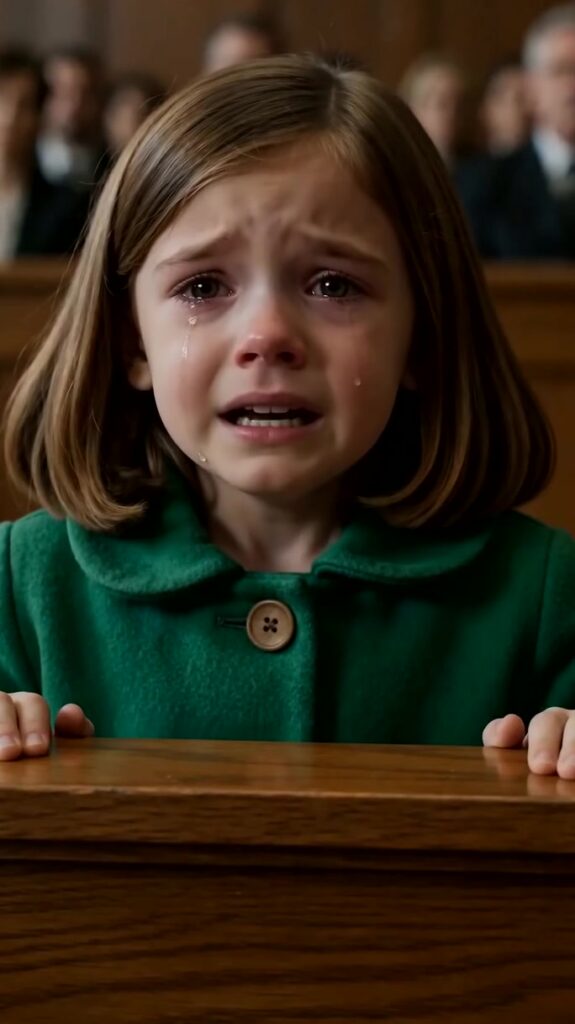
At the front, a child stood too small for the architecture. She wore an emerald coat so bright it looked defiant against the varnished wood and gray suits. Her fingers were braced on the witness bench, tiny knuckles whitening as if she could anchor herself by force. She had been told to wait outside, but she had slipped in anyway when the bailiff turned to open a side door. Now she stared at the judge like the judge was the last light left on an emptied street.
Judge Inez Harrow sat in a wheelchair that had become as much a symbol as the seal behind her. Years ago, an accident on winter ice had taken her legs from her in a way the body can do without amputation—present, intact, and unreachable. She was known for an even voice, for sentences delivered like carefully laid stones. She had read the file in front of her with the same practiced calm, her glasses perched low, her hands steady, the law cleanly between her and everything else.
The little girl’s mouth moved before she seemed ready. “Your Honor,” she said, and the words came out thin, like thread pulled too hard. “If you let my dad come home… I can fix your legs.”
Silence did not fall; it crystallized. The attorney at the prosecution table froze with his pen lifted, ink dotting the page like a bruise. A woman in the gallery lowered her face into her palm. Judge Harrow’s eyes lifted above her glasses—not angry, not indulgent, simply caught off-guard, as though the child had spoken in a language she had forgotten she knew. Her fingers paused on the edge of the document, the paper bending slightly under the pressure of a grip that hadn’t tightened in years.
“Do you believe,” the judge asked at last, voice quieter than the room, “that your father needs to come home?”
The girl nodded too quickly, the way someone agrees before the question can change. “Yes,” she whispered. “He really does.” Her breath hitched. Tears welled and didn’t fall at first, as if they were trying to decide whether they were allowed. “He did something wrong. I know. He told me it was wrong.” She swallowed, eyes fixed on the judge’s face as though the judge could turn her gaze into mercy. “But it wasn’t… it wasn’t for fun. It wasn’t to be bad.”
Judge Harrow’s gaze shifted briefly to the file: petty theft from a grocery, a misdemeanor elevated by repeat warnings, a man named Daniel Reeve who had already signed one diversion agreement and broken it. On the page, the facts were tidy. In the room, they weren’t. “Tell me,” she said, and the invitation was small but real, “what it was for.”
The girl wiped her cheek with the back of her hand, smearing a shiny trail that made her look even younger. “We didn’t have enough,” she said. “Not after the factory cut his hours. Not after Mom got sick and couldn’t do the cleaning jobs.” The words tumbled with the urgency of a secret that had been too heavy too long. “He said taking what isn’t yours is wrong. He said it makes a hole inside you. But he also said watching your kids go to sleep hungry makes a bigger hole.”
A murmur tried to rise and died immediately. Judge Harrow’s eyes did not go to the gallery. They dropped, slowly, to the wheelchair—its metal frame, its footrests, the neatly placed shoes that covered feet that had become, for her, more idea than sensation. Something in her expression tightened, not with judgment but with recognition she did not want.
When she was a new judge, she had sentenced a man who stole antibiotics from a pharmacy for his wife. She remembered the way his hands shook as he tried to explain that hospitals required deposits he didn’t have. She remembered the certainty in her own voice then, the way she had told herself she was teaching a lesson. She remembered later, too, the newspaper clipping: the wife’s obituary. She had kept it in a drawer and never opened it again.
The little girl leaned forward, as if if she stopped leaning she might topple into despair. “I can fix your legs,” she repeated, more softly now, as if pleading could become proof. “I know I can.”
Judge Harrow inhaled, preparing to correct her—preparing to do what adults do when children offer miracles: explain, dismiss, set boundaries. But before she found the words, a sensation moved through her like a distant bell struck in another room. Not pain. Not heat. Something else—an impossibility that felt like a question.
Her right foot shifted against the footrest.
It was small, barely a twitch, the kind of movement a camera might miss and the mind might deny. The judge stared down as if her gaze could force reality to sit still. For a heartbeat, nothing happened, and she almost exhaled in relief. Then it happened again—more deliberate this time, the toe lifting, the ankle flexing, the shoe scraping faintly against the metal.
The child saw it first. Her eyes widened and her mouth opened on a soundless gasp, like someone witnessing a candle relight itself. Judge Harrow’s fingers loosened on the file until the papers slid slightly, no longer important enough to hold. She felt her pulse in her throat. Fear came swift and sharp, not of paralysis, but of hope. Hope was the most dangerous thing in a courtroom; hope had no statute and no limit.
“How…” the judge started, and stopped. She looked up at the girl again. The child’s face was wet, her lashes clumped, her lips trembling with something that wasn’t only sorrow. “What did you mean,” Judge Harrow asked, voice unsteady for the first time anyone in that room could remember, “when you said you could fix them?”
The girl’s shoulders rose and fell in a shaky breath. “When my mom couldn’t breathe good,” she said, “I sat with her and held her hand and I told her stories. And she got calmer. And then she could breathe.” She swallowed. “When my little brother wakes up screaming, I put my hand on his back and he stops shaking.” She looked down at her own palm as if surprised to find it attached to her. “I don’t know how. I just… I just want it so bad that things stop hurting.”
Judge Harrow stared at the child’s hand. She thought of nerves that had gone quiet, of doctors who had spoken in careful voices about permanence. She thought of the countless people who had sat where this child stood and asked her for something the law was not designed to give. She felt her right foot twitch again, a stubborn answer to a question no one had asked aloud.
The prosecution rose, clearing his throat, trying to salvage procedure. “Your Honor, with respect—”
Judge Harrow lifted one hand, not sharply, but with the authority of someone who had carried silence like a gavel for years. The man stopped. The judge looked at the file again, and the words on it did not rearrange themselves, did not soften. Still: theft. Still: breach. Still: consequences. Yet beneath the ink she could suddenly see the child’s kitchen table, the empty bowl, the mother’s shallow breaths, the father’s hands making a decision with no good doors.
“Mr. Reeve,” she said, turning her gaze to the man in shackles at the defense table, a man who looked hollowed out by shame, “stand.” He rose, chains whispering. He did not look at his daughter, as if her presence was both rescue and condemnation. Judge Harrow watched his eyes glisten and then harden with the effort of not crying in public.
“The court cannot be traded miracles,” she said, and her voice steadied around the shape of truth. The girl flinched—then held herself still, bracing for the world to do what it always did. Judge Harrow continued, “but neither can it pretend it does not see what is in front of it.” She paused, feeling her foot press, very lightly, into the footrest as if to remind her she was alive. “I am ordering a presentence investigation and immediate review for alternative sentencing. Mr. Reeve will be remanded today, but this court will reconvene within seventy-two hours. Counsel will provide documentation of medical hardship and employment loss. The court will also explore supervised release with restitution and community service.”
A ripple ran through the room—relief that was not victory, surprise that was not certainty. The girl’s knees wobbled. She clung to the bench, blinking hard, trying to understand what seventy-two hours meant in a child’s calendar. Judge Harrow leaned forward in her chair, lowering her voice so it carried only as far as the front row.
“And you,” she said to the girl, “will not promise to fix what you did not break.” Her gaze softened, not into pity, but into something sharper: respect. “But you may have reminded this court what it forgot.”
The girl nodded, tears spilling freely now, and for the first time since she’d entered, she looked less like she was begging at a closed door and more like she was standing in a doorway that might open.
Judge Harrow’s foot moved again—small, real, undeniable. She felt it, and she did not look down this time. She looked instead at the child in the emerald coat and at the father trying not to fall apart, and she let the sensation settle where it belonged: not as a miracle owed, but as a warning. Painful places could be quiet, yes. But they could also listen. And sometimes, in the hush between law and mercy, something that had been dead for years could stir.