The rain was pounding so hard against the little jewelry shop window that the whole street outside looked blurred and broken. Water ran in frantic veins down the glass, turning headlights into pale smears and pedestrians into ghosts with umbrellas for wings. Inside, the shop held itself like a secret: warm amber lamps, polished wood, and a hush that made each tick of the wall clock sound like a decision.
Henri Mallory sat hunched at his bench behind the counter, a loupe pressed into his right eye, his hands steady over a ring whose stones refused to catch the light the way he wanted. He had spent most of his life chasing that perfect flare—gold turning to sunrise, diamonds giving back a clean, hard star. He had learned, slowly, that beauty was something you could shape, but not keep.
On the wall behind him, half-hidden by a cabinet of velvet trays, hung a framed photograph that never moved: a little girl in a yellow raincoat, smiling at a puddle as if it were an ocean. The glass over the photo was faintly scratched, as though someone had once tried to wipe grief away with their thumb until the world blurred.
The bell above the door had barely finished ringing when the door itself flew inward, dragged by wind and desperation. A young woman stumbled across the threshold, soaked through, hoodie plastered to her shoulders, ripped jeans dripping onto the tile. Her breath came in sharp, uneven pulls, like she had been running from something that didn’t tire.
She didn’t look at the displays. She didn’t take in the warmth. Her gaze was fixed on Henri as if he were a single step between her and a cliff edge. In both hands, pressed hard against her chest, she held a gold necklace with a round locket. The chain trembled—whether from cold or from her grip, Henri couldn’t tell.
He stood, pushing his stool back, and his knees complained with the small, familiar pain of age. He noticed three things at once: the rain sliding down her cheeks, the vacancy in her stare, and how the locket seemed less like jewelry than a confession.
She came closer until the edge of the counter was between them. Her voice arrived flat and careful, as though she had wrapped it in cloth to stop it from breaking. “How much will you give me for this?”
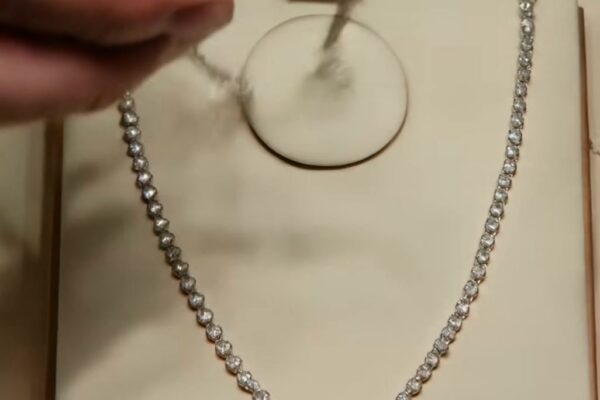
Henri held out his hand, and after a fraction of hesitation she set the necklace into his palm. Her fingers were numb with cold; when their skin brushed it startled him, the way ice startles through fabric. He turned the locket under the lamp, letting the light skim over it. The gold was real, but the clasp was worn. The hinge had been opened and closed too many times by someone who needed reminding.
“Fifty,” he said, because it was what he could say without thinking, the automatic calculus of metal weight and workmanship. “Not more.”
“Okay. Deal.”
The quickness of her answer hit him harder than the rain. People haggled in this neighborhood. They argued about ten dollars like it was pride itself. This girl didn’t want a good price. She wanted escape.
Henri’s thumb found the tiny latch by habit. He told himself he was checking for damage, verifying the piece. He told himself it was professional. The latch clicked.
The locket opened like a mouth finally forced to speak.
Inside, under a plastic film gone faintly yellow with years, was a black-and-white photograph: a young man with a shadowed jaw holding a small girl in a raincoat. The child’s grin was wide enough to hurt. Beneath the picture, in tiny letters worn down by touch, an engraving read: For my little Clara.
Henri’s lungs forgot what they were for. The shop, the rain, the clock—all of it dropped away as if the floor had opened. His hand began to shake. The locket nearly slipped from his fingers, saved only by the way the chain looped around his knuckles.
Clara.
Twenty years earlier, the rain had sounded the same—like handfuls of gravel thrown at the world. Henri had fastened that locket around his daughter’s neck on her seventh birthday. He had chosen it because it was simple and strong, because it could hold a picture and a promise. He had engraved the words himself in the back room after closing, his hands steady with joy.
That same autumn, Clara had vanished.
One afternoon when the school let out into sudden weather. One moment a yellow raincoat in the crowd, the next an emptiness so complete it made sound ring. Police searched. Neighbors searched. Henri searched until his voice failed. The city kept moving. He did not. He learned a new kind of clock—the kind that measured life in absence.
The young woman had already begun to turn away, pulling her hood up as if to barricade herself against warmth, as if anything gentle might crack her from the inside. Her hand reached for the door handle.
Henri lurched out from behind the counter so fast he hit his hip against the drawer. Pain flashed and vanished beneath something sharper. He crossed the narrow space and slammed his palm against the glass before she could open it. Rain exploded against the pane, loud as applause.
He held the open locket up between them like evidence and like a prayer. His voice, when it came, was not the practiced tone of a shopkeeper. It was raw, scraped down to bone. “That necklace—”
He swallowed, and the swallow hurt. “It belongs to my daughter.”
The woman froze. Her back stayed to him. Her hand remained on the handle, knuckles white under wet fabric. The air between them thickened with the smell of rainwater and old velvet.
“My missing daughter,” Henri said, and the word missing sounded too clean, too polite for what it had done to him. He stepped closer, careful as if she might shatter. “Her name was Clara.”
Slowly, painfully slowly, the young woman turned her face halfway toward him. Her lips trembled. Rain and tears mingled on her cheeks until they were indistinguishable. Her eyes—dark, exhausted, flinching—flicked from the locket to Henri’s face and back again as though she were watching a trap close.
Henri saw it then: not certainty, not the cinematic thunderbolt of recognition, but a crooked alignment of small things. The shape of her mouth, the slight tilt of her chin. A scar at the edge of her left eyebrow, faint as pencil. His own hands went cold.
“Clara…?” he whispered, as if speaking louder would anger whatever fragile force had brought her here.
Her eyes widened, and true fear entered them for the first time—fear of being named, of being claimed. She looked past him, to the quiet shelves, to the warm lights, to the photograph on the wall she hadn’t noticed when she ran in. Her gaze snagged on it like cloth on a nail.
Henri watched her throat work, watched the fight in her expression between running and collapsing. Then, with a voice that sounded as though it had traveled a long way through darkness, she said, “I’m not Clara.”
It should have ended it. It should have made him step aside, let her escape back into the storm with whatever secret had pushed her through his door. But she was shaking too hard, and the lie was too thin. She reached up, unconsciously, and touched the hollow at the base of her neck where the chain had rested. The motion was intimate, habitual—someone touching the place a memory lives.
Henri’s hands trembled around the locket. “Where did you get this?” he asked, and every word cost him. “Tell me who gave it to you.”
She pressed her forehead against the glass of the door, eyes squeezed shut as rain hammered outside like a countdown. “I didn’t steal it,” she said. “I don’t—” Her breath broke. “I don’t even know if I’m allowed to have it.”
Henri turned his head toward the counter, toward the phone hidden beneath a stack of receipts, toward the old instincts that demanded police, procedure, proof. Then he looked back at her, at the way she held herself like someone braced for impact, and he remembered the day Clara vanished: the way adults had spoken over him, around him, as if a father’s fear were background noise.
He moved his hand away from the door, not opening it, but removing the barrier. “Come away from there,” he said softly. “Sit down. You’re safe in here.”
Her laugh was a small, broken sound. “Safe?”
Henri lifted the locket closer to the lamp. The photograph gleamed, the engraving catching a thin line of light. “I don’t know what you’ve been running from,” he said. “But I know that necklace. I know the hands that made it. I know the child who wore it.” His voice wavered, then steadied on something stubborn. “If you are not Clara, then you are someone who has been living with Clara’s name close to your skin.”
The young woman’s shoulders sagged as if the storm outside had finally reached inside her. She stepped away from the door, each movement reluctant, as though she expected the floor to vanish. She came to the counter and stared at the open locket until her eyes flooded again.
“My name is Mara,” she whispered. “That’s what they told me.”
“Who are ‘they’?” Henri asked.
She flinched at the pronoun, and he understood: there were many, faceless and coordinated. She pulled back her hood. Her hair was dark and wet, clinging in strands to her temples. “I found the locket in a box,” she said, voice shaking. “Hidden behind towels. Like someone didn’t want it found, but couldn’t throw it away.”
Henri’s heart beat hard enough to hurt. “Where?”
She looked up, meeting his gaze for the first time without running. In her eyes was a plea and a warning braided together. “In the house I grew up in,” she said. “The one I just ran from.”
Outside, lightning flashed white through the blurred street, and for an instant the whole world looked like a photograph—caught, exposed, impossible to deny. Henri closed the locket carefully, the click sounding like the locking of a door and the opening of another.
“Then you’re not selling it,” he said, and his voice carried a decision he had not known he still possessed. “You’re bringing it back.”
Her lips parted, trembling. “Back to who?”
Henri reached beneath the counter and drew out the framed photograph of the little girl in the yellow raincoat. He set it on the glass between them so the warm light fell across it. “Back,” he said, “to the man who has been waiting in the rain for twenty years.”
Mara stared at the picture, then at Henri, as if she were watching two halves of a story finally touch. Her hands rose, hovering above the frame without daring to hold it. “If I’m not Clara,” she said, voice thin, “why does this feel like it’s mine?”
Henri’s eyes burned, and he didn’t bother to hide it. “Because someone lied to you,” he said. “And someone lied to me.” He pushed the locket gently toward her, not as payment, not as property, but as an offering. “And because the truth—whatever it is—has your fingerprints all over it.”
The rain continued to pound the window, turning the street outside into a shattered painting. Inside the shop, the amber lights held steady. Mara took the locket with both hands, the way she had carried it in, but now her grip loosened as if she were finally allowed to breathe.
Henri reached for the phone, then stopped. He looked at her again and saw that the fear in her eyes had shifted—not gone, but sharpened into resolve. “Tell me everything,” he said. “Start with the name on the mailbox.”
She swallowed, then spoke. And as she did, the jewelry shop—small, quiet, warmed by gold—became something else entirely: a room where a lost child might be found, and where a father, shaking and alive, prepared at last to follow the truth into the storm.