The terrace glowed like a world built for people who had never gone hungry. Above the marble balustrade, the city’s lights sifted through a haze of summer heat, turning the river into a sheet of hammered copper. String bulbs were draped in clean arcs, each one a little sun. Crystal glasses waited in neat ranks on linen so white it looked newly invented. The piano—black, lacquered, enormous—sat at the edge of the evening as if it were an altar and everyone here was afraid to confess.
Adrian Voss stood where the light could not quite decide what to do with him. His suit was cut with the kind of money that never asked permission, yet he kept his hands clasped behind his back like a guard. He had come because the foundation demanded his presence and because people had learned to say his name as if it were a promise: Voss Charity Gala, Voss Scholarship, Voss Housing Initiative. The world liked a tragedy with a tidy ending, and his widowhood—his wife, Lyra, vanishing seven years ago—had been packaged into something palatable. He had learned to swallow that version himself.
On the far side of the terrace, laughter rose and fell in careful measures. Men in cufflinks talked about the market as if it were a tide they could command. Women in dresses that barely touched their shoulders held their smiles like fans. Waiters slid through the scene, invisible as good service is meant to be.
Then something moved low across the stone, a small pale thing propelled by a shoe with a polished toe. A piece of bread skidded, turned once, and came to rest near the terrace edge where the shadows gathered.
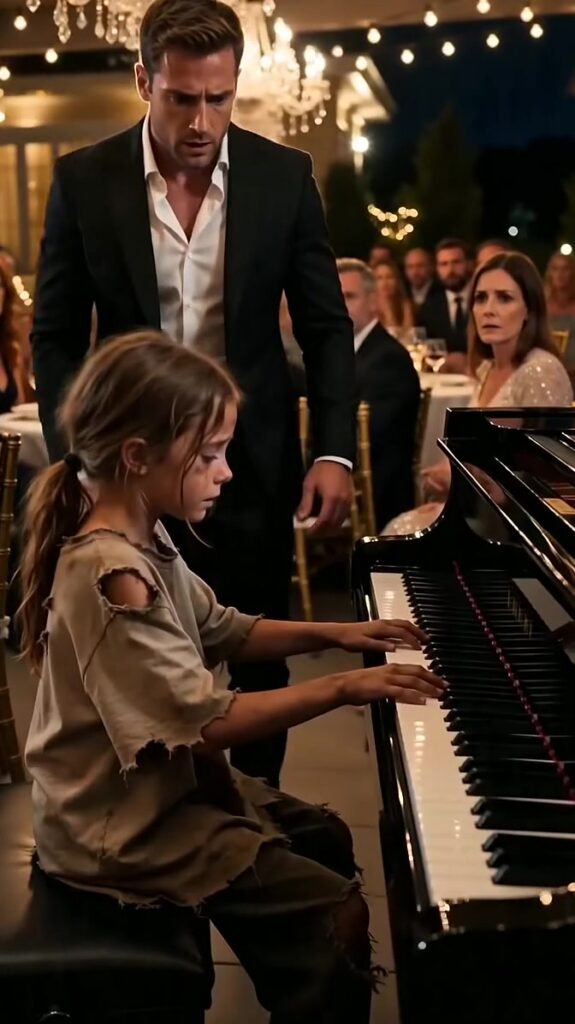
A child was there—no more than ten, maybe less—curled against the balustrade as if she could be folded small enough to vanish. Her clothes were layers of wrong sizes, sleeves swallowing her wrists, a shirt stretched long past her hips. Dirt made a map of her knees. When the bread stopped near her, she didn’t reach for it. She flinched as if it had been thrown.
“Go on,” said a man in a blue suit, his voice bright with the kind of ease only the full stomach understands. He was round-faced, pink-cheeked, and comfortably cruel. He nudged the bread closer with his toe. “Earn it.”
His friends made that soft sound people call laughter when they don’t want to be seen doing it. A woman hid her mouth behind a napkin. Someone leaned in as if this were entertainment.
The girl’s eyes stayed on the bread as though it might bite. Her hands remained tucked tight against her ribs, guarding heat. It wasn’t fear of hunger. It was fear of the price hunger made you pay.
“Play something for it,” the man in blue added, glancing toward the piano like it was a trick he’d brought to the party. “That old thing’s not just for decoration, is it?”
Adrian felt the room tilt, as if the terrace had shifted on its foundations. He had spent years in boardrooms where people smiled while cutting others to pieces, but something about this—about a child used as a garnish for amusement—opened a seam inside him.
His voice did not rise. It didn’t need to.
“That’s enough.”
The words landed with weight. Conversations thinned. Forks paused above plates. Even the string lights seemed to sharpen.
Adrian stepped forward, not looking at the bread first. He looked at the girl. Really looked. Her face was smudged, yes, but beneath it was a narrow bone structure and a stubborn set to the jaw that reminded him of someone he had not allowed himself to picture clearly in years. The child’s hair was a dark snarl held back by a cheap elastic. Her eyes were wide, watchful, and wet with anger she couldn’t afford to waste.
He crouched at a careful distance, keeping his hands where she could see them. “What’s your name?”
She didn’t answer. Her gaze flicked to the diners, to the man in blue, to the bread, and back to Adrian. Trust, he realized, was a currency she had never possessed.
Adrian nodded toward the piano. “Can you play?”
The girl’s throat worked. “A little.”
“Do you want to?” he asked, as if the choice mattered. As if she were not trapped in their world like a stray cat surrounded by children with rocks.
Her chin lifted a fraction. “I never forgot.”
That was the moment the air changed. Not because a child claimed she could play, but because of the way she said it—like a vow made in private and kept through ruin.
Adrian stood and offered his hand. He expected her to recoil. Instead she stared at his palm as if it were a door. She hesitated, then placed her small, grimy fingers in his. Her grip was light but determined, like she was holding on to the only stable thing in a shaking room.
Together they crossed the terrace. Silence gathered around them and thickened, a curtain of attention. Faces turned. Glasses lowered. The man in blue’s smile cracked at the edges and did not recover.
The piano bench was too high for her. Adrian pulled it back and, without touching her, guided it closer. She climbed up, knees knocking once against the wood. Her hands hovered above the keys, trembling. She drew a breath that looked like it hurt.
Then she began.
The first notes were soft, uncertain, as if she were coaxing sound out of a locked room. The melody was delicate but not pretty. It carried grit. It carried night. It was wrong for this terrace in the best possible way—too honest, too unpolished, too alive.
Adrian froze when the second phrase arrived. His throat tightened as if a hand had closed around it.
He knew that song.
Not as something heard on the radio or played at a concert. As something breathed into darkness by Lyra when storms made their old apartment tremble. As something she played when she thought he’d fallen asleep, her fingers moving like a prayer she didn’t dare speak aloud.
Adrian stepped closer, the world narrowing to the girl’s hands. Each note struck him with the force of a memory he’d kept buried under paperwork and public grief.
“Who taught you that?” he asked, and his voice sounded like it had been scraped raw.
The girl didn’t stop. Tears slid down her cheeks and dropped onto the keys, tiny dark marks vanishing as fast as they appeared. “My mom,” she said, the words threaded between notes like wire through cloth.
Adrian’s breath caught. He stared at her profile, at the curve of her cheek, at the stubborn tilt of her brow. His heart did something unfamiliar: it stumbled, as if it had been running on a lie.
“Your—” His mouth could barely form the sound. “How old are you?”
Her fingers kept moving, the melody now surer, angrier. “Nine,” she said. “Almost ten.”
Nine. Almost ten. Seven years ago Lyra had vanished. Adrian’s mind tried to reject the math the way the body rejects poison, but the numbers did not care about his denial.
The girl hit a chord that rang like a bell in a cathedral. She lifted her eyes to him, and in them he saw something he had only ever seen once before in the mirror on mornings Lyra was furious with him for working too late: a hurt that had sharpened itself into a weapon.
“Wait,” Adrian whispered. The terrace, the lights, the linen—everything blurred. “You’re…”
She played the final notes, each one placed as precisely as a stone on a grave. When the last sound faded, she let her hands fall into her lap. Her shoulders shook once. She swallowed, hard.
“You left us,” she said.
It wasn’t an accusation screamed for the room. It was worse: it was a verdict delivered quietly by someone who had survived long enough to stop hoping.
The terrace held its breath. Somewhere a glass clinked against a plate and the sound was obscene. The man in blue stared at his shoes, suddenly interested in anything but the child he’d tried to buy like a trick.
Adrian felt the floor steady under him only because his knees locked. “I didn’t,” he began, and heard how weak it sounded against seven years of absence. “I searched. I—”
The girl’s lips pressed together. “You searched for a story that made you look sad,” she said. “Not for us.”
Adrian opened his mouth and nothing came out that could stitch this back together. In the distance, a waiter stood frozen with a tray of champagne flutes, his face pale, as if he’d wandered into a courtroom by mistake.
Adrian lowered himself to the level of the bench, careful not to crowd her. “What’s your name?” he asked again, and this time he let the question break him.
She looked away toward the balustrade, toward the city that didn’t care. “Mara,” she said at last. “My mom called me Mara when she was happy.”
The name struck Adrian with the final, undeniable shape of truth. Lyra had once traced the letters on his palm, laughing softly, saying if they ever had a child, she wanted a name that sounded like the sea at night.
Adrian closed his eyes. When he opened them, the terrace’s golden world looked thin, like paper held up to flame. “Where is she?” he whispered.
Mara’s gaze returned to him, fierce and terrified. “I don’t know,” she said. “But I know why she taught me that song.”
Adrian’s chest tightened. “Why?”
She glanced at the crowd—at the money, the lights, the people who pretended not to tremble now that the evening had teeth. “She said if I ever found you,” Mara said, “I should play it. Because you’d have to listen. Even if you didn’t want to.”
Adrian’s hands shook as he reached into his suit jacket and pulled out his phone, then stopped. For once, the instinct to control the narrative—the press, the foundation, the optics—felt like another kind of cruelty.
He looked at Mara’s small hands, the dirt beneath her nails, the red marks on her wrists where sleeves had rubbed too long. He thought of the bread on the stone and the laughter that had followed it. He thought of Lyra’s music, her disappearance, the lullaby used as a key across years of locked doors.
He held out his hand again, not as a command, not as a display, but as an offer he knew she had every right to refuse. “Come with me,” he said. “Not to my table. Not to their world. Away from here. We’ll find the truth together.”
Mara stared at his palm for a long time. The terrace’s lights reflected in her tears like tiny flames. At last she slid her fingers into his, and this time her grip was iron.
Behind them, the piano sat silent, its glossy surface catching the gold glow of a world that suddenly seemed to Adrian like a stage built over a trapdoor. And as he led Mara through the stunned crowd, he understood that hunger was not only of the body. Some hungers were for answers. Some were for forgiveness. And some—sharp, relentless—were for the reckoning that had been delayed too long.