The fairground looked like a ribcage after the heart had quit—rides skeletal against the sky, stalls shuttered, puddles holding broken reflections of bulbs that hadn’t gotten the message to die. Wind dragged paper cups along the midway and made the prize plushies sway in their nets as if something invisible were still trying to win them. The asphalt was slick with spilled soda, rain, and the kind of sadness that didn’t wash away. Somewhere in the distance a generator coughed once and fell quiet again.
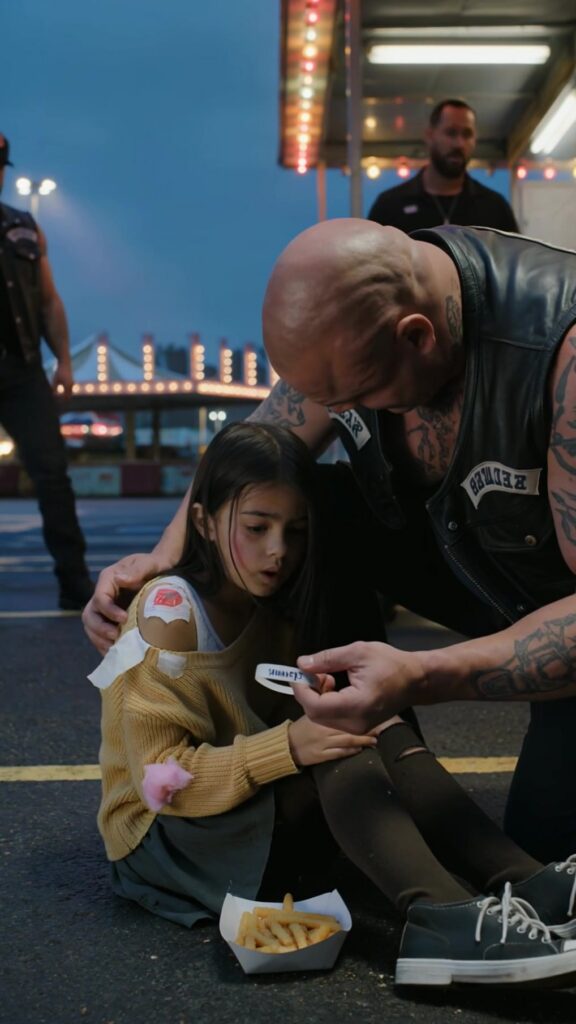
Behind the corn dog stand, a girl sat with her knees pulled tight to her chest. Her sweater was yellow, but it had been through too much to stay bright. Cotton candy stuck to her cuff like a last, stubborn attempt at joy. Her tights were laddered, her skirt stained, her shoes enormous—hand-me-downs from a different life. She watched the empty midway with the wide, stunned patience of someone who’d learned adults were unreliable. A paper tray of fries sat near her, cooling into pale curls.
Hawk lowered himself into a crouch in front of her, all leather and bulk, the kind of man who made people clutch purses in daylight. His head was shaved clean, and his forearms were a map of inked stories—serpents, dates, names crossed out and rewritten. Yet his hands moved like a nurse’s, gentle as he peeled medical tape from her shoulder. Under it, a raw scrape showed where she’d been dragged or had fallen hard. He didn’t ask how it happened. He watched her face instead, tracking every flinch like he could catch pain before it spread.
Two men from his crew stood under a buzzing bulb at the edge of the midway. Deke kept scanning the parking lot, thumb hooked near his belt where a tool could become a weapon if needed. Riddle leaned against a closed game booth, eyes moving as if counting exits. They were quiet, but it wasn’t a peaceful quiet. It was the quiet of people who knew the night could change its mind. Hawk glanced toward them, then back to the girl, and softened his voice.
“Who put you out here?” he asked. He didn’t say who hurt you, because he’d learned the wrong words could make a child shut like a fist. The girl swallowed, then lifted her wrist. A cheap plastic bracelet encircled it, the kind they sold at the ticket counter: flimsy, too bright, the clasp barely holding. Something had been written on it in smudged marker. She held it out like it weighed more than metal. “Mom,” she whispered. “Before… before the loud men.” Hawk took it between finger and thumb and turned it as if it were a clue he could read with his skin.
The outside held a name that had bled into itself. The inside held three words, cramped and uneven, written by someone who’d had to choose between speed and neatness. Hawk read them once, then again, because he couldn’t make his mind accept what his eyes already had. NOT HER DAUGHTER. The air seemed to tighten around his ribs. Something old and violent shifted behind his calm, like a door in his chest slamming open. His gaze snapped to the girl—not at her injuries, but at her features. The shape of her chin. The shadow of her eyes. She looked like no one and everyone at once.
Hawk moved fast. He hooked an arm around her and drew her down behind the corn dog stand, into the pocket of darkness where the smell of old grease could hide them from a passing glance. “Listen to me,” he said, mouth close to her ear. “No matter what you hear, you stay quiet. You breathe through your nose. You understand?” She nodded, small and trembling. He pressed the bracelet into his palm as if it could cut him and maybe that would make this real. In his other hand, he slid his phone out and tapped once—one code word to his crew: GHOST.
Engines answered before the men did. Not from the road outside, but from within the fair’s own parking lot, where the darkness was thick enough to conceal anything until it wanted to be seen. Headlights sprang on, harsh as interrogation lamps. Motorcycles surged through puddles and sent water fanning out like shattered glass. Hawk didn’t have to count them to know the sound. This wasn’t some weekend club ride. This was a pack moving with purpose. Deke’s silhouette stiffened under the flickering bulb. Riddle’s hand disappeared inside his jacket. The fair, dead a moment ago, suddenly had predators.
Hawk’s mind ran backward and forward at once. Two weeks earlier, he’d been asked to do a job he’d refused: escort a woman from county lines to the city, no questions. The man offering it had smiled too much and talked about “reunions” like he was selling greeting cards. Hawk had said no because he’d done enough damage in his life without adding human trafficking to the list. He’d thought walking away was the end of it. But the bracelet told a different story. Someone had brought a child to the fair, slapped a smile on her face with cotton candy, then marked her like cargo. NOT HER DAUGHTER wasn’t a warning to the girl—it was a note to the buyers. A label. A lie made portable.
The motorcycles slowed as they entered the midway, tires whispering over wet pavement. Their riders wore helmets with dark visors; even the bulbs couldn’t find their eyes. Hawk peeked through a gap in the stand’s warped boards. One bike stopped near the ticket booth. A rider dismounted and held up a phone, its screen throwing blue light on a glove. He turned in a slow circle, searching. Another rider moved toward the corn dog stand, boots splashing. Hawk’s heart beat low and hard, like a drum signaling war. He looked down at the girl. “What’s your name?” he asked, because names mattered, because they made people harder to sell. She hesitated, then whispered, “Lena.” Hawk swallowed. “Okay, Lena. I’m Hawk. And you’re not going anywhere with them.”
He slid the bracelet onto his own wrist, the plastic biting into skin thick with scars. It felt ridiculous and sacred at the same time. A promise made of cheap material, the kind the world loved to break. He nodded once toward Deke and Riddle without looking—an old signal from older nights. Deke moved like a shadow to the left, drawing attention. Riddle circled right, quiet as regret. Hawk stayed crouched over Lena, his body a wall. When the first rider came close enough for Hawk to hear the soft click of his helmet latch, Hawk rose in one smooth motion. “Looking for a kid?” he called into the dark, voice carrying across the empty midway. “You’re late.” The rider froze. Somewhere behind the visor, recognition flared—or confusion. Hawk lifted his wrist so the bracelet caught the light. “Tell your boss,” he said, every word sharpened by the message on the inside, “she wrote the truth where you wouldn’t think to look.”
The night held its breath. Then the midway erupted—boots pounding, engines revving, a shout cutting through the air like a thrown bottle. Hawk dropped back down, dragging Lena with him, and the corn dog stand shook as something slammed into it. Splinters rained. Lena squeaked, and Hawk pressed her face into his vest so she couldn’t see the worst. Over the chaos he heard Deke’s voice barking directions, Riddle’s grunt of effort, the crack of something breaking that wasn’t wood. Hawk tasted copper and rain. He had no idea if they’d survive the next minute. But he knew the meaning of the bracelet now: a mother had sent a message to the only person she hoped might read it, even by accident. A desperate truth wrapped in plastic. And Hawk, who’d spent years pretending he was only what he looked like, finally had something worth being careful for.