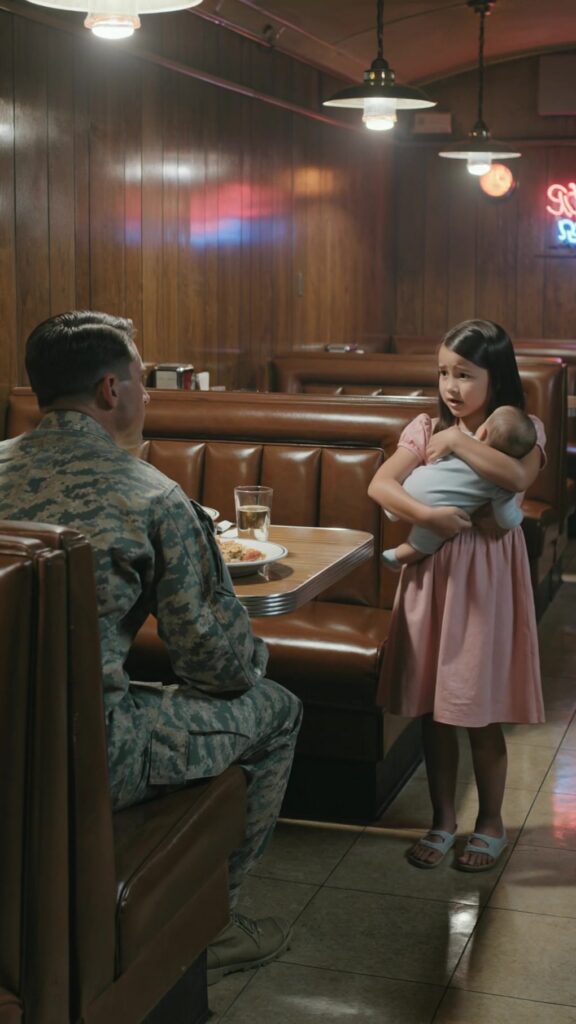
The bell above the diner door had a tired voice, the kind that rang like it had been woken too many times in the night. Staff Sergeant Eli Mercer sat in the last booth by the window, back to the wall, because old habits didn’t retire just because you signed papers. The jukebox was dead. The coffee was alive—burnt, bitter, stubborn. In front of him, a plate of eggs sweated in cooling silence, as if it, too, knew it wouldn’t be touched.
He had come off the highway because the rain had turned the world into a smear, and because the quiet in his own head had become loud. The waitress had asked, gentle as she could, if he wanted anything else. He’d said no. His hands were flat on the table, palms down, keeping himself anchored.
That was when he noticed the little girl.
She wasn’t running, wasn’t crying, wasn’t tugging at anyone’s sleeve. She moved like someone who’d learned to take up as little space as possible. A pink dress—too thin for this weather—hung from her shoulders. Her shoes were dark with damp. And in her arms she held a baby wrapped in a blanket that had seen too many washes and not enough rest.
The baby’s head fit in the curve of her elbow as if she’d practiced. The girl’s forearms trembled with the effort, but she did not ask anyone for a chair, or a napkin, or anything that would have marked her as a child.
Eli’s first thought was simple: lost. Hungry. A problem someone was ignoring. He half rose from the booth, scanning for a frantic parent, a harried adult. No one stood. No one called her name. The diners kept chewing, kept staring into phones, kept being safe in their own lives.
The girl stopped beside his booth and looked at him—not at his face first, but at the small insignia stitched on his jacket, the eagle and globe he still wore like a vow he didn’t know how to unmake.
Her voice was careful, as if each word had been rehearsed in a room where mistakes weren’t allowed. “Are you… my father’s brothers?”
For a moment, Eli couldn’t find the right kind of air. The question didn’t land like a plea. It landed like a key turning in a lock he hadn’t known existed. His vision tunneled to the child’s eyes: too old, too steady, as if sleep had been a luxury she’d traded away.
“Who’s your father?” Eli asked, and hated how rough his own voice sounded. Like gravel dragged over a bruise.
The girl swallowed. Her gaze didn’t wander. “My mom said if I ever saw the symbol on a uniform, I should ask that first. She said you’d understand.” She adjusted the baby higher, a practiced hitch, and the blanket shifted.
Something metal flashed at the infant’s throat.
Eli’s stomach tightened. A chain. A tag. Not costume jewelry, not a charm. A real, worn military dog tag—edges smoothed by time and touch, surface scratched by sand and fear.
He knew that tag the way you know the weight of a rifle you’ve carried through months of heat. It belonged to Sergeant Mateo Cruz.
Mateo had been the kind of Marine who smiled as if he’d made a deal with the darkness and won. He could coax laughter out of a miserable convoy, could find shade where there was none, could fix a radio with tape and stubbornness. He’d also been the one who’d walked into a mission that later got called “non-survivable” by men behind desks who didn’t have to look at the consequences.
Mateo hadn’t come back.
He hadn’t been found, either.
Eli’s chair scraped the floor as he stood too fast. The sound snapped the waitress’s head around. Somewhere a spoon clinked. The world kept pretending to be normal.
“Where did you get that?” Eli asked, and his hands were already reaching, careful, like he was approaching a live wire.
The girl didn’t flinch. “It was my dad’s,” she said. “My mom keeps it on the baby so we don’t lose it. She said it’s proof. She said it’s the only proof that doesn’t lie.”
Eli touched the tag between thumb and forefinger. It was warm from the baby’s skin, and the warmth made him feel sick. He turned it over. The serial numbers were nearly rubbed away, but the name—CRUZ, MATEO—still clung to the metal like a confession.
And beneath, carved by hand so shallow it could have been a mistake, were words Eli had never seen before.
If I fail, find Rosa.
His throat tightened. “Rosa,” he repeated under his breath, like the name could open a door or close one. He knew a Rosa. They all did. Mateo’s younger sister, the one who’d come to base that one time with a tray of homemade empanadas and nerves she tried to hide behind a bright smile. She’d hugged Mateo too hard, like she already knew hugs could be the last thing you get.
Rosa Cruz had died three years ago. Car accident. That’s what the message thread had said. A picture of a memorial with too many flowers.
Eli looked down at the little girl again. “What’s your name?”
“Lena,” she said. “This is Nico.” The baby blinked, unfocused, unaware of the storm around him.
“Where’s your mom, Lena?” Eli asked. “Is she here?”
Lena hesitated for the first time. Her eyes flicked toward the front window, toward the rain that veiled the parking lot in gray. “She’s outside,” she whispered. “She said she couldn’t come in. She said… if she came in, someone might take us. She told me to look for the uniform and ask the question. She said if you were real, you wouldn’t let us go back.”
Eli felt a cold line draw itself down his spine. “Back where?”
Lena tightened her grip on the baby. “The motel,” she said. “The one with the red sign. The man there said we have to pay or leave. Mom said she could make calls, but her phone doesn’t work. She said we’re out of time.”
That was the help Eli had expected—money, a ride, a call to social services, a sensible solution with paperwork and distance. But Lena hadn’t come for charity. She’d come for a claim.
Eli slid back into the booth and held his hands open, slow. “Sit,” he said. “Please. You can put Nico down.”
Lena sat on the edge of the bench as if she didn’t trust it to hold her. She didn’t set the baby down. It occurred to Eli that she might not have set him down in hours. Maybe days.
“Lena,” Eli said, keeping his voice low, “your dad—Mateo—how do you know he’s your dad?”
Her mouth tightened. “Mom showed me pictures,” she said. “She said he used to call. She said he promised he’d come back after the bad job. She said he didn’t come back because something happened, and then men came to tell her he was gone. But she said gone isn’t the same as dead. She said he left a message with the tag. She said it meant he had a plan.”
Eli stared at the metal, at the carved words. Mateo had never been the kind to leave a plan written on a tag. Unless he thought he wouldn’t have another chance. Unless someone else would be wearing his identity, or someone else would be telling the story.
“Your mom’s name?” Eli asked.
“Marisol,” Lena said. “She said you’d know.”
Eli didn’t. But his mind flickered through faces, through dusty briefings, through the handful of locals they’d trusted and the many they hadn’t. Marisol. A name like a match struck in a dark room—small light, big shadow.
He reached into his jacket and pulled out his phone. The battery was low. Service blinked weakly, like it was reluctant to get involved. Eli opened his contacts and scrolled to a number he hadn’t called in months: Gunnery Sergeant Hargrove, retired. Mateo’s best friend. The one who still answered even when his voice sounded like it had been sandblasted by memories.
Eli held the phone to his ear and watched Lena’s face, watched the way she held her breath like she’d been trained by fear to expect disappointment.
When the call connected, Eli didn’t bother with pleasantries. “Gunny,” he said, “I need you. Right now. There’s a kid here with Cruz’s dog tag. And there’s a name on it you need to hear.”
Silence on the line, sharp as a blade. Then Hargrove’s voice, suddenly awake. “Say it.”
Eli glanced at the tag again. The carved letters seemed darker now, as if they’d been waiting to be read aloud. “It says: If I fail, find Rosa.”
On the other end, something shifted—breath, a chair, maybe a life rearranging itself. “Where are you?” Hargrove asked, and his tone had changed. It wasn’t just concern. It was recognition. It was fear.
Eli gave the address, then looked at Lena. “We’re going to see your mom,” he promised, and he realized it wasn’t a promise he was making to a child. It was a promise he was making to a dead friend, to the version of himself that still believed brothers could keep each other safe.
Lena’s eyes filled, but no tears fell. She nodded once, solemn, as if accepting orders. “Okay,” she whispered. “But hurry. Mom said the people who know about the bad job don’t like loose ends.”
Eli stood, leaving money on the table he hadn’t eaten at. The diner felt smaller, the rain louder, the world less innocent. He shrugged off his jacket and draped it around Lena’s shoulders. The patch with the eagle and globe settled over her chest like a shield that didn’t fit but still mattered.
As they walked toward the door, Eli felt the old, familiar weight return—not his rifle, not his pack, but responsibility. The kind you can’t put down.
He had thought the little girl was asking for help.
He hadn’t imagined she was asking for family.
And somewhere out in the rain, a woman named Marisol was waiting beside a motel with a red sign, holding secrets that had survived missions, funerals, and time—secrets that might finally drag Mateo Cruz’s disappearance into the light, whether that light burned or saved.