The café sidewalk was loud with the kind of life that never stops for anyone. It was the kind of noise that didn’t belong to any single person—china tapping saucers, a bus exhaling at the curb, laughter on a phone call, heels cracking a rhythm against stone. Even the wind seemed busy, tugging at umbrellas and napkins as if it had errands.
At a small round table pressed close to the window sat a man whose stillness looked expensive. His wheelchair was black and brushed-steel, its arms polished, its spokes clean enough to reflect the pale morning. He wore a coat that fell like a curtain and gloves that never touched the pavement. He ate slowly, as if every bite had been approved in advance. If anyone glanced his way, their eyes slid off, redirected by the practiced manners of a city that learned early what to pretend not to see.
Across from him, the chair remained empty, untouched—no purse, no scarf, no lingering warmth. Only a second cup of coffee that had gone cold. The waiter had offered to remove it. The man, without looking up, had said, “Leave it.”
His name was Gideon Sable. People on this block knew it, though they rarely said it. His building was two streets over, a tower of glass with a lobby that smelled like citrus and money. He had once been photographed beside mayors and athletes, smiling with the certainty of legs that carried him anywhere he wanted. Then, years ago, something had broken—some abrupt calamity whose details were never told cleanly—and the smile had changed into something thinner. Now his wealth moved around him like armor, and the wheelchair was its most obvious plate.
Three children stepped out of the crowd as if they had been waiting for a gap in the city’s attention. They were small, with hair that had given up on order, with sleeves too long and shoes too cracked. Their clothes were not just dirty; they were tired. Their faces had the look of people who had learned to ration more than food.
Most pedestrians did what pedestrians always did: they navigated around hunger without letting it touch them. A woman with a clean coat adjusted her scarf and stared straight ahead. A man with earbuds increased his pace. A couple laughed louder, as though joy were a shield.
But the children did not drift past Gideon Sable’s table. They approached it like a doorway.
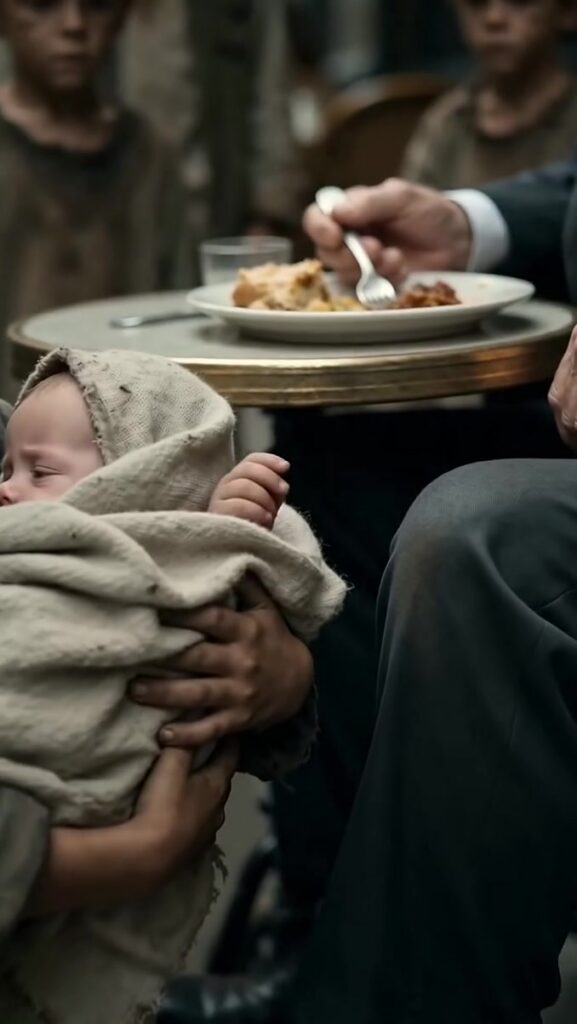
The oldest—a thin boy with wrists like knots, with dirt ground into the lines of his palms—held a bundled infant against his chest. He stopped at the edge of the table and, with an abrupt seriousness that did not fit his age, sank to his knees on the cold stone.
He lifted the baby up, not in offering, not in display, but with care, as if the air itself might bruise her.
Gideon’s fork paused halfway to his mouth. The stillness in his face tightened.
“This one can heal your legs,” the boy said.
The sentence hung there, bright and absurd, like a spark thrown at a river.
For a heartbeat, it was ridiculous enough to make Gideon almost grateful. He let out a laugh—sharp, unkind, too loud for the intimacy of the moment. Heads turned, then turned away. The city filed it under Not My Problem.
“You expect me to believe that?” Gideon said, his voice gravelly with the confidence of a man who’d paid his way out of believing.
The boy didn’t flinch. His eyes were wet, but his jaw held steady. “Just let her touch you.”
Gideon’s laugh stuttered and began to die. Not because he believed; because he recognized the particular weight in the boy’s tone. It wasn’t the frantic pitch of a scam. It was the desperate calm of someone holding a final match over a dark pit.
The infant shifted under the blanket. A tiny fist pressed outward, searching for the world. Gideon’s eyes dropped to it despite himself.
He had intended to order them away. To ring for security. To raise his voice until the sidewalk became a wall. Yet his hand stayed on the table, and his other hand tightened around the fork as if it were anchoring him to the present.
The boy rose just enough to bring the baby closer. The two other children—one with a torn knit cap, one with a bruise blooming along his cheekbone—stood behind him like witnesses. They did not plead. They simply watched, their hunger contained, their silence loud.
“Wait,” Gideon heard himself whisper.
The boy’s trembling hands steadied as if he’d been given permission to live. “She did it once before,” he said, softer now, like a confession.
Something in Gideon’s face shifted. A door creaked open somewhere deep behind his ribs.
Years ago—before the chair, before the papers, before the lawyers and the private doctors and the sterile therapies that promised progress and delivered polite failure—there had been another table. Not in a café. In a hospital. A plastic tray. A little girl with a fever-flushed face, too small for the bed. A daughter whose hair smelled like baby shampoo, whose laugh had made nurses pause in hallways.
He had lost her in a night of alarms and blinding fluorescent light. It had been sudden and unreal, the kind of tragedy that makes you question the stability of the entire world. Afterward he had bought stronger locks, higher floors, quieter cars, as if loss could be deterred by architecture.
The infant’s hand slipped free of the blanket. Her fingers unfurled, impossibly delicate—five pale threads reaching. Gideon felt his throat close. The shape of those fingers, the way they searched, did not match any memory he wanted to have. It matched the one he couldn’t stop carrying.
He should have moved back. Should have shoved the wheelchair away from the table. Instead he leaned forward, as though pulled by a rope tied around his sternum.
The baby’s fingertips touched his knee.
Under the table, his foot twitched.
The movement was small, almost nothing—an involuntary spasm that could be dismissed as coincidence. Except Gideon knew his body too well. He knew the deadness he lived with. He knew the clean silence below his waist, the absence that had become routine.
The fork slid from his hand and clattered against the plate. The sound was sharper than gunfire in the hush that seemed to bloom around them. Gideon sucked in a breath, eyes wide, mouth parted as if the air had changed density.
The children stared. The boy on his knees did not smile. He looked terrified, like someone standing at the edge of a bridge praying the rope doesn’t snap.
“Did you—” Gideon began, and his voice broke with the strain of wanting to believe and the horror of it.
The blanket shifted as the baby wiggled. A corner slid down far enough to expose her neck.
There, against her skin, hung a tiny silver charm on a thin chain: a half-moon, its curve worn smooth at the edges.
Gideon’s vision tunneled. The café noise continued—cups, engines, footsteps—but it arrived as though from underwater. His skin went cold.
He knew that charm.
He had bought it twelve years ago from a stall at a night market, when his daughter had pointed at it with both hands and demanded, with all the tyrannical joy of a toddler, that the moon belonged to her. He had laughed then, the kind of laugh that came easy, and fastened it around her neck like a promise.
They had buried her with it.
Gideon’s gloved hand hovered above the baby’s throat, not daring to touch, as though one wrong move would make the charm vanish. “Where did you get that?” he rasped.
The boy swallowed. “We didn’t steal it,” he said quickly, as if he had already lived in the accusation. “She came with it. We found her under the bridge two nights ago, wrapped up in a coat. The charm was there. And when we were cold… when we couldn’t wake up… she touched Mina’s chest and Mina started breathing again.”
Gideon stared at the infant. Her eyes were open now—dark, unfocused, newborn-wide. She looked like any baby. And then she blinked, and the motion struck him like a familiar gesture.
He remembered a nurse once saying, gently, “Some children come back in other ways.” At the time he’d nearly thrown the woman out of the room for daring to lace hope into grief.
The baby’s hand drifted again, and Gideon felt another tremor—higher this time, a faint awakening traveling up his calf like a whispered message. His chest tightened, not with joy, but with panic. Because if this was real, then the universe had rules he hadn’t accounted for. And if the universe had rules, then maybe his money had never mattered at all.
He looked at the three children—at the hollowed cheeks, the cracked lips, the way they stood ready to run. Not thieves. Not performers. Survivors.
Gideon’s cold coffee sat untouched, the second cup still waiting beside it like a ghost of hospitality. He had asked the waiter to leave it, thinking of someone absent. Now he understood he had been leaving space for an impossible arrival.
“Why bring her to me?” he asked, voice low, almost pleading.
The boy’s gaze did not waver. “Because you have walls,” he said. “And doctors. And food. And a place where she won’t freeze. We don’t want money.” His hands tightened on the baby as if he feared Gideon might try to buy her. “We just want her to live. And… if she can help you, then maybe you can help us.”
A car horn blared. Someone laughed too loudly at the next table. The waiter approached, noticed the children, hesitated—then stepped back, pretending to study the pastry case.
Gideon Sable sat very still, feeling the faint flutter in his leg like the first tremor before an earthquake.
He had built his life around control, around contracts, around the certainty that the world could be negotiated into obedience. Now three dirty children had knelt at his table and offered him something that did not fit into any ledger.
He reached out, slowly, and this time he let his gloved fingers touch the half-moon charm. It was warm from the baby’s skin. Real. Not a hallucination, not a cruel joke.
His eyes burned. He hated that. He hated vulnerability like a stranger in his home. Yet it came anyway, unstoppable.
“What’s your name?” he asked the boy.
“Eli,” the boy said.
Gideon nodded once, as if signing a document no one else could see. He lifted his gaze to the city that kept moving, the sidewalk that never paused for anyone’s sorrow or miracle. Then he looked back at the infant, at the children, at the cold second cup waiting like an unfinished story.
“Come inside,” he said. And in the way his voice softened, in the way his hand lingered near the baby’s fragile wrist, it was clear he was not only inviting them into the café. He was inviting them into the part of his life he had boarded up after the hospital, the part that still believed the dead might leave messages if you listened hard enough.
Behind them, the sidewalk remained loud with life that never stopped. But at Gideon Sable’s table, for the first time in years, something in him moved—quietly, dangerously—toward hope.