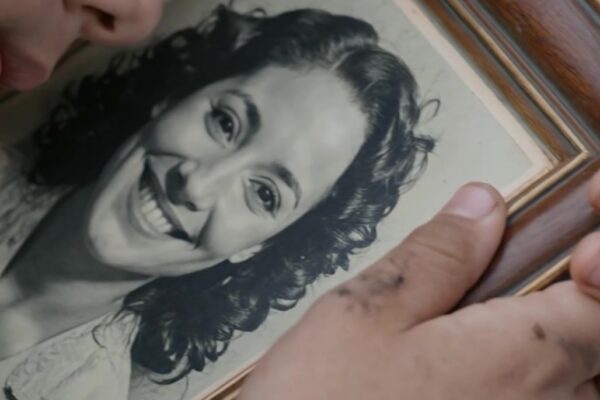
The funeral parlor had the kind of silence people trust too easily—thick, padded, expensive. It muffled sobs into something respectable. It turned footsteps into apologies. It made people believe that if they stood still enough, the day might pass over them without choosing a victim.
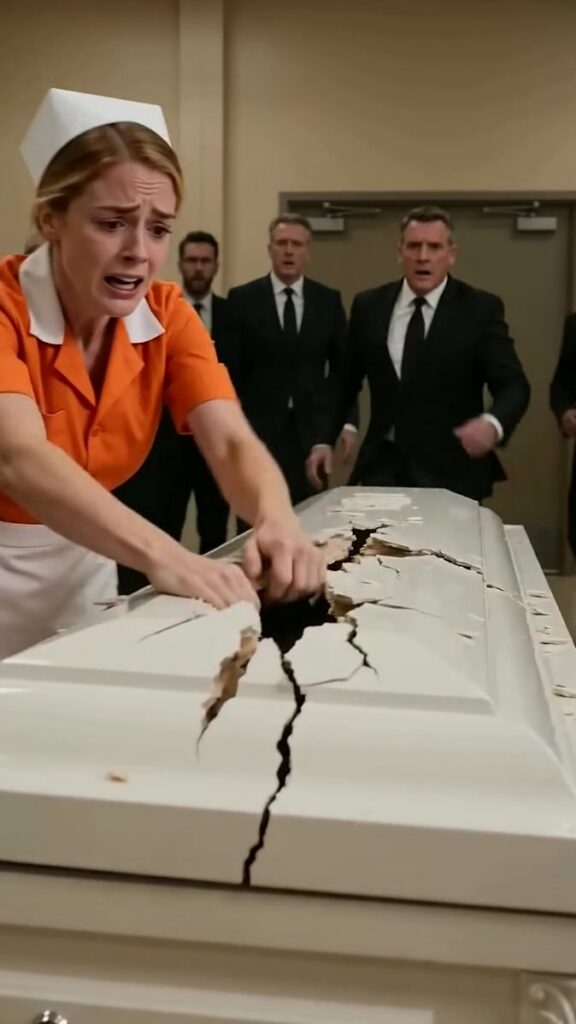
Lila moved through it in a uniform the color of dried orange peel, collecting empty water cups, straightening chairs no one had sat in, wiping a fingerprint from a brass handle that didn’t belong to anyone anymore. Beige walls boxed in the gathered mourners, their black clothing absorbing light and courage alike. At the front, a white coffin waited on a low platform above a floor polished to a mirror—a clean, final line drawn under a life.
They had said the woman inside was named Clara Halloway. They had said the illness was swift. They had said her husband had been devoted. They had said a lot of things in gentle voices, the way people do when they need a story to hold still.
Lila had worked in buildings where stories leaked under doors. She knew what sounded true and what sounded rehearsed. This whole day felt rehearsed—too smooth, too neat. Even the flowers were arranged as if someone had measured the grief.
She was supposed to keep her eyes down. She was supposed to be invisible. But as she passed the coffin a second time, carrying a tray of paper cups, she heard it again: a faint rasp, not a sob, not a cough—something smaller and meaner, like a breath forced through cloth. It didn’t belong in the room. It came from the white box.
Lila stopped so abruptly that a cup toppled and rolled under a chair. Nobody noticed. The minister at the lectern was saying a name as though it were a prayer. The lead mourner—Clara’s husband, Edwin—stood at the front with his hands folded and his jaw set. His suit was perfect. His expression was the kind that got praised for strength.
Lila’s pulse climbed into her throat. She told herself it was imagination, the way the mind invents sounds when silence is too complete. Then it came again, unmistakable: a scrape, soft but frantic, like fingernails catching on wood from the wrong side.
Her body moved before permission arrived. She turned toward the service corridor behind the fern arrangement and slipped through the door marked STAFF ONLY. In the dim utility room, the air smelled of bleach and wax. A fire axe hung in its cabinet, pristine behind glass. The building expected flames, not coffins, but the tools of emergency didn’t care what shape panic took.
She broke the glass with her elbow and didn’t feel the cut until later. The axe handle was heavy and absolute in her grip. When she returned, the mourners glanced at her only long enough to be offended that the help was carrying something sharp.
Edwin saw her first. His eyes narrowed, not in fear, but in irritation—as if she’d spilled something where it would stain the afternoon.
Lila didn’t ask. If she asked, someone would say no, and then the sound inside the coffin would become a secret shared only between her and the dead.
Her scream ripped through the room, raw and unshaped. Not a polite interruption. Not hysteria. The cry of someone who understands that waiting is a kind of murder.
She swung the axe down. The blade bit into the white lid with a crack that made every spine flinch. Splinters flew like pale shrapnel. Someone dropped a purse; it hit the glossy floor with a slap that sounded indecent in the hush that followed. A woman near the front made a thin sound and clapped both hands to her mouth. A man stumbled backward into another mourner, knocking them together like toppled dominoes.
The axe stayed lodged for a heartbeat. Lila’s chest rose and fell as if she’d been running for miles. Her uniform looked obscene against the sea of black, a bright wound among the mourners.
“Stop,” she said, hoarse. “She isn’t gone.”
They stared at her with faces arranged for grief, trying to fit shock over the top like a hat that didn’t sit right. Edwin stepped forward, his composure sharpening into anger.
“What are you doing?” he demanded. The words were meant to control the room, to put the silence back in its place.
Lila yanked the axe free. The lid splintered further, the coffin suddenly less like a holy object and more like carpentry. Her hands shook so violently the blade trembled in the air.
“I heard her,” Lila said. Tears made hot tracks down her cheeks. “I heard breathing.”
There was the smallest laugh from somewhere in the crowd—disbelief trying to turn into relief. Edwin reached for her arm, not to help, but to stop her. His fingers brushed her sleeve.
Lila swung again before he could close his grip. The second blow landed harder, driven by terror and certainty. The lid split wider, the fracture line yawning. A brittle sound echoed—wood giving up.
Then, from inside, a noise answered. Not loud. Not a dramatic gasp. Just a thin, trapped exhale and the scrape of something desperate against satin.
The room’s breath stopped as one. Even Edwin froze, his hand half-raised, the mask of strength slipping a fraction.
Lila dropped the axe and fell to her knees. She tore at the broken wood with her bare hands, ignoring the splinters that bit into her palms. “Help me!” she cried, not to any person in particular but to the idea of humanity itself.
At last, two men in black suits—strangers, not family—stepped forward, their faces pale with a fear that had nothing to do with mourning. They grabbed the lid and heaved. The coffin opened with a sound like a door pulled off its hinges.
A body lay inside, wrapped in lace and satin, a veil turned sideways across a face gone waxy with drugs. The woman’s eyes fluttered as if she were drowning in air. Her mouth opened and closed, pulling at oxygen like it was something she had to earn. She was alive in the worst possible way: awake enough to know she’d been sealed in.
“Clara,” someone whispered, and the word fell into the room like a stone.
Lila leaned closer, relief breaking her nearly in half—until her gaze snagged on the hand that twitched weakly against the lining. A gold ring caught the light, bright and wrong. Thick band, engraved crest. Not delicate, not sentimental. A man’s ring.
Lila knew that ring. She had polished it once, months ago, when Edwin Halloway left it on the edge of his sink in the private washroom and forgot to lock the door. It had a small chip on the underside where it had been struck against something hard, the kind of flaw you notice when you’re paid to notice.
Clara’s own wedding ring, Lila remembered, had been thin, set with a modest stone. It had never looked like that.
Lila lifted Clara’s shaking hand gently, as if it might crumble. The gold band sat too loosely, hurriedly forced on. There was a faint smear of wax beneath it, as though someone had pressed it into place in haste.
Across the coffin, Edwin’s left hand rose reflexively—an unconscious gesture to where his ring should have been. His fingers touched bare skin. His face drained so fast the beige walls seemed to take color from him.
A murmur surged through the mourners, confusion turning sharp. Eyes moved from the ring to Edwin’s empty hand. A woman’s sob became a strangled laugh, then a scream. The silence they had trusted shattered into something feral.
Edwin took one step back, then another, as if distance could undo the evidence. “That’s not—” he began, but his voice cracked on the second word.
Clara’s eyes, still heavy with whatever they had given her, managed to focus on him. Her lips moved. At first no sound came, only breath. Then, with a rasp that scraped straight through every stomach in the room, she forced out two words, each one a nail.
“He watched.”
Lila’s vision narrowed. She remembered the way Edwin had stood so perfectly still at the front, like a man performing grief to an audience. She remembered the too-neat flowers, the too-clean story. She remembered how the mortician had refused to meet anyone’s eyes when he spoke of “preparation,” how his hands had trembled when he closed the lid earlier.
Outside the parlor, a siren wailed in the distance—someone must have run for help when the axe came down. Edwin turned his head as if listening for rescue, then looked back at the coffin, at Clara dragging air into lungs that had almost been denied their job.
Lila stood slowly, her palms bleeding, her uniform streaked with white dust and red. She didn’t feel heroic. She felt late. She felt furious at how close the world had come to letting a woman disappear because the room was quiet and the story was convenient.
“You put your ring on her,” Lila said, voice low enough that it was somehow worse than shouting. “So you could say she was yours even when she couldn’t speak. So you could close the lid and call it love.”
Edwin’s eyes flicked toward the door. His shoulders tightened, preparing to run. The mourners—friends, associates, neighbors—shifted as one, not yet brave enough to grab him, but no longer willing to make room.
Clara’s hand found the edge of the coffin, fingers curling like a hook. Lila reached for her, steadying her as she fought her way toward sitting up. The veil slid aside, revealing a bruise on her throat the color of storm clouds.
“Not dead,” Clara whispered again, this time with something like iron behind it. Her gaze pinned Edwin in place. “Not yet.”
And in that moment, the funeral parlor lost its trusted silence forever. It became what it always had been beneath the beige walls and polished floors: a room built to hold endings, now forced to witness a beginning made of splinters, breath, and the ugly truth of who had tried to decide when a life was allowed to stop.