The morning had the kind of cold that didn’t just sting skin—it made breath feel borrowed. Frost clung to the curb like white ash, and the city moved around it with practiced indifference. Commuters hunched into their coats, noses tucked down, eyes forward. No one looked for miracles at eight-thirty on a Tuesday.
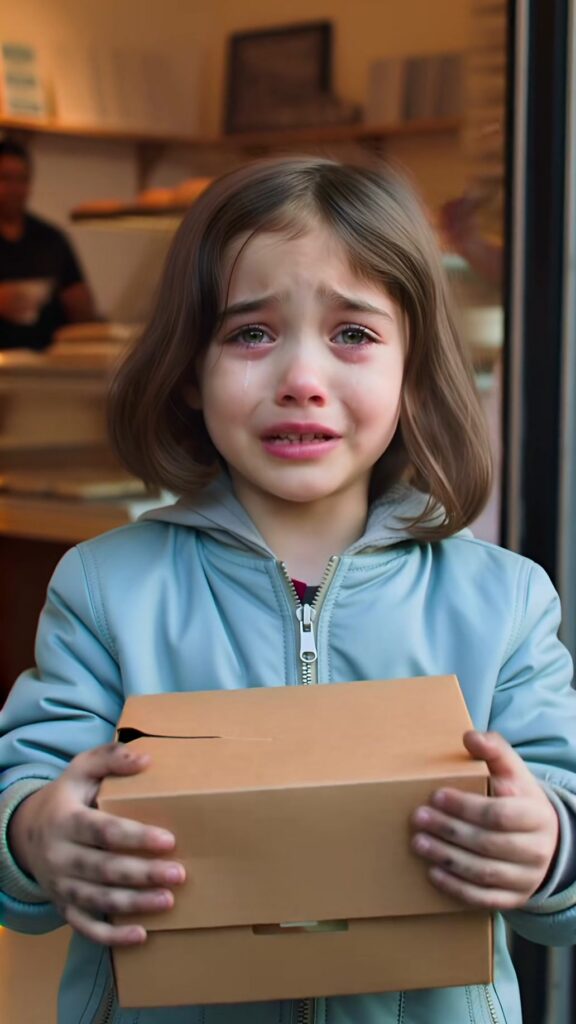
Outside Maribel’s Bakery, where the windows were always fogged with warmth and sugar, a little girl stood so still she looked like part of the display. She couldn’t have been more than eight. Her jacket was too thin, her mittens mismatched. Her fingers, bare at the tips, were smudged with flour and something darker. She clutched a cardboard cake box that had been squeezed at one corner as if she’d hugged it too hard.
People went by. A man with earbuds swerved around her as if she were a mailbox. A teenager glanced, then looked away. A woman in a blazer slowed for half a second, then accelerated, the click of her heels harsh on the pavement.
It might have continued like that if Lila Hart hadn’t turned back for her forgotten phone. Lila had been walking past the bakery without even tasting the air. She was a legal assistant, a creature of deadlines, caffeine, and unscanned documents. She turned, annoyed at herself, and her gaze snagged on the child’s face—those wet cheeks, those eyes fixed on the glass as if she were watching something inside that couldn’t touch her anymore.
Lila stopped. The child’s shoulders tightened, as if she’d been caught doing something wrong. The cake box shifted, and Lila saw the edge of a hand-drawn sticker: a heart colored in with red crayon that had bled outside the lines.
“Hey,” Lila said softly, hearing how wrong her voice sounded in the cold. “Are you… are you waiting for someone?”
The girl swallowed. Her lips were cracked, and there was a crescent of dried salt at the corner of her mouth. She lifted the box a little, not offering it like a gift, but like a confession. “Ma’am,” she murmured, the word careful. “Would you… buy this?”
“Buy it?” Lila repeated, baffled. “From you?”
The girl nodded once, sharp, as if the motion hurt. Then her small hands pried the lid open just enough to show what was inside. It wasn’t bakery-perfect. The cake was the size of a saucer, frosted unevenly in pale pink. Sprinkles sat in clumps where fingers had dropped them. A single candle lay crooked, wax smeared like it had been lit and put out too quickly. In the center, lopsided letters in icing tried to say something—MOM—though the O sagged into a teardrop.
Lila’s throat tightened. She knew every pastry in Maribel’s case and this wasn’t one of them. This cake had been made on a kitchen counter with a stool dragged to the stove, with a child’s determination and a child’s fear of messing up.
“It’s… it’s beautiful,” Lila said, and watched the girl’s chin wobble.
“It was for my mom,” the girl whispered. She stared at the cake like it might start speaking. “It was her birthday today.”
Lila crouched so their eyes were level. She caught the faint smell of vanilla trapped inside the box, and underneath it something metallic, like pennies. “Okay,” she said. “Where is your mom?”
The girl’s breath hitched. Her gaze slid past Lila to the street, to the ordinary morning, to the bakery window with its rows of croissants and glossy fruit tarts. “She didn’t wake up,” she said, so quietly Lila thought she’d imagined it. “I tried. I shook her. I said I made the cake and I didn’t burn it this time.”
Something in the world seemed to tilt. Behind the bakery glass, a worker paused mid-tongs. A customer stopped chewing. Even the espresso machine sounded too loud, too alive.
Lila’s hands hovered, uncertain whether to touch the girl’s shoulders. “Sweetheart—what’s your name?”
“Nina.” The girl blinked hard. A tear slid down her cheek and dropped onto the box, leaving a dark dot that spread in the cardboard. “She told me if it happened, I had to come here. To the lady in the bakery window.”
Lila’s stomach went cold in a new way. “The lady in the… window?”
Nina nodded and reached into her pocket, fingers fumbling like she might lose the courage if she moved too slowly. She pulled out a folded note, creased many times, edges softened by handling. She held it out with both hands, as if offering a sacred thing she didn’t understand.
Lila took it. The paper was warm from Nina’s skin. Her eyes tracked the first line, and the breath left her chest as if someone had pressed on her ribs.
Lila—if you’re reading this, I didn’t make it. Don’t look for miracles. Look for my daughter.
Lila stared at the words until they blurred. She read the signature and felt her knees threaten to buckle.
—Elena
Elena. A name Lila had tried to pack away like old winter clothes, sealed and heavy with mothballs of guilt. Elena Reyes: her best friend from foster care, the girl who taught Lila how to steal extra peanut butter packets without getting caught, how to braid hair, how to laugh without permission. The girl Lila promised she’d never abandon again. The girl Lila hadn’t spoken to in ten years.
On the paper, Elena’s handwriting was the same as it had been on the back of contraband library books—slanted, impatient, brave.
I’m sorry I didn’t find you sooner. I got sick and I got scared and I told myself you were better off without my mess. But Nina isn’t. She’s mine, and she’s the only clean thing I ever made. I can’t leave her to the system. Not again. Please. Take her. I’m begging you the way I never begged anyone before.
Lila pressed the note to her chest as if it might steady her heartbeat. Her mind filled with images: Elena at sixteen, making birthday pancakes with stolen syrup. Elena at eighteen, disappearing after an argument, leaving Lila staring at an empty bed and promising she wouldn’t cry because no one came back for criers.
“Nina,” Lila managed, voice breaking on the child’s name. “Your mom… Elena… she wrote me.”
Nina’s eyes searched Lila’s face with a ferocity too old for her age. “Do you know her?” she asked. “She said you would. She said you’d know what to do when people didn’t.”
Lila opened her mouth and nothing came out. In the bakery window, her own reflection hovered over Nina’s small frame—tall, tidy, capable on paper. Not capable enough to have kept a promise a decade ago. Not capable enough to have found Elena before the end.
Outside, the cold kept pressing in, but Lila felt heat prick behind her eyes. She looked at the cake again, that uneven frosting, that sagging O, that candle bent like it had tried to stand and failed.
“You shouldn’t be selling this,” Lila said, swallowing. “This isn’t something you sell.”
Nina’s grip tightened. “I need money,” she whispered, shame and terror tangling. “For… for the ambulance. For the landlord. For something. They said grown-up things and I don’t know the right ones.”
Lila reached into her purse and pulled out her wallet, but her hand stopped. She could hand Nina bills—she could do the easy part and pretend it was help. Or she could do the part Elena had asked for, the part that terrified Lila because it would change everything and because it would prove, finally, whether Lila was the kind of person who kept promises.
She stood, shrugging off her scarf. She wrapped it around Nina’s neck, tucking the ends in the way Elena used to do for her. Then she lifted the cake box from Nina’s hands carefully, reverently, as if it were fragile in a way that wasn’t cardboard.
“Listen to me,” Lila said, steadying her voice like she steadied files before court. “We’re going to your mom. We’re going to call the right people, and we’re going to make sure you’re safe. You’re not alone, Nina. Not today. Not anymore.”
Nina stared at her, a child balanced on the edge of belief. “You’ll… you’ll come?”
Lila nodded once, feeling the weight of Elena’s note like a hand on her shoulder. “I’m here,” she said. “And I’m not leaving.”
Nina’s eyes flicked to the cake box in Lila’s arms. “Can we still light it?” she asked, voice small. “Just once. For her.”
Lila looked toward the bakery, toward warmth and flame and the ordinary way people celebrated. She imagined Elena’s face, imagined her laughter, imagined how hard she must have worked to write that note while her body was failing, how she must have repeated the bakery window like a prayer because it was the only landmark she could trust.
“Yes,” Lila said, and felt the word anchor itself inside her. “We’ll light it. And we’ll say happy birthday. And then we’ll do what she asked.”
She held Nina’s hand as they stepped away from the window, the cake cradled between them like a promise that had arrived late, but had arrived. The city continued rushing around their small island of grief, but Lila kept walking, kept holding on, as if the future depended on the grip of her fingers. In a way, it did.