The woman had almost nothing, and the street she lived on seemed determined to keep it that way. It was a narrow ribbon of cracked earth between sun-bleached buildings, where wind shoved dust into doorways and the afternoon heat made the air shimmer like a warning. People passed through without looking up, saving their eyes for brighter streets where shop windows still had glass and hope still had a price tag.
Her name was Laleh, though most of the neighborhood had shortened her to “Auntie,” as if affection could replace respect. She wore the same faded dress through three seasons, and the apron tied over it carried the history of every meal she ever fought to make. If you asked her what she did for work, she’d say, “I mend, I scrub, I cook,” and if you asked what she earned, she’d shrug as if money were an unreliable rumor.
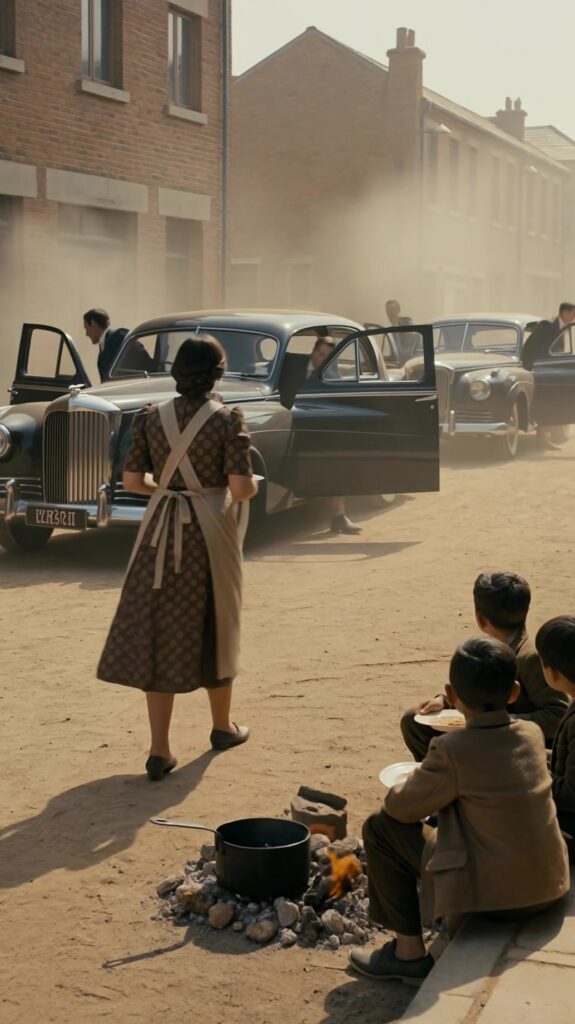
Every morning she swept her stoop with a broom whose bristles had thinned to a whisk. Then she filled a pot with water, lentils, whatever bruised vegetables she’d coaxed from the market’s discard crate, and a pinch of spice she guarded like a family heirloom. The neighbors called it stubbornness; Laleh called it practice. Hunger, she believed, learned your schedule. If you fed it once, it returned. If you ignored it, it multiplied.
The boys arrived one by one, like stray notes finding the same melody. Three of them: a tall one with a guarded face, a middle one who tried too hard to grin, and a smallest who watched every adult hand as if expecting it to strike. They never said where they slept. They never asked for seconds unless Laleh offered. They sat on the curb, knees up, elbows sharp under their shirts, holding their bowls as if warmth might leak out if they gripped too loosely.
Laleh did not question them, because questions could be weapons disguised as concern. She simply handed over the food and repeated the rule she’d made the first day to keep herself from asking the wrong thing: “Eat first. Speak later.” The boys obeyed like it was sacred. She noticed everything anyway—the oldest waiting until the other two swallowed their last mouthful, the middle boy coughing into his sleeve with a kind of embarrassed defiance, the smallest hiding his hunger behind a quick shake of the head so his brothers could have more. Laleh watched, and her chest tightened the way it did when she stitched cloth that was already tearing.
Months passed, and the street began to expect the ritual. A few shopkeepers rolled their eyes. Some muttered that she was inviting trouble. But when the pot simmered, the scent threaded down the lane and softened even the hardest faces. The boys started to talk after they ate—small things, careful things. They said their names were Amir, Kian, and little Reza. They talked about a river they remembered, about a dog that had followed them once until a man threw stones. They never spoke of parents. When Laleh’s voice grew rough from age and dust, Reza, without being told, started bringing her a cup of water as if he’d been raised in a gentler house.
Then one morning, Laleh carried out three bowls and found the curb empty. No footprints fresh in the dust. No scraps of cloth. The silence sat heavily, like a lid clamped on the street. She waited, bowls cooling in her hands. She walked to the corner, peered down both directions. Nothing. For the first time in months, she ate alone, and the food tasted like she’d forgotten an ingredient she couldn’t name.
Days became weeks. The pot still simmered, because she couldn’t bear to let the habit die. The neighbors told her to stop. “Children disappear,” they said with the shrug of people who make room in their hearts by throwing others out. Laleh kept cooking anyway, because love didn’t have a switch. It had only a stubborn, aching endurance.
Years wore grooves into her hands. Her hair thinned, silver strands catching sunlight like spiderweb. The street grew drier, the buildings more tired. And still, sometimes, she would set aside three extra bowls before she remembered and felt the old sting. She began to imagine what hunger had done to the boys—whether it had swallowed them whole or whether, somehow, they had escaped it.
On a blistering afternoon when the sun pressed down like a palm, a sound tore through the lane—engines, low and expensive, the kind the neighborhood only heard in movies. Two black vintage cars surged into view and stopped hard behind her, sending a storm of dust curling around their tires. Doors opened in unison. The street held its breath. Curtains shifted in windows. Even the stray cats froze mid-step.
Laleh turned, still holding a plate as if the day had not changed. Three men stepped out and walked toward her with a strange symmetry—shoulder to shoulder, not speaking, their shoes too polished for the ground beneath them. They wore dark suits cut with precision, but it wasn’t their clothing that unsettled her. It was the way they moved together, like a single decision split into three bodies.
“Can I help you?” Laleh asked, and heard how small her voice sounded against their presence.
The man in the center stopped close enough that she could see his eyes clearly. They were older, heavier, but the shape of them was familiar as a childhood dream. His throat worked. “You already did,” he said. “A long time ago. You fed us when we were nothing but bones and fear.”
The plate tipped in her hands; she steadied it with trembling fingers. Her gaze flicked from face to face, and recognition rose slowly, like dawn, painful in its brightness. Amir’s cautious intensity. Kian’s too-bright smile now restrained by a man’s discipline. Reza’s watchful gaze softened by something that looked like gratitude and grief at once.
“No,” she whispered, because the heart refuses miracles before the mind can catch up. “It can’t be—”
“It is,” Reza said, voice breaking in a way that made her knees weaken. “We never forgot you. Not the food. Not the way you talked to us like we were human beings.”
Amir reached into his coat and withdrew a thick envelope. He didn’t wave it like a prize. He held it as if it were heavy with consequence. He placed it in her hands gently, like he was returning something he’d borrowed. Laleh stared at it as though it might burn her. The seal was unbroken. Her name was written across it in careful letters.
Before she could open it, Kian lifted a hand, palm out, as if to stop a flood. “Please,” he said quietly. “Before you read that, you need to know what happened the night we vanished.”
The street seemed to narrow, the air turning thin. Laleh felt the old fear stir—the fear that she had fed them into danger, that her kindness had been bait for some unseen trap. Amir swallowed and forced the words out. “We didn’t leave because we wanted to. Men came for us. Not thieves. Not the police. Men with clean shirts and hard eyes. They knew our names.”
Reza’s fingers curled into a fist at his side. “We heard them before you did,” he said. “That night we slept behind the bakery. Amir saw their flashlights. He made us run.”
“They were looking for our father,” Kian added, and the word sounded unfamiliar in his mouth. “He was a driver for people who didn’t forgive mistakes. He hid us when he realized he’d made one. Then he disappeared. The men decided to collect the debt from us.”
Laleh pressed a hand to her chest, as if to hold her ribs together. “Why didn’t you tell me?” she asked, and it came out as a plea, not an accusation.
Amir’s eyes glistened. “Because we had finally found a place where danger didn’t live in the bowl. We were afraid if we said it aloud, it would reach you. We ran so they wouldn’t use you to get to us.” His voice dropped. “We watched from the alley when you put out the bowls the next morning. We saw you wait. We wanted to come back. We couldn’t.”
Laleh looked down at the envelope as if it had suddenly become a living thing. “And then?” she managed.
Reza exhaled shakily. “A man found us before they did. A woman, too. They ran a shelter outside the city. They took us in. It wasn’t easy. We fought. We stole. We tried to disappear before anyone could throw us away again. But they stayed.” He glanced at Amir. “And we kept hearing your voice in our heads. Eat first. Speak later. It taught us something—survival, yes. But also dignity.”
Kian nodded toward the envelope. “That’s not just money,” he said. “It’s paperwork. A house deed. Your name. Your rights. You’ve lived your whole life one bad day away from losing even this doorway. We came to change that.”
Laleh’s hands shook so hard the envelope rustled like dry leaves. “Why?” she whispered, though she knew. She knew the arithmetic of hunger and the strange, unmeasured interest kindness earned over time.
Amir stepped closer and lowered his head, a gesture of respect so deep the watching neighbors fell silent. “Because you fed three boys before you fed yourself,” he said. “And because we are men now, and we cannot carry the weight of that debt without returning it.”
Laleh’s eyes blurred. The street, the cars, the cracked earth—all of it swam behind the sudden flood. She clutched the envelope to her chest and let out a sound that was half sob, half laugh, the noise of a heart finally finding what it had been reaching for in the dark. “Eat first,” she whispered, and then, with a tremor of fierce tenderness, she added, “Speak later.”
This time, they all understood what it meant. This time, they stayed.