The ribbon should have been ruined a dozen times over. It was the color of old milk, thinned by rain and city grime, and yet the fabric still held a stubborn softness where a thumb had worried it into comfort. Mara kept it knotted around her wrist, not like a decoration, but like a tourniquet—tight enough to remind her she was still attached to something that mattered.
Her mother had pressed it into her palm on the last night, when the apartment windows shook with distant sirens and the air smelled of boiled water and sickness. “Listen to me,” her mother had said, voice thin as thread. “You don’t keep this because it’s lovely. You keep it because it knows when to open.” Then, after a ragged breath that sounded like a door catching on its hinge: “If you ever see the woman with the ring, open it. Don’t argue. Don’t wait. Open it.”
Three days later, Mara sat on the stone steps of Saint Brigid’s, the old church that perched above the city like a watchman who had fallen asleep. Her dress had torn at the hem and her shoes had given up somewhere between the shelter line and the market. Wind needled through the arches and found every bruise on her skin. She pressed the ribbon to her mouth to stop the sound that kept escaping her—half sob, half prayer—while below, people hurried through their errands as if grief were a private weather that didn’t touch them.
The church doors remained closed, heavy and indifferent. A caretaker moved through the yard with a bucket and broom, head down, as though sweeping could erase the way the world had cracked. He glanced at Mara now and then—an anxious, practiced glance—like someone counting problems he could not afford to take on.
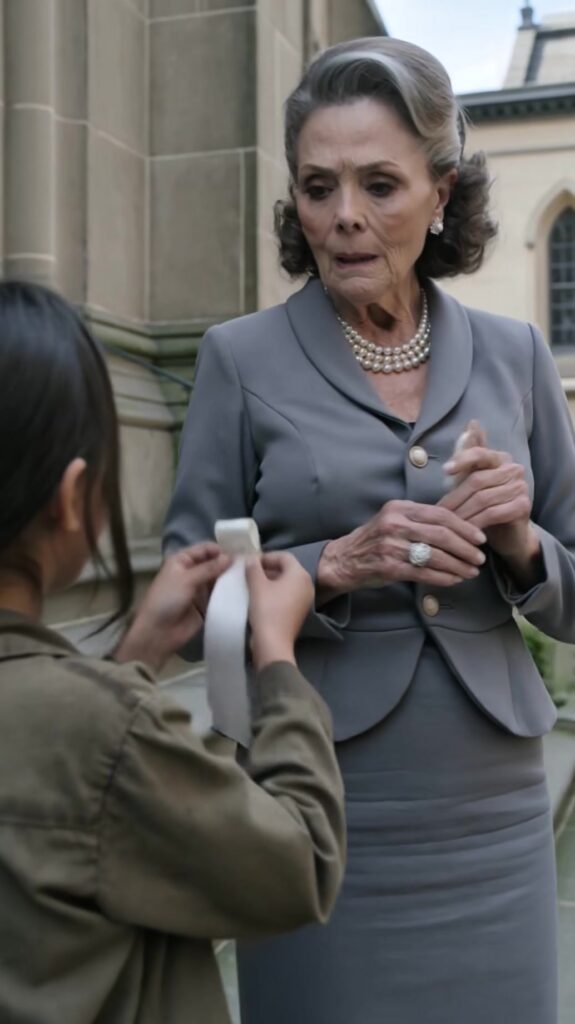
Footsteps clicked on stone behind her: measured, confident, out of place amid the grit. An older woman descended the steps, not carefully but as if the stairs belonged to her. Her shoes were polished, her coat dark and impeccable, her gloved hands held a small leather book. When she lifted one hand to adjust a strand of silver hair, a ring flashed—a gemstone bright enough to catch the pale daylight and throw it back like an accusation.
Mara’s breath stopped. The ring was not merely pretty. It was impossible, a shard of a life with clean sheets and hot tea, a life that did not end in hospital corridors. The memory of her mother’s eyes—wide, urgent—pinned Mara in place. Then Mara stood so quickly she swayed.
“My mom—” The words came out as a scrape. The woman turned, annoyance already forming in her mouth, the expression of someone who had been interrupted by a creature she did not expect to speak. Mara held up her wrist, and for the first time that day, her hands did not shake from cold alone. The ring caught the light again. Mara’s fingers went to the knot.
The woman’s face changed in a way Mara would remember for the rest of her life: not fear at first, but recognition, the sudden emptying of a mask. She went still, like a portrait painted over a living person. Behind them, the caretaker paused mid-sweep. Silence gathered, thick as incense. Mara’s fingers worked the ribbon’s seam, picking at the tiny stitches her mother had once made by lamplight. The fabric unfolded into a narrow strip, and on the inside—hidden until the ribbon was laid flat—fine thread formed small, deliberate marks.
Not a name. Not a prayer. A lily, its petals stitched with the precision of someone who had been taught to make symbols. A cross, plain and stern. And beneath them, three numbers, so small they might have been mistaken for decoration unless you knew to look.
The caretaker stepped closer, the broom forgotten. His eyes narrowed, then widened. Color drained from his face as if he’d been struck. “That—” he began, then swallowed. He looked from the numbers to the ring, then to the woman’s gloves. “That isn’t… that’s not a child’s stitching.” His voice lowered, rough with something like dread. “Those numbers. They’re not a pattern.” He stared as if the fabric were a wound that had reopened. “It’s an archive mark. A baptism registry code.”
The old woman’s lips parted, but nothing came out. For a moment, she seemed to age ten years in the space between one heartbeat and the next. Her gloved hand rose toward the ribbon and stopped, hovering, as though touching it would burn. “Where did you get that?” she asked, and the question was wrong in the way a thief’s question is wrong—too much ownership hidden inside it.
“She gave it to me,” Mara said, and surprised herself with how steady her voice sounded. “She said it would tell me when to open it. She said if I saw you, I had to.” The wind tugged at the ribbon’s ends, making them flutter like a white flag that refused surrender.
The caretaker took the ribbon carefully, as if it might crumble. “Lily and cross,” he murmured, eyes darting. “That’s Saint Brigid’s orphan annex, back when it was… when it was something else.” His hands trembled now. “These numbers—these would have been assigned to infants brought without names. Placed under guardianship. I’ve seen them in old ledgers. We were told the annex closed decades ago.” He looked at the woman, and the look was not merely accusation; it was the realization of a story he had been made to forget.
The woman’s ring glinted again, and Mara noticed for the first time that the gemstone was set in a band engraved with the same lily, the same cross. A matching mark, worn openly.
“You’re from the annex,” the caretaker said. “Or you worked with them.” His voice rose, unable to stay quiet anymore. “What is this? Why would an adult carry—”
The woman snapped her book open with a sharp motion, the pages whispering like wings. “This is none of your concern,” she said, and in her tone the city’s indifference hardened into command. “The child is mistaken.” She reached for Mara’s wrist with the certainty of someone accustomed to taking what she wanted.
Mara flinched back. The caretaker moved between them, broom lifted like a poor man’s spear. “Don’t,” he said, and his fear turned into a kind of courage that made his posture taller. “If that code exists, there’s a corresponding ledger. If there’s a ledger, there are names—real ones. You don’t get to erase them again.”
Mara didn’t understand all of it, not yet. But she understood the ring. She understood the way the woman watched the ribbon as though it were a key that could unlock a door she’d sealed. She understood the warning sewn into her memory: open it, and the world changes.
“My mom said you would come,” Mara whispered, staring at the gemstone until it stopped dazzling and started looking like an eye. “She said you’d try to take it back.”
The woman’s composure fractured. “Your mother,” she said, and the words came out bitter, almost furious. “Your mother was… ungrateful. We gave her a life. We gave her a name.”
“You gave her a number,” the caretaker said, voice shaking now with rage. He backed toward the church doors, as if the building could suddenly decide to help after all. “And if you think those records are gone, you’re wrong. Saint Brigid’s keeps copies. I have keys. I can call the diocese. I can call the papers.” He looked down at Mara, and the gentleness in his eyes made her throat ache. “Child, what was your mother’s name?”
Mara swallowed. Her mother had told her once, in a moment of softness, then had never repeated it. “Elena,” she said. “Elena Hart.”
The woman’s face tightened, as if the name were a pin driven under a nail. “That wasn’t hers,” she hissed.
The caretaker’s jaw clenched. “Then let the ledger speak,” he said. He held out his free hand to Mara. “Come inside. Out of the wind.”
Mara hesitated only long enough to feel the ribbon’s fabric against her skin, to remember her mother’s fevered hand closing over hers. Then she took the caretaker’s hand and stepped toward the doors. Behind them, the woman with the ring stood rigid on the stone, watching as if she had just seen a locked room open without permission.
And as the church door groaned inward—reluctant, old, but finally yielding—Mara realized what the ribbon had been all along: not a keepsake, not a charm, but a summons. A strip of cloth that could drag the past into daylight, where even a jeweled hand could not hide what it had done.