By the time the officiant asked for the rings, the ballroom had settled into that rehearsed hush people buy with money: the kind where every cough feels like a mistake. The chandeliers threw warm light onto the white runner, onto the polished shoes of men who smiled with their teeth, onto the bride’s veil stitched with tiny crystals like trapped starlight. A quartet on a small stage coaxed a melody so delicate it seemed to float rather than travel.
Then a small sound cut through it—soft, uneven footsteps on fabric.
At first the guests turned with the mild irritation reserved for latecomers. Someone whispered that a child must have wandered in from another event. A waiter took a half-step toward the aisle and stopped, as if a rule in his training had never covered this.
The little girl was no more than six. Her dress, the color of oatmeal, was wrinkled like it had been slept in. Her hair was pulled back with an elastic that didn’t quite hold, and her cheeks were slick with tears that had dried and returned and dried again. She carried a photograph with both hands, gripping its edges so hard the paper bowed. She did not glance at the flowers or the glittering table settings. She did not stare at the bride in her tower of satin. She walked as though the only thing in the world that mattered waited at the end of the aisle.
The violinist’s bow skidded, a single sour note raising gooseflesh. Conversations died. Even the bride lowered the glass she had been given as a prop for the reception to come.
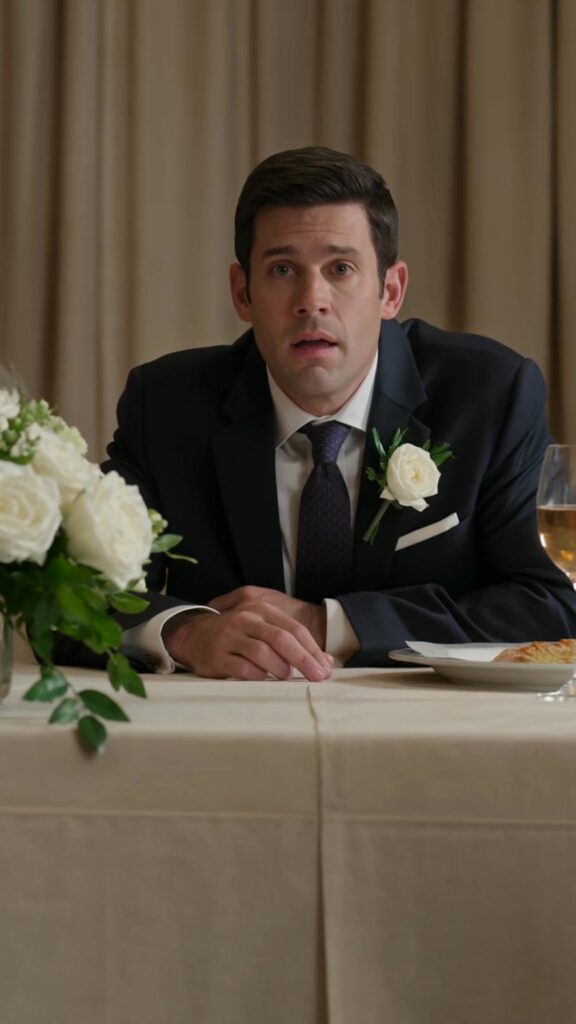
The groom, Esteban Marín, stood at the front with the ease of a man who had practiced being watched. He had been the headline in society pages for months: heir, investor, a new face in politics. He smiled at the officiant, at the crowd, at the future he had been carefully fitted into. When he noticed the girl, the smile didn’t fall at once—it stiffened first, as if trying to remain loyal to the script.
The girl stopped a few feet from him. She lifted the photograph as if it were an offering.
Her voice was small, but it had the raw clarity of a bell struck in an empty church. “I’m not here for gifts,” she said. “I’m here because I don’t want my mama to die.”
The room tightened. Someone near the back sucked in breath too sharply. The bride—Isabella Soria, daughter of a senator—turned her head toward Esteban, confusion threading into her expression like a crack in porcelain. “Esteban,” she murmured, careful not to sound afraid, “who is she?”
Esteban did not answer. His eyes were fixed on the photograph, on the woman smiling in it beside a roadside stand, wind tugging her dark hair, one hand curved over a pregnant belly. The picture looked sun-worn, as if it had traveled in pockets and purses, as if it had been taken out and put away until the edges softened.
Esteban’s posture changed, the way a man changes when he recognizes a threat he can’t buy off. He stepped down from the platform. The microphone picked up the scrape of his shoes and made it enormous.
He crouched in front of the child, close enough to see how her lashes clumped from crying. His voice dropped to a whisper that still traveled, because everyone had leaned forward without realizing it. “What is your mother’s name?”
The girl swallowed, and for a second she looked terrified—not of him, but of the truth itself. “Yohandra,” she said.
The name moved through the ballroom like a draft. A few older guests shifted, as if they had heard it before, in other contexts, in whispers that had never made it into newspapers.
Esteban’s face emptied of color. For a heartbeat, the groom looked younger than his tailored suit, as though the polished man had stepped aside and left a frightened boy in his place. “Where is she?” he asked.
The girl’s chin trembled. “In a hospital,” she said. “They told me she might not make it to tomorrow. The nurse said I shouldn’t come here, but… I had to.”
Only then did Esteban look beyond the child. Near the doors stood a woman in scrubs, breathless, her hands half-raised as if she could still catch the moment and rewind it. She met Esteban’s stare with a hard, apologetic resolve.
Isabella reached for Esteban’s sleeve. Her fingers brushed his cufflinks—family heirlooms. “This is ridiculous,” she hissed, the politeness cracking. “We can handle whatever this is after—”
But Esteban was already standing. He looked at the ring in the best man’s hand, at the officiant frozen mid-ceremony, at the crowd that had become an audience to something no one had paid to see. His mouth opened as if to speak, and no words came. The only sound he made was the inhale of someone about to run.
He took the little girl’s hand, gently, like it might shatter. “Come with me,” he said, and before anyone could stop him, he was moving—past the altar, past the stunned bride, past the guests whose lives were orderly enough that this felt like a disaster instead of a rescue.
Outside, rain had started, thin as needles. The town cars lined the curb like obedient black animals. Esteban ignored the driver reaching for the door and climbed in himself, the little girl scrambling after him. The nurse squeezed in beside them, already dialing on her phone. The ballroom’s music faded behind closed doors, replaced by the harsh rhythm of tires on wet street.
In the hospital corridor, fluorescent lights made everyone look sick. Esteban moved too fast, guided by the nurse’s badge and the child’s urgent tug. People turned to watch him pass, recognizing him not as a groom but as a man unraveling.
They entered a room that smelled of antiseptic and wilted flowers. A woman lay on the bed, skin pale against the sheets, hair scattered across the pillow like spilled ink. Machines whispered and beeped as if trying to keep time for a body that had lost its own rhythm.
Esteban stopped at the threshold, as though the air itself pushed back. Then he stepped forward, each step a confession. “Yohandra,” he said, and his voice sounded like it was coming from a long way away.
Her eyelids fluttered open. Even in exhaustion, her gaze found him with impossible accuracy. For a moment, something softer than anger rose in her expression—astonishment, grief, the ghost of a smile—and then it hardened into a question that had waited years for an answer.
“So you came,” she whispered, words scraping out of her throat. “They told me you were the one who paid for us to vanish. They said you wanted us erased.”
Esteban’s throat worked as if swallowing broken glass. He looked at the child—his child, the truth now standing beside his leg—then back at Yohandra. “No,” he said, and the single syllable held a decade of searching and a decade of lies. “I was told you left me. I was given papers. I was shown transfers. My father—”
Yohandra’s breath hitched at the mention. “Your father’s men came to the stand,” she murmured, eyes shining with fever and fury. “They said I’d ruin you. They said if I didn’t disappear, I’d disappear for good.”
The nurse shifted uncomfortably. The machines kept their indifferent rhythm. Somewhere down the hall, a cart squeaked, mundane as a cruel joke.
Esteban sank into the chair by the bed. His hands, which had signed contracts and shaken hands with ministers, trembled as they hovered over the blanket. “I would have burned everything to find you,” he said. “I tried. I swear I tried.”
Yohandra studied him as if weighing a soul. The little girl climbed onto the edge of the bed carefully, as if she had done this before. She pressed the photograph onto the blanket, beside her mother’s hand. “I told you,” she whispered to Yohandra. “He’s real.”
Yohandra’s fingers, weak but determined, closed over her daughter’s. Her eyes returned to Esteban. “Then prove it,” she said, voice thin as paper. “Not with flowers. Not with speeches. With truth.”
In the silence that followed, Esteban heard, far away in his mind, the echo of a wedding crowd waiting for a groom who would never return. He thought of Isabella’s face—betrayed, furious, confused—and of the empire built on appearances. Then he looked at Yohandra’s pale mouth and the child’s exhausted eyes and understood, with a clarity that felt like pain, that his life had been arranged like a ceremony: beautiful from a distance, rotten in the seams.
He took Yohandra’s hand at last. “Tell me everything,” he said. “Names. Dates. What they did. What they threatened. All of it.”
Yohandra exhaled, and her gaze sharpened, as if the request had handed her a rope in deep water. “Start with your father’s lawyer,” she whispered. “The one who smiled at me while he signed the order.”
Esteban looked down at the little girl, whose small fingers clung to both their hands as if she could bind them together by force. In the next room, someone laughed at a television show. In another city, a ballroom waited with champagne and blame. In this room, a wedding had ended, and something far more dangerous had begun.