The organ’s last note thinned into a hush so complete it felt like the entire church had been sealed in glass. Candle flames shivered in their holders, small gold tongues licking at the shadows in the rafters. On the altar steps, Mara stood in lace and borrowed pearls, her hands wrapped around a bouquet like it was the only solid thing left in the world.
Julian did not take her hand when the priest gestured. He didn’t even look at the priest. His gaze moved over Mara the way a buyer inspects a flawed product—measuring, weighing, deciding what can be discarded. Guests shifted in their pews, uneasy, because cruelty has a temperature and the room had begun to chill.
He reached for the bouquet. For a breath, Mara’s eyes lit—an old reflex, a hope trained by two years of apologies. Then his fingers tightened and he yanked it from her grip, crushing a few petals between his knuckles. He held it up as if it were evidence, then pushed it back into her chest hard enough that the stems bit into her bodice.
“You honestly believed I’d marry you?” Julian said, voice pitched for the whole sanctuary. A thin laugh slipped out of him, practiced and effortless. “A girl with no name anyone recognizes. No money. No leverage.” His gaze flicked to the pews where a few of his colleagues sat—people he’d invited for the spectacle, not the vows. “I needed someone obedient while I climbed. That’s all.”
A sound like a swallowed cry passed through the guests. Someone’s bracelet clinked against a hymnal. Mara didn’t collapse. She didn’t scream. She stood perfectly upright, but her mouth parted as if her lungs had forgotten how to accept air. Tears arrived anyway—slow, disbelieving, like water finding cracks in stone.
She saw, as if scenes were being yanked through a projector: the nights he “worked late” but wouldn’t answer calls; the times he snapped whenever she mentioned a simple life; the ring he’d offered with a smile too polished to be real. She’d called it ambition. She’d called it pressure. She’d called it love because love was the only word big enough to cover the holes in his story.
Julian took a step back, satisfied with the damage. “Let’s not drag this out,” he added, almost kindly, as if he were doing her a favor. “You can keep the dress. Consider it compensation.”
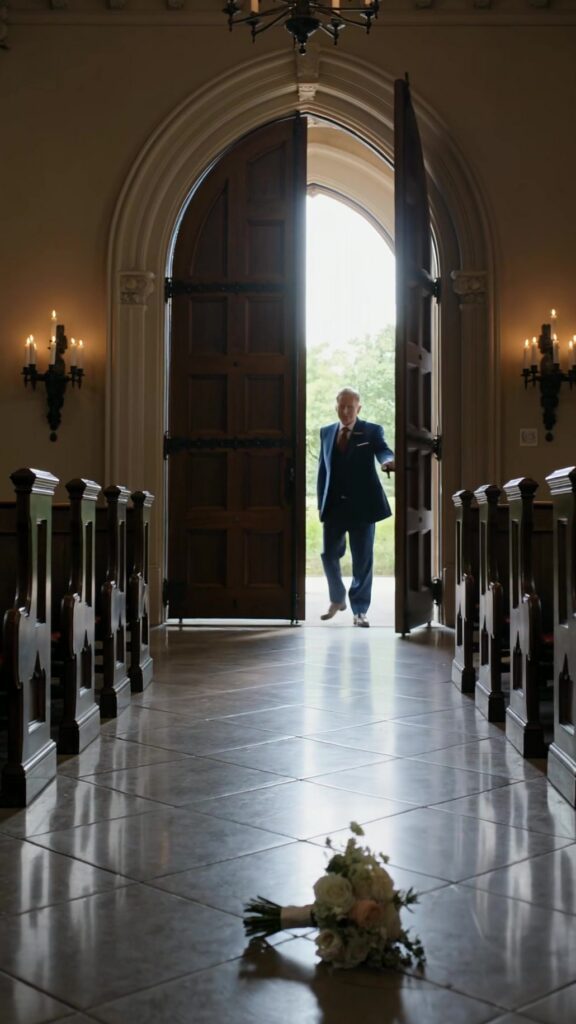
The priest’s lips moved—perhaps to intervene, perhaps to pray—but no sound came. And then the church doors opened with a force that made the candle flames lean away. Daylight cut a sharp white stripe down the center aisle, and in it stood a man with silver hair and a posture so controlled it seemed carved. His suit was dark, his tie perfectly knotted, his expression unreadable in the bright rectangle behind him.
He walked forward without hurry, as if he had arrived early rather than late. Each step landed with quiet authority on the stone floor. When he reached Mara, his face softened in a way that didn’t belong in a room full of witnesses.
“I’m sorry,” he said to her, voice low but carrying. “A meeting ran long.” He looked at her eyes first, not her dress, not her tears. Then he turned to Julian, and the softness left him as cleanly as a door shutting.
Julian’s confidence cracked so fast it was almost comical. His throat bobbed. His lips tried to form a smile that had worked on board members and bartenders alike, but it collapsed halfway. “Mr. Vale,” he stammered, recognition flooding his face. “Sir—what… what are you doing here?”
More than one guest inhaled sharply. Elias Vale. Founder, owner, the man whose signature could turn careers into legends or erase them from the building directory overnight. Julian had talked about him constantly—how Vale admired “hunger,” how Vale rewarded “boldness.” Julian had built his entire future around being seen by that man.
“I’m here for my daughter,” Vale said, and the word daughter landed like a gavel. Mara turned her head so quickly her veil slipped on her hair. Her eyes searched his face, confused, pleading, as if she were afraid she’d misunderstood the language she’d grown up speaking.
“Dad?” she whispered, the syllable breaking into something smaller. She hadn’t used it out loud in years, not since she’d moved out at eighteen and insisted she didn’t want anything from him. Not since she’d changed her last name on her résumé so she could feel she’d earned her own life.
Julian took one unsteady step back from the altar. “No,” he said, not to anyone in particular. “That’s—this is a joke.” His eyes darted over the guests, hunting for laughter, for agreement, for oxygen.
Elias Vale didn’t move. He reached for the bouquet still pressed against Mara’s chest. His fingers were careful, not because he was gentle by nature but because he understood what it meant to touch something already bruised. As he lifted it, a folded paper—pinned beneath the ribbon—came free. It fluttered once, like a frightened bird, then settled against his palm.
He unfolded it. Read. And went utterly still.
Mara watched the color drain from her father’s face and felt something inside her tighten—an old childhood instinct that meant danger. “What is it?” she asked, voice hoarse.
Vale held the page up so Julian could see it from the altar. “This,” he said, and his calmness was a blade, “is an authorization form submitted to my legal department. It grants access to a trust account. It authorizes the transfer of shares that are not yours to touch.” He tapped the bottom line. “And this is my daughter’s signature.”
Julian’s eyes widened. “I—I don’t know what you’re talking about.”
Vale’s gaze didn’t blink. “You should. Because it’s traced. Poorly.” He turned the paper slightly, letting the light show the faint tremor where the pen had hesitated, where a forger tries to imitate confidence. “You used her. And you tried to use her name.”
Julian’s mouth worked soundlessly, like a fish pulled from water. His hands lifted in a reflexive defense. “Mara, tell him—tell him you signed it. We talked about it. We—”
Mara looked at the page and then at Julian. And in that moment the humiliation he’d tried to pin on her began to fall apart, because she saw his fear. Not remorse—fear. The kind that has nothing to do with love and everything to do with losing.
She shook her head slowly. “I never signed anything,” she said. The sentence steadied as it left her mouth, as if truth had weight and could anchor her. “You brought papers to my apartment. You said they were ‘wedding logistics.’ You rushed me. You said I didn’t need to read them because you’d handled it. I trusted you.”
Julian’s eyes flashed, and for a heartbeat the mask returned—anger at being exposed. Then it vanished again under the crushing reality of the man beside her. Vale took a small step toward Julian. He didn’t raise his voice, and that was worse.
“There are two kinds of poverty,” Vale said. “Lack of money, and lack of character. You mistook my daughter’s quietness for weakness. You mistook her choice to live simply for an absence of worth.” His eyes narrowed. “And you made your play in a church, in front of witnesses, as if cruelty were a victory.”
Julian’s knees looked close to giving out. “Sir, please—this is a misunderstanding. I can fix it. I can—”
“No,” Vale said. One word, final as stone. He turned slightly, and a man in a gray suit appeared from the back pew—someone no one had noticed until that second, holding a slim folder like a weapon. Security, legal, perhaps both.
Vale placed a hand lightly on Mara’s shoulder, not claiming her, simply steadying. “I own your future,” he told Julian, voice low enough that it felt intimate, like a confession. “And now you will watch it leave you.”
Mara’s tears still clung to her lashes, but she lifted her chin. The church remained silent—not because no one dared to speak, but because the room had understood the reversal. Julian had come to the altar to destroy a poor girl under stained glass and sacred vows. Instead, he stood exposed, stripped of his performance, in front of the one man who could turn his ambition into ash.
The priest finally found his voice. “What would you like to do?” he asked softly, not to Julian, but to Mara.
Mara looked at her father, then at the aisle washed with daylight. Her hands loosened around the bouquet. Petals fell to the stone like the quiet end of a lie. “I’d like to leave,” she said.
And as she stepped away from the altar, the sound that followed wasn’t applause or outrage. It was the steady, irreversible cadence of consequences beginning to walk behind her.