The restaurant’s windows glowed like a promise—amber light, polished glass, laughter that didn’t leak into the street. Adrian Voss stepped out with the kind of easy confidence money bought: tailored coat, watch that caught the streetlamp, a mind already moving to the next meeting.
On the curb, half swallowed by shadow, a little girl hovered as if she were afraid the light might sting. Her dress was a tired gray, torn at the hem, and her hair had been tied back with a strip of cloth that looked like it had once been part of a bedsheet. She watched the takeout box in his hand with a hunger that wasn’t greedy—just urgent.
Adrian hesitated. He could have walked past. He’d walked past hundreds of needs in this city and called it survival. But something in her stillness—how she didn’t beg, how she simply waited as if hoping the world might remember her—caught him off guard.
He held out the white box. “Here.”
The girl took it with both hands, as carefully as if it were something breakable. Her smile flashed quick and bright, then tightened like she feared it might be stolen. “Thank you, sir.”
“You’re welcome,” Adrian said, and for a second he let himself feel the warmth of being decent.
Then she ran.
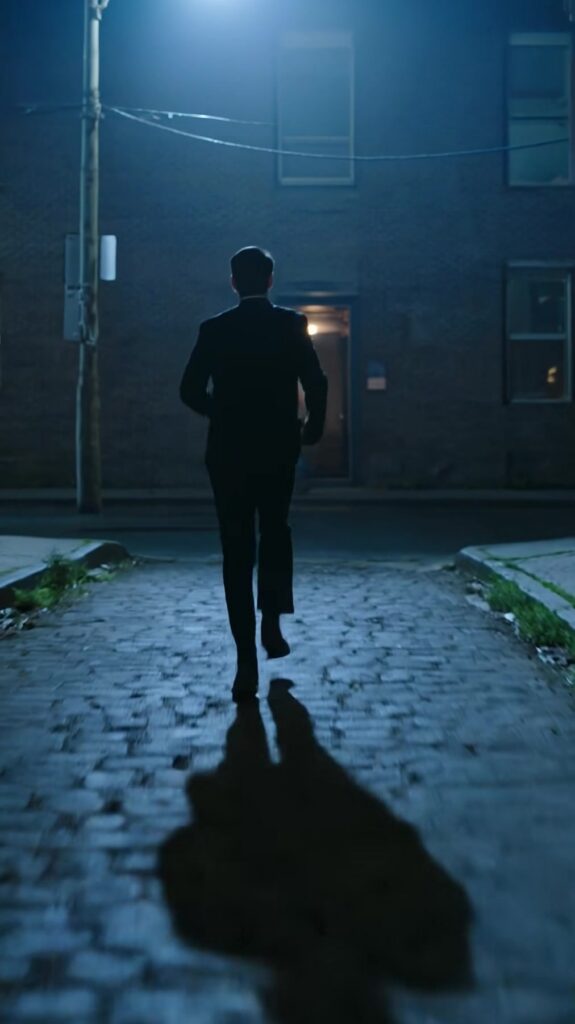
Not the wandering trot of a child who’d found a snack. She moved like someone late to a rescue, clutching the box against her chest and slipping between parked cars, into a corridor of alleyways where the light turned cold and blue. The speed was what unsettled him—panic dressed up as purpose. Adrian stood there with the restaurant’s comfort at his back and a thin, sharp unease in his throat.
He told himself he was only making sure she got somewhere safe. That he wasn’t the kind of man who gave once and then stopped looking. And yet his feet followed, his shoes splashing through shallow puddles that smelled of rust and old rain, his breath turning visible as the night deepened.
She ducked under a sagging chain-link fence and vanished into a stretch of buildings that looked abandoned from the street. Adrian paused at the fence, glancing around. No one watched—no one that wanted to be seen. He lifted the chain and stepped through, ignoring how ridiculous it felt for a man like him to climb into the city’s forgotten spaces.
The girl reached a doorway that wasn’t a doorway at all, just a gap in a wall where boards had been pried loose. She slid inside. Adrian approached more slowly, the air damp and sour, his heartbeat beginning to argue with his logic.
Inside was a room so small it barely deserved the name. A single bulb hung from a wire, trembling in the draft, casting light over cracked plaster and a threadbare blanket that served as both bed and table. And there, huddled close together like birds in winter, were children—three of them, younger than the girl, their knees tucked to their chests, their eyes fixed on the takeout box as if it were a miracle they didn’t dare believe in.
“Did you get food?” the smallest one asked. His voice was thin with hope.
The girl nodded and knelt. “Eat first,” she murmured, already prying open the lid. She didn’t take a bite. Instead she broke the bread in halves, then quarters, and laid portions in little hands with a deliberate fairness that made Adrian’s stomach tighten. She cut the meat into small pieces, counting silently. She kept the last bite aside as if it belonged to someone else entirely.
Adrian stood just outside the broken doorway, frozen by the shame that arrived without warning. He had imagined a story where his box of food ended a hunger. Instead he was watching hunger managed, rationed, endured—something a child should never have learned to do.
Then the second child—an older boy with dirt under his nails and eyes too watchful for his age—looked up. His gaze caught Adrian’s silhouette in the doorway.
The boy went pale so quickly it was as if the color had been erased. He didn’t shout. He didn’t call for help. He simply whispered, voice shaking with a kind of dread that made the room’s air turn heavy.
“He came back.”
Silence fell like a slammed door.
The girl’s hands paused mid-motion. The children stopped chewing, as if swallowing had become dangerous. And from the darkest corner, where the light barely reached, an older woman stirred beneath a coat that had once been expensive and was now only a memory of one. She lifted her head slowly, like someone waking from a nightmare and finding it still present.
Adrian felt something inside him drop, clean and absolute. The boy hadn’t said someone. He’d said he—specific, familiar, already feared.
The woman’s face came into view. Her hair was grayer than Adrian remembered, and her cheekbones were sharper, as if the years had been cutting at her. But her eyes were unmistakable. Adrian had seen them in a mirror, in old photographs, in the glance he avoided in his own reflection.
“Mara?” he said, and the name tasted like dust.
Her gaze fixed on him with a steadiness that made him feel suddenly young, suddenly guilty. “Adrian Voss,” she answered. It wasn’t a greeting. It was an accusation delivered with perfect calm.
The girl’s head snapped toward the woman. “You know him?”
Mara’s jaw worked once, as if she were biting back words that would only bleed. “I used to,” she said. “Before he decided we were the kind of problem that could be signed away.”
Adrian took a step into the room. The bulb swayed. The children shrank back. The boy’s hands curled protectively around his crumbs.
“I didn’t—” Adrian began, and then stopped, because the sentence had too many possible lies. He had left. He had known. He had chosen to be comfortable.
Mara’s laugh was small, broken. “You thought you were generous,” she said, nodding toward the emptying box. “A man with soft hands feeding a child and walking away clean.”
The girl stood, placing herself between Adrian and the children with a fierceness that made her seem taller than her years. “We don’t want trouble,” she said, voice low. “We just—” Her eyes flicked to the last bite she’d set aside. “We just take care of each other.”
Mara watched Adrian with something like exhausted contempt. “They know what men in fine coats do,” she said. “They show up. They promise. Then they leave you in ruins.”
The words struck Adrian harder than any shout could have. In his mind, the past unspooled in sharp fragments: his father’s office, the eviction notices stamped and stacked, the argument he’d walked out of because it was easier than disobeying. He’d told himself it was business. That his father’s company would have done it with or without him. That one signature wasn’t a life.
But the room smelled like those consequences—cold stone, stale air, and children rationing joy.
Adrian looked at the girl again, at the way she guarded the younger ones, at the way she never once reached for her own share. “What’s your name?” he asked gently.
She hesitated. “Lina,” she said, and Adrian heard the lie as clearly as the tremor in her voice. Names were dangerous here. Names could be used to find you.
He nodded as if he believed her. Then he set his wallet on the blanket and pushed it forward, not like a gift but like an apology that would never be enough. “I’m not here to take anything,” he said. “I’m here because I saw you run like you were carrying more than food.”
Mara’s eyes narrowed. “Words,” she said. “They’re the cheapest thing you own.”
Adrian swallowed. Outside, the city’s distant sirens rose and fell like indifferent breath. He realized, with a clarity that chilled him, that he could still turn around. He could still retreat into the restaurant’s warm light and tell himself this had been a strange encounter he’d tried to fix with a box of food.
Instead he sat on the floor, expensive coat pooling in dust, and kept his hands in view like someone negotiating with fear. “Tell me what you need,” he said. “Not a speech. Not a promise. Just… what comes next for you, if I do nothing?”
Mara stared at him for a long time. In that silence Adrian felt the weight of every absence he’d justified. Finally she spoke, her voice flatter than despair. “If you do nothing, we keep hiding until hiding stops working.”
Lina’s chin lifted. “We’re not thieves,” she said quickly, as if preempting a judgment. “I just—” Her voice cracked. “I just wanted them to eat.”
Adrian’s throat burned. He thought of his own childhood dinners—linen napkins, silverware arranged like ritual, the quiet cruelty of abundance taken for granted. He looked at the three small faces watching him, deciding whether he was danger or rescue, and he understood why the boy had whispered he came back. In their world, return meant harm returning to finish its work.
Adrian reached slowly into his coat and pulled out his phone. He didn’t dial the police. He didn’t call his assistant. He called the one person in his life he’d never dared to ask for help without bargaining for control: the director of a shelter his company publicly funded and privately neglected.
When the call connected, Adrian spoke with a steadiness he didn’t feel. “This is Adrian Voss,” he said. “Listen carefully. I need beds tonight. I need a doctor. I need a social worker who won’t ask questions in front of children. And I need it done without cameras.”
Mara’s eyes widened, not with trust, but with something like wary surprise.
Adrian ended the call and looked at her. “I can’t erase what I signed,” he said. “I can’t fix what my family broke with paperwork. But I can stop pretending one meal is kindness.” He glanced at Lina. “I followed you because you ran like your life depended on it. I’m asking you to let me carry some of that weight, if only tonight.”
For a moment no one moved. Then Lina reached behind her and picked up the last bite she’d saved. She held it out—not to Adrian, but to Mara.
“You eat first,” she said, voice barely a whisper, as if she were afraid the world might punish her for hope.
Mara’s hands trembled as she accepted it. Her eyes never left Adrian’s face. “If you walk away again,” she said quietly, “they won’t recover from it.”
Adrian nodded, feeling the truth of her words settle like iron in his chest. Outside, footsteps echoed in the alley—his driver, the shelter van, the first signs of consequence moving toward the room.
Adrian rose slowly, not towering, not commanding, but careful. “Then I won’t,” he said, and for the first time that night, the promise wasn’t meant to make him feel good. It was meant to bind him to what he had finally seen.
In the doorway, the boy who had whispered watched Adrian with a suspicion that was older than him. Adrian met his eyes and didn’t flinch. He understood now: the hardest part wasn’t giving food. It was earning the right to be someone whose return didn’t mean terror.
The bulb above them swayed once more, casting their shadows across the cracked walls—four children, one weary woman, and a man learning too late that charity was not redemption, only the beginning of accountability.