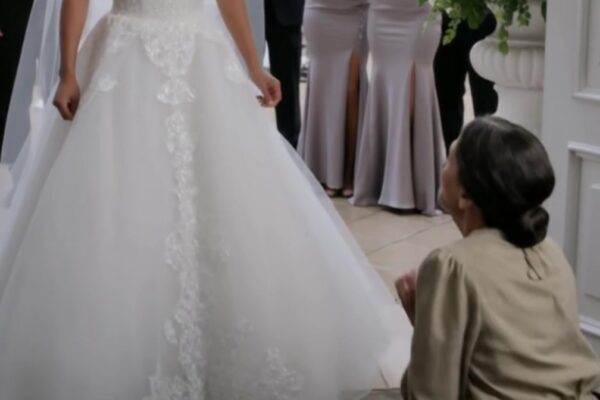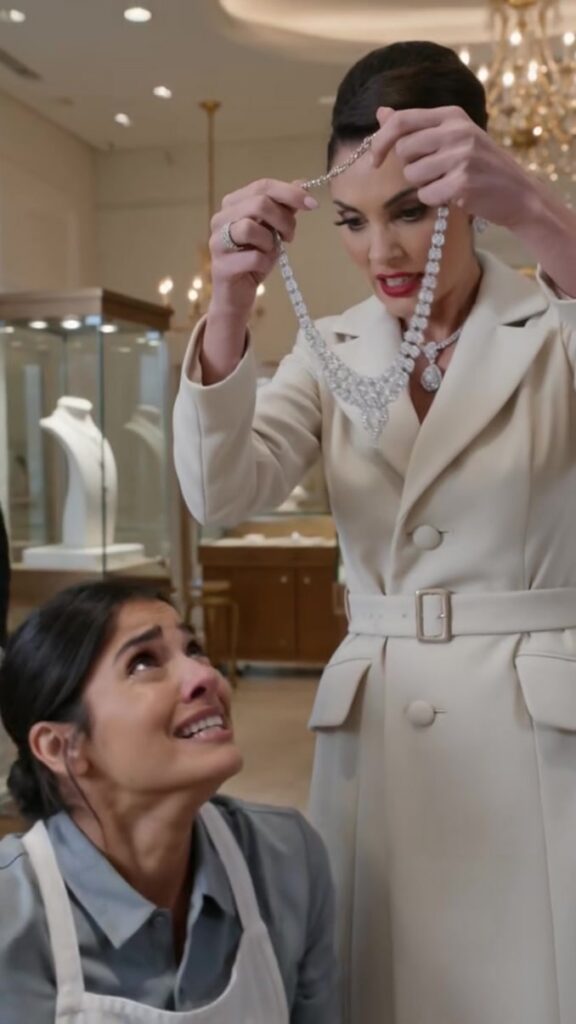
The jewelry boutique glittered with cold white light, the kind that made diamonds look like ice and made skin look like porcelain—flawless until you got close enough to see what the light tried to erase. Glass cases lined the room like coffins of velvet and gold. Above them, chandeliers threw hard reflections onto polished marble, and every heel click sounded like a verdict.
Mara kept her hands folded at her apron as if she could will them not to tremble. She was the newest assistant—quiet, careful, instructed to speak only when spoken to. She had learned which customers wanted their names remembered and which wanted their secrets forgotten. Today, a private bridal viewing had pulled in the city’s most expensive silence: silk dresses, restrained smiles, and a groom who looked too young to be buying anything that could outlive him.
At the center counter stood Odette Laurent—though most people called her Madame Laurent as if the title itself were armor. She had arrived in a pale coat with the collar turned up, the fragrance around her sharp and cold. The groom, Luc, hovered a step behind, his fingers worrying the button of his cuff as if he could undo the day by undoing his sleeves.
“We’ll see the heritage pieces,” Odette said. Not a request. A decree.
The older jeweler, Mr. Besson, had brought out a narrow tray lined with charcoal velvet. He moved with the reverence of a priest, lifting one clasp at a time, naming stones like saints. Mara’s eyes followed his hands because that was her job, because she was supposed to witness and learn. She knew the rules: never touch without permission, never turn your back, never let a customer see you startled.
Then the necklace appeared.
It was not the biggest diamond in the room; it didn’t need to be. The chain was old-fashioned, the stones set in a pattern that made the light break oddly, as if the diamonds were holding their own private storm. Mara felt the sudden prickle of recognition behind her ribs—an ache like a memory you didn’t earn.
Odette’s eyes narrowed, and for a moment Mara thought she saw fear. But fear, on Odette Laurent, looked like anger.
“Where did you put it?” Odette snapped, and before Mara understood the question, a hand cut through the air.
The slap landed with a crack that made everyone flinch. Mara’s head snapped sideways. The counter edge caught her hip as she staggered. A flash of pain bloomed across her cheek, hot and humiliating, and the boutique—moments ago a cathedral of careful whispers—filled with sharp intake of breath.
“Thief!” Odette screamed, as if the word itself was evidence.
People turned. A woman near the bridal display lifted a gloved hand to her mouth. A man by the entrance stopped mid-step, his expensive face suddenly common with shock. Phones rose like mechanical flowers, blooming toward the violence.
Odette seized the necklace from the tray and held it high. “She hid it. I saw her. She tucked it away.”
The guard—tall, stiff, hired by the boutique to protect its stones and, occasionally, its reputations—stepped forward. His gloved hand reached toward Mara’s apron pocket, toward her body, as if her skin were part of the inventory.
Mara pressed a hand to her cheek. Tears came without permission; her face burned, her throat closed. She was shaking hard enough that the tiny tag clipped to her apron rattled. She knew how this ended. She had watched videos, read stories, lived the mathematics of poverty: accusation plus witnesses equals punishment.
“Stop,” she whispered, the word barely audible beneath Odette’s furious breathing.
The guard hesitated, not out of mercy but out of uncertainty. He hadn’t expected the thief to speak like that—like someone refusing to play the part written for her.
Mara lifted her gaze to Mr. Besson, because he was the only person in the room who had ever looked at her with something like respect. “Open the clasp,” she said. “Please. Open it.”
Mr. Besson frowned. His eyes flicked to Odette, then to Luc, then back to the necklace trembling in Odette’s grip. “Madame,” he began carefully, “perhaps—”
“Do it,” Odette hissed, her voice low now, lethal. “Prove it’s mine.”
Mr. Besson took the necklace with hands that had appraised emperors and insured fortunes. He found the clasp—a delicate latch shaped like a leaf—and snapped it open.
Something fell out.
Not a stone. Not a broken link. A folded slip of yellowed paper, sealed inside the hollow of the clasp like a secret tooth. It fluttered onto the velvet tray, and the boutique’s cold white light turned it almost transparent. Mr. Besson’s face emptied of color.
“Impossible,” he breathed.
He picked up the paper with the tip of his tweezers, as if touching it with his skin would burn. There was writing—ink faded, handwriting slanted and elegant. A wax seal, cracked but still visible, stamped with a crest.
“This was buried with Madame Laurent,” Mr. Besson whispered, and the word buried landed like a shovel strike.
Silence rushed in, heavy and immediate. Even the phones paused, their owners unsure whether to keep recording or to pretend they had never been here.
Luc stepped closer, his face draining as if the boutique’s light had found a vein to drink from. “Besson,” he said, too softly. “What are you saying?”
Mara swallowed. Her cheek throbbed. She looked through tears at Luc, at the boy-man whose engagement ring appointment had been turned into an exhumation. “Then why,” she said, voice trembling but steady enough to cut, “did your mother put it in my locker?”
Odette’s eyes widened by a fraction. The crack in her composure was small, but in this room of glass and reflection, it was everything.
“Your locker?” Luc repeated, and now his voice rose. “Mother—what is she talking about?”
Mr. Besson stared at Mara, then at the necklace, then back at Mara again. His hands began to shake. “I have seen that handwriting,” he murmured. “I have held letters like this before.”
He lifted his gaze to Mara’s face as if he were comparing it to something stored behind his eyelids. His eyes narrowed, not in suspicion but in dawning recognition. “The eyes,” he said. “The mouth. That sorrow—”
Odette’s laugh came out wrong, too bright. “Don’t be absurd. She’s a shop girl.”
But Mr. Besson was no longer listening to Odette Laurent. He was looking past her title, past her money, toward a portrait that wasn’t there—toward oil paint and a woman who had been forbidden to exist.
“No,” he whispered, the sound barely more than air. “She has Isabelle’s face.”
Luc’s eyes shut as if the name were a blow. Isabelle. The name nobody said at the estate. The name servants had once traded in whispers and then swallowed like poison when Odette arrived. Isabelle Laurent, first wife, first mistress of the family fortune, the woman whose death had been quick, inconvenient, and sealed behind a rushed funeral and a closed crypt.
Mara’s breath hitched. The boutique seemed to shrink around her, walls of glass pressing in. She did not know Isabelle. She had never seen the estate except in photographs online. But she had grown up with a different kind of portrait: a face in a locket her foster mother kept hidden; a face that looked like hers when she turned sixteen.
And now, with that name spoken aloud, something inside her steadied. Not certainty. Not triumph. Just the end of running.
The boutique doors chimed, bright and ordinary, as if welcoming a casual shopper.
Odette’s head snapped toward the entrance.
A woman stepped in wearing a black coat tailored to perfection, hair swept back, earrings like tiny blades. She carried the air of someone accustomed to rooms rearranging themselves around her. The guard straightened instinctively. A customer lowered her phone, suddenly aware of the consequences of evidence.
Luc’s mother had arrived, though she had been standing in front of them all along.
Odette Laurent looked at the open clasp in Mr. Besson’s hand, at the yellowed note, at Mara’s swelling cheek—and then she looked at Mara’s face.
For one suspended moment, her mask slipped completely. What showed beneath was not anger. It was recognition, naked and terrified.
Odette stopped dead in the cold white light, as if the boutique itself had turned into a courtroom and the verdict had already been read.
“You,” she said, the word thin as a thread about to snap.
Mara’s voice came out quieter than anyone expected. “You told me,” she said, “that if they ever called me a thief in this place, I should make them open what they buried.”
Mr. Besson, hands still hovering over the tray, finally unfolded the paper. His lips moved as he read. His breath caught. He looked up at Odette, and the years fell away from his face, leaving only stark truth.
“This is a confession,” he said, and his voice sounded like metal. “It says she didn’t die the way we were told.”
Luc staggered back a half step, as if the marble had tilted. “Mother,” he said again, louder now, raw. “Tell me what this is.”
Odette’s gaze darted from the note to the phones to the customers, calculating exits the way other people calculated prices. She lifted her chin, trying to rebuild her title brick by brick. “This is a forgery,” she said. “A trap. She’s—she’s an actress. Someone paid her.”
Mara wiped her tears with the back of her hand, smearing them across her swollen cheek. “You put it in my locker,” she repeated, not arguing the lie so much as placing it on the table where everyone could see its shape. “You wanted them to find it on me. You wanted the story to end before it started.”
Odette’s nostrils flared. “I don’t know you.”
“You do,” Mr. Besson said quietly. “Because you buried Isabelle with this clasp closed. And you never expected anyone to open it.”
The boutique’s cold white light caught the diamonds and turned them into hard, unblinking eyes. Outside, traffic moved as usual; inside, time held its breath.
Luc looked at Mara as if seeing her for the first time, not as an employee, not as an accusation, but as a person tethered to his life by a knot he hadn’t known existed. “Who are you?” he asked, voice breaking on the last word.
Mara’s throat tightened. She could feel every gaze in the room, every phone, every remembered rumor. She reached into her apron pocket—not to steal, not to hide, but to finally show what she had carried like a stone in her chest. She pulled out a small, worn locket and opened it with a thumb that no longer shook.
Inside was a painted miniature of a woman with the same eyes.
“My name is Mara,” she said, and then, because the truth was a door that once opened could not be closed, she added, “but she called me Isabelle’s child.”
Odette’s face twisted, grief and rage braided so tightly they looked like one. For an instant, it seemed she might lunge, might slap again, might try to smash the locket and the proof and the past all at once.
Instead, she stared at Mara with the terror of someone who had built an empire on a grave and just heard the dirt move.
Mr. Besson set the necklace down as if it were suddenly too heavy to hold. “Madame Laurent,” he said, formal now, mercilessly calm, “the police will be called. And the crypt will be opened.”
Odette’s gaze flicked to the door, to the guard, to the glass cases—at all the things she owned and all the things she could not buy her way out of anymore. Her voice, when it came, was almost a whisper. “You have no idea what you’re waking.”
Mara met her eyes, cheek still burning, tears drying into salt. “I know,” she said. “You.”
In the glittering cold white light, surrounded by diamonds that could not soften a single hard truth, the boutique finally became what it had always been: a place where things were appraised. And at last, it wasn’t Mara’s worth being weighed—it was Odette’s sins.