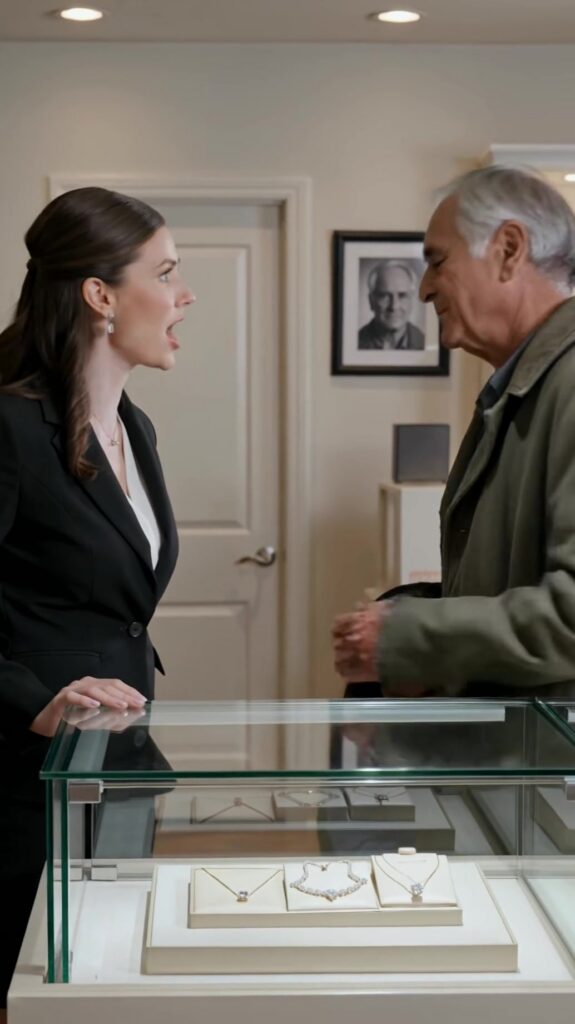
The jewelry boutique was silent in the cold, beautiful way only expensive places can be. Sound didn’t travel there so much as it surrendered—swallowed by thick carpeting and the soft hush of money. Light pooled in the glass cases like milk, turning every chain into a thin ribbon of fire and every diamond into a splinter of winter. Even the customers moved carefully, as if speed might be vulgar.
Near the necklace display, a man stood with shoulders slightly bowed from years rather than shame, his coat darkened at the cuffs and frayed at the seams. In his right hand was a small, warm hand—his granddaughter’s—whose fingers kept opening and closing like she was practicing courage.
She leaned forward, breath fogging the glass, eyes locked on a pendant no bigger than a thumbnail: a heart carved from pale rose gold, the center pierced with a tiny stone that caught the light and returned it like a wink. “Grandpa,” she whispered, not wanting to disturb the quiet, “if I ever get rich, I’ll come back for that one. I’ll buy it and I won’t even be scared.”
The man’s mouth lifted into a smile that tried its best. It almost held until it reached his eyes. There, pain lived—old, organized pain, stored in neat compartments the way the boutique stored its gems. He started to answer, then stopped, as if the words were too heavy to lift in public.
A sharp knock cracked the stillness. A saleswoman had appeared beside them, perfume and impatience arriving together. Her nails clicked against the glass again, faster this time. “Don’t stand there fantasizing,” she said, her voice loud enough to ricochet off the marble. “These aren’t playthings. If you’re not buying, move along.”
Heads turned. A couple near the engagement rings paused mid-sentence. A man in a charcoal suit looked over his shoulder as if watching something indecent. The girl shrank backward, her cheek pressed to her grandfather’s sleeve. The old man lowered his gaze, a reflex as practiced as breathing.
“She’s only looking,” he said quietly. “She likes the lights.”
“Then teach her not to reach above herself,” the woman snapped, her smile thin and professional in the cruelest way. “We’re not a museum. We’re a business.”
The girl’s fingers tightened until her knuckles blanched. Her eyes dropped to the carpet, as if she could sink into it and vanish. The old man stood very still. He swallowed the moment whole, the way people without leverage learn to swallow: no chewing, no choking, just a forced calm that tasted like metal.
A door opened behind the counter. The manager stepped out, adjusting his tie, already wearing the exhausted expression of someone who spent his days translating luxury into numbers. He had been halfway to the front when he caught the last line—reach above herself—and something in his face paused, as if a hidden latch had clicked.
His gaze went first to the saleswoman, then to the old man. It lingered. The manager’s eyes narrowed not in suspicion, but in recognition that arrived like a bruise rising under skin. Then his attention drifted, almost involuntarily, to a framed photograph near the register: black-and-white, slightly curled at the edges, the kind of photo businesses displayed to make history feel like decoration.
In it, a younger man stood beside a rough wooden counter, sleeves rolled up, holding a jeweler’s loupe to one eye. He looked tired and proud, as if he’d built a world with his hands and was still surprised it held. The sign above him bore the boutique’s name in its original lettering.
The manager’s throat moved. “Do you know who that is?” he asked the saleswoman, and though the question was aimed at her, his eyes never left the old man.
“The founder,” she said quickly, as if that settled everything. “The story. It’s on the website.”
“It’s not a story,” the manager replied, voice tightening. He stepped closer, close enough to see the map of fine lines around the old man’s eyes. “My father used to talk about him like he was a ghost. Said he disappeared the night the paperwork changed.”
The old man closed his eyes for a breath, as if the air here was suddenly too bright. When he opened them, they were glassy but steady. “I didn’t disappear,” he said. “I was removed.”
A murmur rippled through the boutique, the customers’ quiet outrage competing with their curiosity. The saleswoman’s cheeks drained of color. “Sir—manager—this is inappropriate. We have policies—”
“We have manners,” the manager cut in, sharper now. “Or we’re supposed to.” He turned fully to the old man. “Are you—”
“I built the first counter,” the old man said, as if stating a measurement. “Not with walnut and lacquer like this. With pine. It splintered and smelled like sap. I worked nights to sand it smooth so the rings wouldn’t snag.”
The little girl looked up at him, confusion and awe mixing on her face. “Grandpa,” she whispered, “is this… is this yours?”
He lowered his head toward her, and in that small movement the years seemed to fall off him like dust. “It was,” he said gently. Then his eyes lifted again, and the gentleness broke into something jagged. “It was until they took it from your grandmother the night she died.”
The manager inhaled like he’d been struck. “My father—he never told me—”
“No,” the old man said. “He wouldn’t. It’s easier to inherit a clean story. Your father came with condolences and contracts. He said he’d keep her safe from debt, that the store would carry our name somewhere inside it. She signed because her hands shook from grief and medicine. By morning, she was gone. By evening, the locks were changed.”
Silence returned, but it was no longer elegant. It was the thick silence after a truth is spoken and no one knows where to put it.
The saleswoman took a step back, searching for the floor beneath her authority. “I didn’t know,” she murmured, and the words sounded less like apology than self-defense.
“Knowing isn’t the hard part,” the manager said. His voice wavered. He glanced at the photograph again, as if trying to compare the past to the living man in front of him. “The hard part is what we do with it.”
The old man’s hand tightened around his granddaughter’s. “I didn’t come to reclaim anything,” he said, surprising himself with the steadiness of his tone. “I came because she wanted to see something beautiful. I wanted her to learn that beauty isn’t only for people who already have it.” He looked at the heart-shaped pendant. “And I wanted to know if I could stand in here without my chest collapsing.”
The manager nodded slowly, shame pooling under his collar. He reached into his pocket, pulled out a small key, then hesitated as if the gesture could rearrange the past. “There’s a safe in my office,” he said. “My father left boxes. He told me never to open one. Said it was sentimental junk, said it would ‘confuse me.’” He swallowed. “I think it’s yours.”
The old man’s expression flickered—hope, then caution, then exhaustion. “I don’t want trinkets,” he said. “I want… I don’t know what I want.”
The granddaughter tugged his sleeve. “I want the heart,” she whispered, bold again now that the room had shifted. “Not because it’s expensive. Because it looks like it’s trying to be brave.”
The manager turned to the case, unlocked it with hands that trembled, and lifted the pendant like it was fragile for reasons beyond gold. He set it in the girl’s palm. “This isn’t a sale,” he said, glancing at the saleswoman as if drawing a line in stone. “This is a return.”
The old man opened his mouth to refuse, pride rising on instinct, but the girl’s fingers curled around the pendant, and her face softened into a light that didn’t belong to the boutique at all. It belonged to kitchens and bus rides and stories told under thin blankets. It belonged to survival.
“Thank you,” the old man said at last, not to the manager alone but to something in himself that had held on long enough to hear the truth spoken aloud. His eyes moved once more to the framed photograph. “He looks like he believed tomorrow would be fair.”
“Maybe,” the manager answered quietly, “we can make it less unfair than yesterday.”
As the old man and his granddaughter turned toward the door, the boutique’s cold beauty shifted. The lights were still soft and the diamonds still sharp, but the silence no longer felt like a wall. It felt, for the first time in a long time, like a pause—like the breath before something changes.